

Use Valsara's bankruptcy probability as a reference to unravel the EA's performance from backtesting (Part 1)
What is the Probability of Ruin for Balsara
The probability of ruin for Balsara is a mathematical theory proposed by the French mathematician “Nauzer J. Balsara”.
It is a concept for fund management that calculates the probability of ruin of a trading method using the proportion of funds used (fund ratio) and its success rate (win rate).
Not limited to FX, it is also widely used in statistics-based probability for gambling such as horse racing, bicycle racing, Baccarat, and poker, and its usefulness is highly regarded.
Balsara’s Probability of Ruin Consists of Three Elements
The probability of ruin is calculated using three elements, and here we will explain by replacing them all with items from an EA backtest.
The three elements are “win rate of trades executed by the EA,” “the ratio of average profit to average loss of trades executed by the EA,” and “the fund ratio of trades executed by the EA.”
First, let's look at which part of the backtest report corresponds to these, by referring to an actual report.
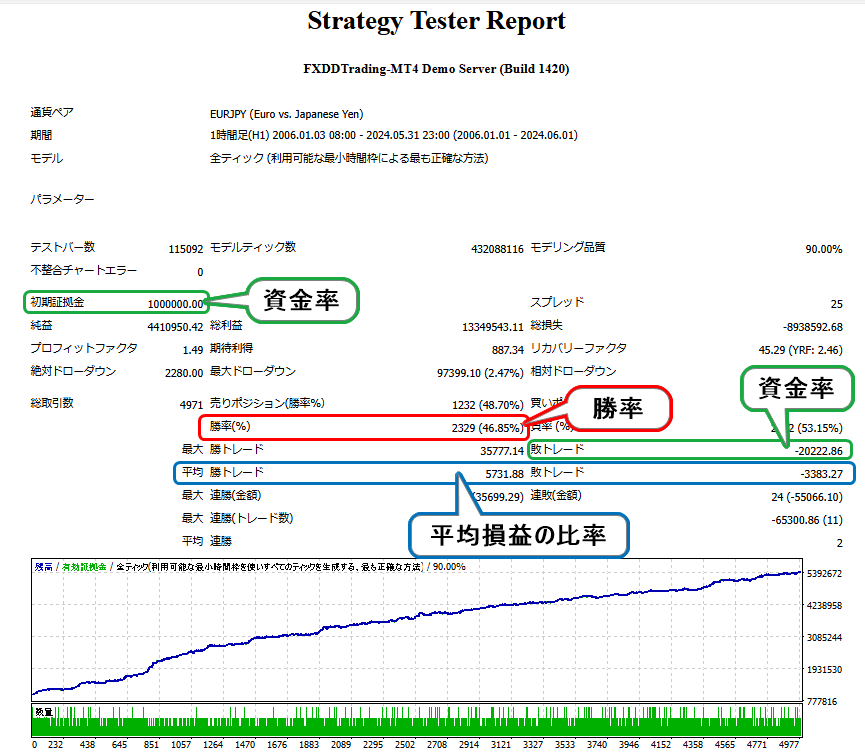
The red-framed part is the win rate.
The report already states what percentage the win rate is, so we will use that value as is.
Next, the blue-framed part is the ratio of average profit to average loss.
This needs to be calculated, but it’s easy, so let’s do it quickly with a calculator.
The calculation is“Average Profit ÷ Average Loss”So in this case,
5731.88 ÷ 3383.27 = 1.695
Therefore, the profit/loss ratio is“about 1.7”.
Lastly, the green-framed fund ratio.
The original fund ratio is“the amount of loss one can tolerate in a single trade”but for an EA it is“the maximum loss when that EA is running”and is calculated as such.
The formula is“maximum loss ÷ initial margin”so in this case,
20222.86 ÷ 1000000.00 = 0.02
Therefore, the fund ratio is“2%”.
In this way, by extracting the three numbers from the backtest report, we create a Balsara’s Probability of Ruin table to determine whether an EA is likely to ruin or not.
Next time, we will introduce how to read the table.
× ![]()