

Exclusive interview with Doruemon Kawasaki, the developer of the “Grugurt Train,” the topic of hot discussion

Do you know the currently talked-about "Guruguru Train," abbreviated as "Gurutrain"?
It is the latest theory of a repeat-type system trading that aims to generate profit automatically from market fluctuations. In Gurutore, by placing orders across the market like a net and also holding positions with the concept of support, it is an excellent system that yields profits in most market developments.
Even for a heavyweight of the FX industry, the shepherd who is praising Gurutore, we have successfully made contact with the developer, Doruemon Kawasaki! This first interview reveals the circumstances leading to Gurutore development, how beginners can set it up, and future prospects in a candid discussion—an interview to watch out for!
• Interviewer: Takeishi Kanai (FX攻略.com Editorial Department)
※ In the photo above, the person on the right is Doruemon Kawasaki, and on the left is the Editorial Department's Kanai.
What is Guruguru Train?
Editor Kanai (hereafter Kanai): The "Guruguru Train" developed by Doruemon Kawasaki is rapidly gaining popularity. I often see it on Twitter, and recently I’ve been getting more questions from real-world practitioners at FX companies. So, in simple terms, what kind of method is Gurutore?
Doruemon Kawasaki (hereafter Kawasaki)It’s a repeat-type system trade. I originally did discretionary trading for about four years, but I wasn’t very successful. With discretionary trading, my own feelings or worries during work often affected my main job, which was not good. To find a method that wouldn’t interfere with work and would be easier to profit from, I studied a book that explains a system-trade method called "Kurukuru Wide" (FX Kurukuru Wide Investment Techniques, Nihon Jitsugyo Shuppansha). While I learned from that, I felt that discretionary elements were still large. So I thought about how to reduce discretionary parts, and that led to Gurutore. In simple terms, it consists of a long and short "main body" and a separate "support" that uses averaging-in.
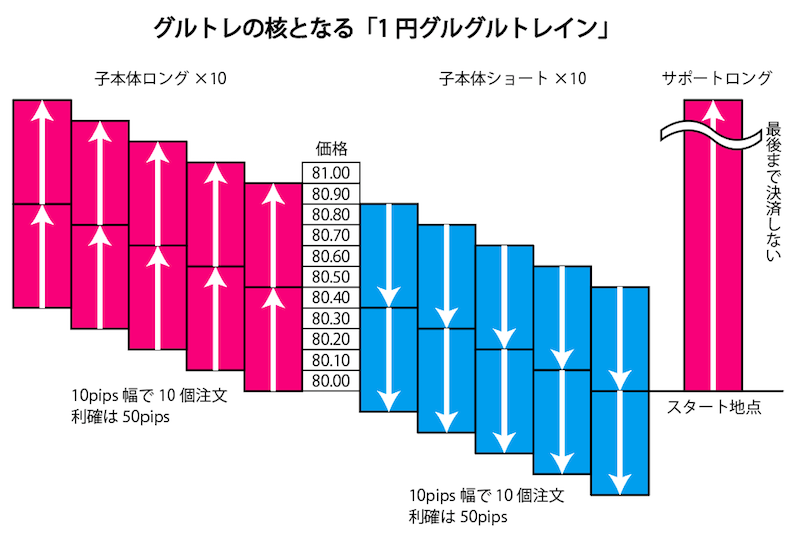
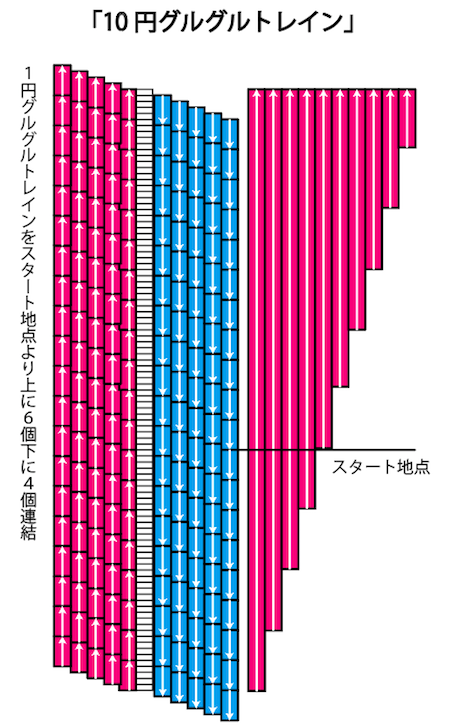
Gurutore uses the "1-yen Gurutore" as its smallest unit, combining a long main body, a short main body, and a support long, connecting these into a target range and initiating orders. While the main body is repeated, the support orders are not settled until Gurutore ends. Because the orders whirl like a carousel, like train cars linked together, it is named Gurutore.
Kanai: You go long and short on the main body and place separate positions for the support. According to the e-book written by Doruemon Kawasaki, "FX Trade New Method Guruguru Train," this is the basic structure, right?
KawasakiYes. For example, suppose you start Gurutore expecting the price to rise. If it rises as forecast, you simply profit. It also profits when it doesn’t rise as expected and stays in a range. Moreover, even if you expected it to rise but it falls, if it recovers to two-thirds of the move from the start, you avoid losses and turn profitable.
Kanai: So, regardless of various price movements, you can profit.
KawasakiYes. There are periods where the unrealized P/L goes negative when the price moves against you, but when the trade ends, you can have a positive unrealized P/L. It’s a system you can leave alone, so once you start Gurutore, you only need to check the setup for about five minutes every morning.
Kanai: So it’s interpreted as being able to profit in more scenarios than conventional repeat-type systems.
KawasakiThat's right. Typical repeat-type systems profit in ranges, but when a contrary trend occurs, you can end up holding many losses and may not recover. But Gurutore, even when moving against you, does incur unrealized losses, but by adhering to money-management rules and waiting for the rate to revert, you can end up positive in the long run.
Kanai: So it improves on the weaknesses of usual repeat-type systems. By the way, where did the idea of making a hedge (both sides) come from?
KawasakiBasically, the market can go up or down, and it doesn’t always move as you expect. Even if you enter thinking it will rise, it might move down, or vice versa. That uncertainty is stressful. So I stopped guessing and made both sides so that the price can move either way.
Kanai: When developing Gurutore, you preferred handwriting simulations over using a computer or Excel. Do you enjoy mathematics?
KawasakiYes. Mathematics has always been my strength. But I’m not good with computers; I’m the type who likes geometry, so I simulated by drawing diagrams. Rather than learning computers, I thought doing it by hand and with a calculator would be faster. Then I computed patterns like, if price rises by X, how much could it move backward, and what profit would result, calculating everything painstakingly.
Kanai: It’s clear from your extraordinary research成果. By the way, as mentioned earlier, even if the price moves counter to the start, if it returns to two-thirds, it becomes a wash. Could you explain this idea more simply for people not versed in mathematics?
Please read the rest on the FX攻略.com official site.
・Click here for the continuation!