

3Q2023 Connected Car Sales Analysis: 5G Technology and Environmental Impact
Introduction
The connected car market in Q3 2023 posted a year-over-year growth rate of 28%, entering an era where more than one out of every two vehicles is equipped with built-in connectivity. This article offers a broad analysis of sales trends in connected cars, the adoption of 5G technology, the environmental impact of the widespread adoption of electric vehicles (EVs), and even the implications for autonomous driving technology.
Current State of the Connected Car Market
What is a Connected Car?
A connected car is a vehicle equipped with internet connectivity that can share data with devices inside and outside the vehicle. This technology enables real-time traffic information reception, remote vehicle diagnostics, streaming of entertainment systems, automatic emergency call systems, and more. Connected cars will also play a crucial role in the development of future autonomous driving technologies. These vehicles can utilize technologies such as vehicle-to-vehicle communication (V2V) and vehicle-to-infrastructure communication (V2I) to achieve higher safety and efficiency.
Growth Trends in 2023 Q3
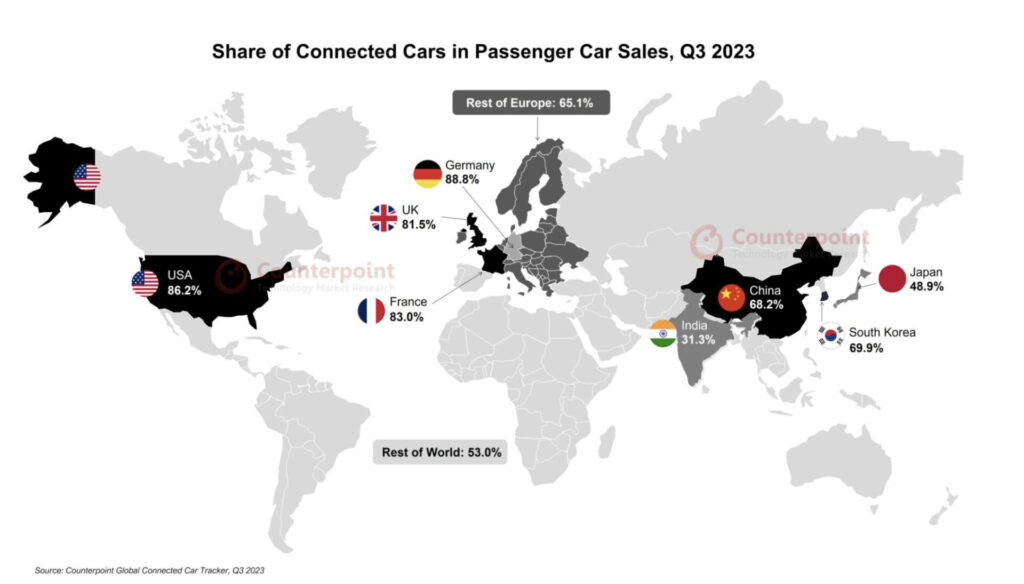
In Q3 2023, connected car sales showed notable growth, especially in China, the United States, and Europe. These regions account for over 75% of the global market and are centers of technological innovation.
Trends Among Major Manufacturers
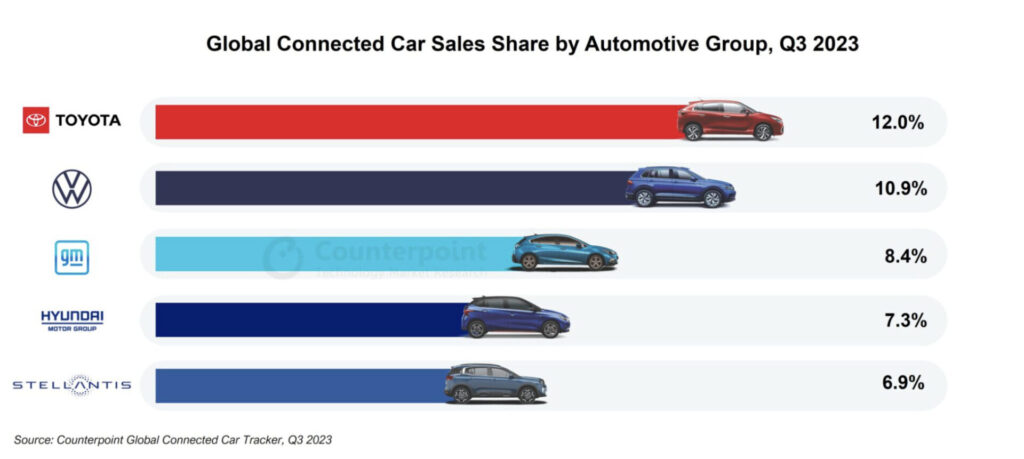
Leading automakers such as Toyota, Volkswagen, GM, Hyundai, and Stellantis are playing crucial roles in the development of connected car technology.
Toyota’s Connected Cars
Toyota’s connected cars leverage advanced technologies and connectivity to offer a wide range of features that enhance driving safety, comfort, and convenience. Below are some of the main types and features offered by Toyota’s connected cars. Note that available features may vary by model and region.
Types
- Navigation System: Receives real-time traffic information and provides optimal route guidance.
- Safety Assistance System: Supports rapid response in case of accidents or theft, including eCall emergency call service and vehicle theft notification.
- Remote Operation: Can remotely unlock/lock the vehicle and start/stop the engine using a smartphone app.
- Vehicle Diagnostics Service: Diagnoses the vehicle’s health in real time and notifies the owner of maintenance needs.
- Infotainment: Enhances entertainment features such as streaming services, SNS access, and playback of music and videos.
Functions
- Wi-Fi Hotspot: Enables in-car internet connectivity, allowing occupants to browse the web and watch videos on smartphones and tablets.
- Driving Assistance Technology: Includes technologies like collision avoidance assistance and lane-keeping assist to support driving.
- Voice Recognition: Allows navigation, climate control settings, and phone dialing via voice commands.
- Cloud-based Services: Retrieves up-to-date information such as weather forecasts and parking information from the cloud.
- Data Analytics: Analyzes driving habits and vehicle usage to suggest fuel efficiency improvements and optimize maintenance.
Toyota provides these connected car features to deliver a safe and comfortable driving experience for drivers and passengers. These features are continually evolving, with new technologies and services regularly added.
What is eCall in Germany?
eCall is a system introduced in the European Union (EU), including Germany, that automatically makes an emergency call in the event of a car accident and reports the exact location to the nearest emergency center. The system aims to enable rapid rescue operations at the scene of serious traffic accidents and improve the chances of saving injured people.
The eCall system uses the vehicle’s communication equipment to automatically call 112 (the common EU emergency number). Even if the driver or occupants are unconscious or unable to move due to an accident, this system activates automatically, allowing rescue teams to reach the scene quickly and begin assistance.
Since April 2018, the EU has mandated the installation of eCall systems in new vehicles. This initiative is credited with contributing to reductions in fatalities and serious injuries from traffic accidents. eCall is positioned as part of connected car technology and greatly contributes to vehicle safety and life-saving efficiency.
These services are intended to provide drivers with a safer and more comfortable driving experience, while also promoting efficient driving to reduce environmental impact.
Entertainment and Convenience in Everyday Life
Connected cars offer many features not only to improve driving safety but also to make our lives more convenient and enjoyable. Here, we focus on infotainment systems, in-car Wi-Fi, and smartphone integration features.
Through infotainment systems, you can easily enjoy entertainment content such as music, movies, and podcasts.
With built-in car Wi-Fi, internet access travels with you, allowing comfortable internet use on the go and keeping kids from getting bored.
Smartphone integration lets you safely use your phone’s features while driving. Hands-free music playback, answering calls, and reading messages can be done without taking your hands off the wheel, maintaining driving focus.
You can set navigation or select your favorite music using voice commands, making the journey to your destination smoother and more enjoyable.
The entertainment and lifestyle conveniences provided by connected cars turn daily travel into a special experience. Your upcoming drives will likely be even more exciting.
5G Adoption and Its Impact
Impact on Connected Cars
5G technology, with its high speed and low latency, dramatically enhances connected car capabilities. This enables real-time data communication and is expected to significantly improve vehicle safety and efficiency.
Path to Autonomous Driving Technology
5G is also a critical technology for the development of autonomous vehicles. Vehicle-to-vehicle (V2V) and vehicle-to-infrastructure (V2I) communication are realized, increasing the safety and reliability of autonomous driving.
EV Adoption and Environmental Impact
Synergy Between EVs and Connected Cars
The proliferation of electric vehicles, in conjunction with connected car technology, holds the potential to significantly reduce environmental impact. In particular, expanding charging infrastructure powered by renewable energy contributes to reducing CO2 emissions.
Contributions to Environmental Protection
The combination of connected cars and EVs enables more efficient energy use and reduced greenhouse gas emissions, representing a major step toward a sustainable automotive society.
Conclusion
Analysis of the connected car market in Q3 2023 shows that the adoption of 5G technology and the spread of EVs are driving transformative changes in the automotive industry. These technologies significantly enhance vehicle safety, efficiency, and environmental considerations, helping shape a future automotive society. The development and adoption of sustainable mobility will continue to be a key theme in our daily lives.