

An upgraded version of Super Recovery, Super Winners, has been completed, so we have good news for users of the old version
Good evening everyone.
In a recent article, we introduced an EA named Super Winners. This EA is planned to be launched after submitting TDS backtest data as a new work on Gogojungle, followed by forward testing and then sale.
SuperWinnersEA originally started as an investigation into the underperformance of the currently sold EA called Super Recovery. The key turning point was improving the fundamental entry logic—the confirmation timing of the indicator signals.
In other words, we began by fundamentally revising the entry timing of the old Recovery indicator.
No matter how much we varied the conditions of the completed Super Recovery, if the Recovery indicator that governs the basic entry timing has issues, we believed that optimization of the EA would not solve the fundamental entry timing problem.
So we started from zero, building the entry timing as an indicator from scratch.
As mentioned in the previous article, please compare the old Recovery indicator with the new Super Winners indicator.
The previous article is here.
https://www.gogojungle.co.jp/finance/navi/articles/65494
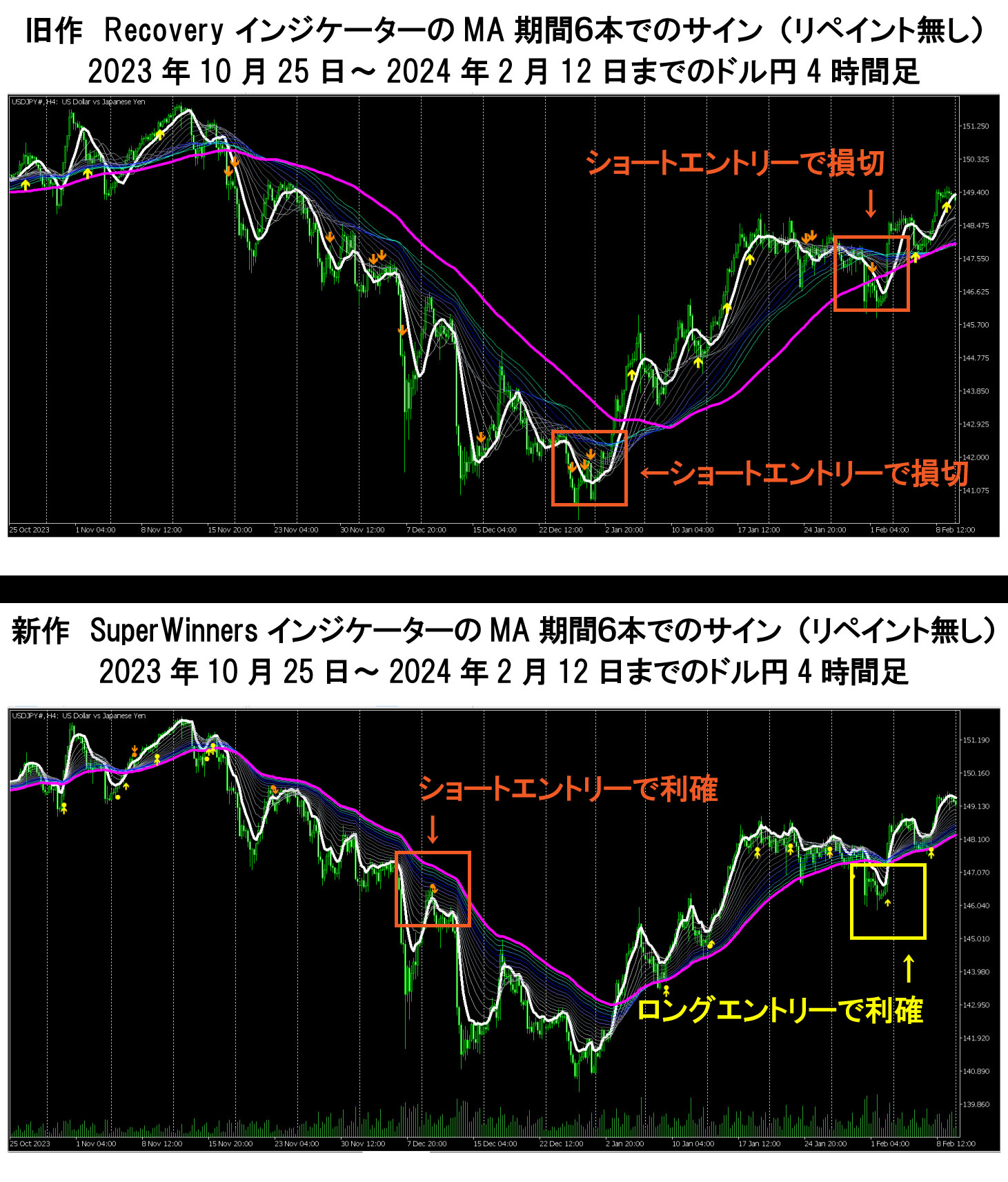
The upper panel in the figure above is the old Recovery indicator.
The lower panel is the new Super Winners indicator.
Both are on the USD/JPY 4-hour chart with a period of 6 bars and enter logic from the MA.
Even with nearly the same conditions, the timing of signal confirmation is very different.
I don’t think it looks like a big difference to you, but when you look at the boxed areas, you may say, “Ah, I see.”
If you hold a position and endure when the stop loss is large, which indicator’s timing of entry is best, the one above or below?
Please compare the upper and lower signals again from that perspective.
Can you clearly see that the lower indicator tends to capture larger profits?
Conversely, in the old version there are many signals at the bottom or after a decline, so for example, in a short position, many times the stop loss hits at the rebound high.
On the other hand, in the new version, signals in the short position are often confirmed near the rebound high, so unrealized losses may be smaller.
This logic fundamentally changed the conditions for confirming signals in the same direction after a trend was established, resulting in different outcomes and different timing for signal confirmation.
And now to today’s main topic: this new EA would not have been born if SuperRecovery had not been underperforming.
Therefore, the new Super Winners indicator will be released as a free update to the old Recovery indicator.
And it will be provided as a Free upgrade of the old Super Recovery EA to the new Super Winners.
Considering development costs, we would like to release it as a new product, so the update version will be provided by default in Low settings.
The Zip file also includes the High set file, so feel free to use either as you prefer.
And the new product SuperWinnersEA will, by default, be tested forward on Gogojungle with the High set.
TDS data will be obtained for the most recent two years, and the Super Winners High=SW_High.mql5 file will be used for the new product sale.
To avoid confusion, I’ll say it again.
We will provide the new SW_Low to anyone who has already purchased SuperRecovery at no additional cost.
The indicator will also be updated to the new SW_indicators.
If you are purchasing the new Super WinnersEA as a new product, SW_High will be available for sale soon, so please wait a little for Gogojungle forward test results.
Here are the backtest results based on MT5 with realistic historical quality from January 1, 2022 to February 12, 2024 (today) for the new Super WinnersEA.
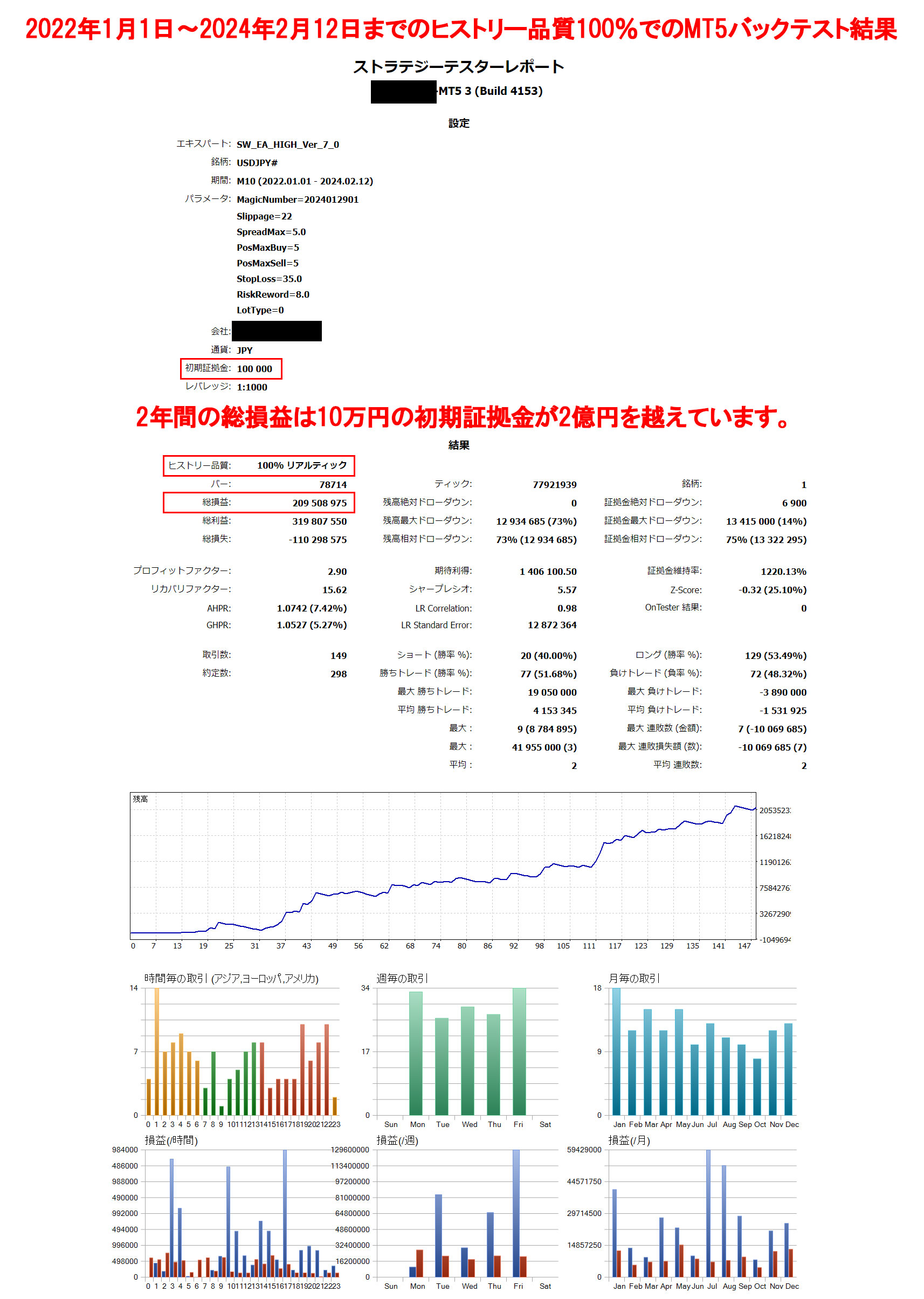
In the old Super RecoveryEA, entries in the same direction were made on the lower time frame of 6 minutes against the trend on the higher time frame of 4 hours, but the new Super WinnersEA does not use multi-time-frame.
In the new Super Winners, the High set builds the entry logic based on the 10-minute signals.
In the free upgrade to the Low set, the entry logic is built on the 1-hour chart.
A common logic for both is that MA-based exits use MAs from different timeframes, so the logic is essentially the opposite of the old SuperRecovery.
In other words, the old version had entries divided across multiple timeframes for upper and lower timeframes, but the new version uses a single timeframe for entries and utilizes another timeframe for exits, forming a more complex exit strategy.
We hope this will also help resolve the exit problems that were an issue in the old Super Recovery.
If anything is unclear, please reply with a private message and we will respond. Please leave a comment.
That is all for the announcement.