Practical Techniques for Scalping Revealed in Detail [Currency Demon]
I have been trading FX for almost 13 years now, and during that time I have continued to experiment in order to improve the precision of my trading methods, leading me to where I am today. My current trading style is ultra-short-term scalping, and it is not rare for me to trade more than 100 times in a day. In this article, under the theme "my ironclad trading method," I will explain in detail the scalping buy-and-sell logic.
Table of Contents
1. What are the most favorable times to scalp and win
2. How to identify when the price has moved too far
3. When to enter
4. Taking profit and stopping loss
5. Two practical application techniques
● Character count: 2542 characters (including headings)
● Images: 6
※ This article is a re-edited version of an article from FX Strategy.com December 2015 issue
What are the most favorable times to scalp and win
In short, the basic logic of my scalping method is: “Trade when there is a certain level of price movement (①), aim for a correction after price overreaction (②), and enter at the optimal timing (③).”
First, regarding the magnitude of price movement, i.e., volatility: I judge it based on the high and low price range of the most recent 15 minutes.
For example, in USD/JPY, if the price move in the last 15 minutes is less than 15 pips, the movement is too small to win, so I do not enter.
When the recent 15-minute range is about 15–35 pips, it is most favorable for winning; if it exceeds that, it tends to be more challenging.
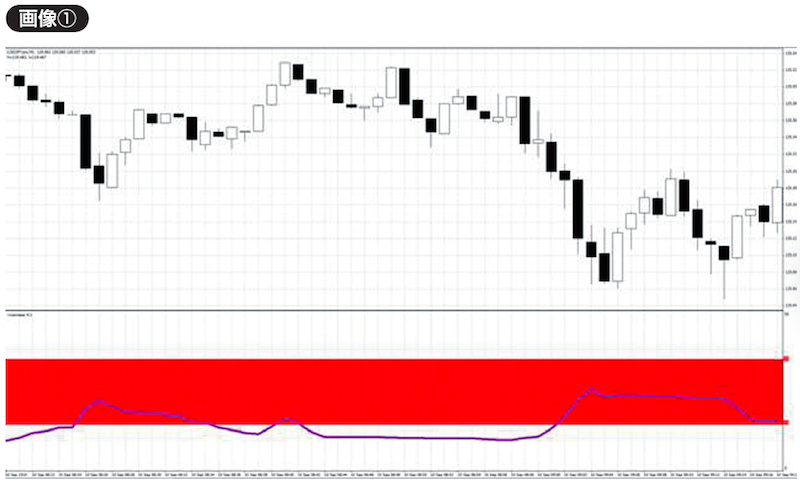
The next image ① shows a 1-minute chart of USD/JPY, where the purple line at the bottom represents the recent 15-minute range, and the red zone marks the exact 15–35 pips of volatility.
Therefore, when the purple line lies within the red zone, it is a time suited for trading.
Thus, the times when USD/JPY tends to be favorable for volatility are typically a few hours before the Japanese stock market opens around 9:00 a.m., a few hours after the European players enter around 4:00 p.m., and a few hours after the American players enter around 9:00 p.m.
On the other hand, for EUR/USD, EUR/JPY, and GBP/JPY, since they naturally have larger price movements than USD/JPY, high win rates occur when the last 15 minutes’ high-low range is about 20–45 pips; when the movement exceeds that, it tends to be more challenging.