

[Episode 1] The Importance of Turning a Trader's Experience into Concrete Form - Edge and Pattern Recognition -
The first installment of “System Trading for Top Intelligence” explains the importance of shaping a trader’s experience. Top Intelligence is a term derived from top athletes, used to describe athletes who utilize their brains. Trading, like athletics, requires practice and mental imagery. In real trading you never know what will happen, but the results demanded are the same as for athletes. And for that reason, we continue training. There are times when things don’t go well, but we endure with an indomitable spirit (resilience) aiming for the top.
Until now, elite and intelligence were often associated with fragility and delicacy as if made of glass, but that is not the case. We aim to unleash a so-called mixed-breed strength and push through. Let us walk together with readers toward an ideal Top Intelligence that is incredibly tough, not quite like top athletes.
Regarding strategy, we try to disclose as much as possible and adopt the open-source mindset. By output and idea refinement, let us evolve each other’s investment techniques.
The main site isInitiative - Future Thinking System TraderThis covers a broader range of events, but in “System Trading for Top Intelligence,” we will delve deeper into the themes. Thank you for your support.
【Hidden, non-public part I don’t want to tell many people = Edge】
Edge should be understood as a mere hint of a hidden flavor. Everyone has something like this depending on their personality, so what others know may not have much meaning. It does not necessarily mean you can use it. There are things that even provoke a rejection. Therefore, the basic underlying logic is important. Edges become effective as buying and selling repeat, so you should have them, but not everyone can find them immediately. They are gained through market observation and reflections on actual trades. Keep a calm mind and stay alert to discover them.
【Pattern recognition does not work as well as you might think.】
Time-based patterns are believed to remain as future anomalies (quirks), but performance tends to be poor. Even if backtests look good, forward tests (trading with real-time data) often yield nearly random results. Perhaps it’s because the readings are easy to anticipate, or because there is larger noise masking them; the exact reason is unclear.
I wonder if it might be good to incorporate AI elements, but if the original logic isn’t substantial, adding AI won’t improve much, so perhaps a strategy of removing pattern recognition is better. Humans tend to think past patterns will repeat, but reality may not be so. Also, when searching for patterns, we often rely on data mining, which may be why they don’t work well; pattern recognition by direct market observation could work better. This remains a future task.
Conversely, trend-following and breakout types are fairly reliable. Perhaps it is more robust to incorporate linear elements rather than points. That would imply that surfaces (three-dimensional) may have even higher reproducibility. It seems worth researching.
【Finalize the trading system in a concrete form.】
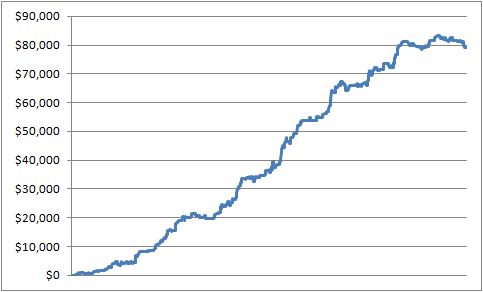
Forward testing is by far the most important. Forward testing assesses whether the system will work well from this point forward. If you don’t preserve the system in a tangible form, you can’t even conduct that test. And whether its performance is positive is crucial. It is also important that the logic operates exactly as intended. I believe this is the accumulation and wealth of a system trader.
Forward testing tends to perform worse than backtesting. It often results in a messy profit-and-loss curve, but we accept that as reality and aim for improvement. It may be nothing more than repeated accumulation.