

Hundreds of million traders are scalping
Good morning everyone.
I have replied to all the messages I received from last night through this morning.
If there are still people who have not received messages, please let me know via a message.
I have summarized important things about trading.
↓
[Definitive Edition] Billionaire Trader Scalp & Not-So-Ordinary Hedging
Current USD/JPY stance
[Hold]
The chart below is the USD/JPY 1-hour chart.
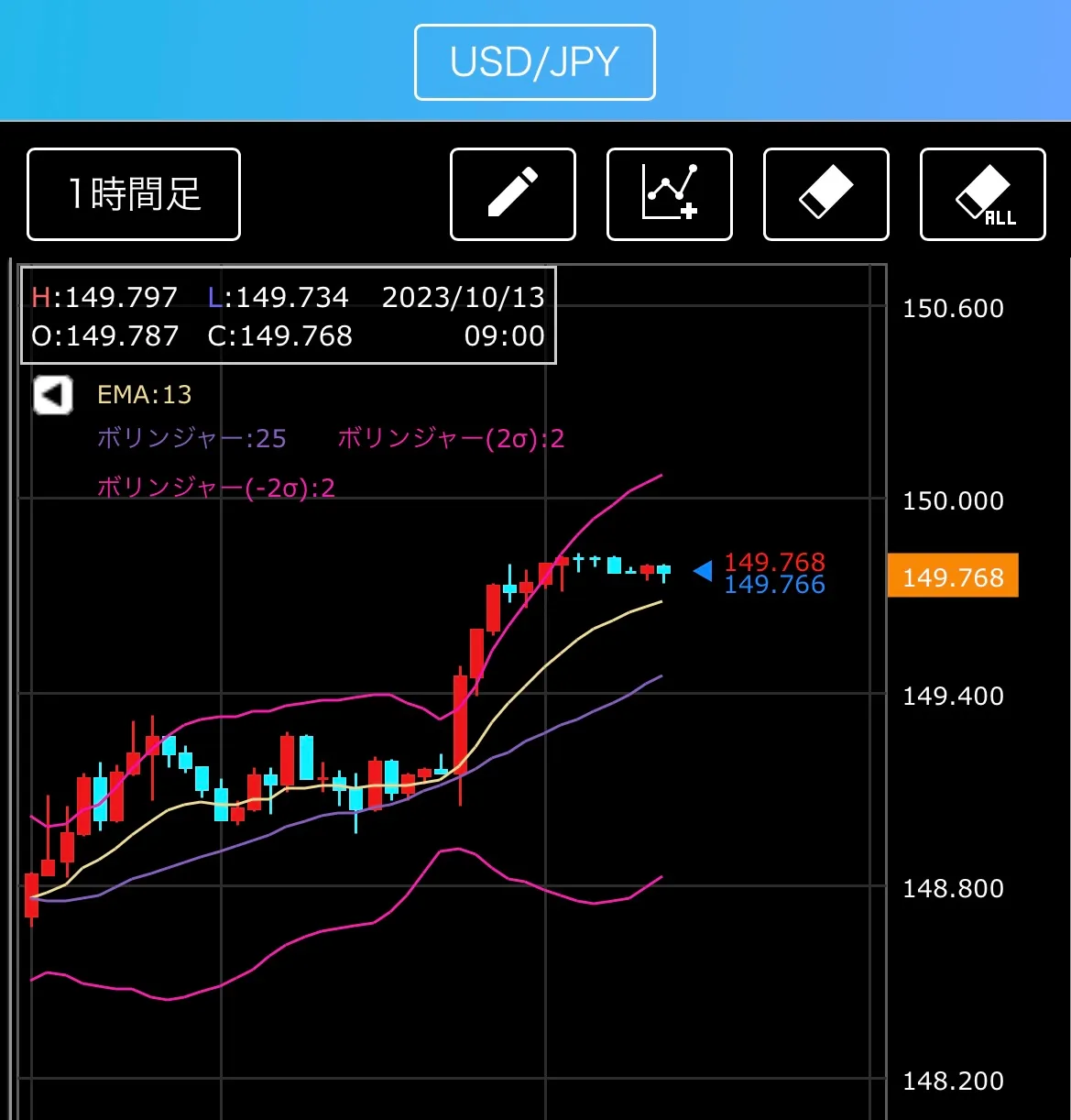
This has space at the bottom, so a drop would not be surprising, but since it looks like a camel’s neck, we are viewing it as a potential pattern for continuing to rise.
Support if it drops is around 149.50.
This 149.50, for the scalping users among Billionaire Traders, if you switch 1-minute charts to the 1-hour chart, the support line can be judged fairly easily.
The scalping chart of Billionaire Traders becomes revealing when viewed on different timeframes, showing various insights.
During trading, you can complete trades using only the 1-minute chart, but if you want to check the time context or take positions for day trading, you can choose the timeframe according to your trading style, which makes it a very convenient chart.
However, when trading on higher timeframes, you must allow for wider stop loss and take-profit ranges, so proper money management is necessary.
Yesterday, among the messages from the scalping users of Billionaire Traders, there was a comment about capital management.
Below is the message.
>>
I’m sorry for always worrying you. It’s somewhat detached from the method, but I’d like to ask a question. Many people must be drawn to Mr. Mori’s words, "Trading is a matter of skill." I initially started FX thinking many people trade by skill, but as I progressed, capital management became the top priority. High leverage greatly increases difficulty, and I realized that making profits from 1 million to 10,000 is easy. Honestly, I’m glad there are professionals who say "it’s about skill," but I’d also be grateful if you could share your priorities and decisions regarding capital management and maintenance rate. As always, thank you.
■ Here is my reply.
Hello. Thank you for your message.Noting capital management is a major achievement. My personal priorities are: ① trading technique and skill, ② capital management. In trading, if the trading rules aren't established, capital management is meaningless; in the extreme, you might end up not trading at all, which would be the strongest form of capital protection.
Until one month before selling Billionaire Trader’s scalping, I operated two accounts aiming for 8 million yen from 4 million per account, totaling 8 million, splitting for scalping and hedging. Now I use one account for both scalping and hedging. My scalping is 200 shares per one shot (2 million currency units), so achieving 200 P per month would be enough. I traded across four key times from Tokyo open to midsession, London open, NY open, and the London FIX, aiming to earn more than 10 P per day.To place 200 shares on a domestic account requires roughly 12 million yen in margin for USD/JPY, and accounting for stop losses, averaging down, hedging, etc., I always keep 50 million in account funds. The flow Tokyo → London → NY → FIX, when you take 10 P, that’s the end for the day.In reality there are days with 15–20 P as well. If at any point the loss reaches around 400,000 yen, I end trading for that day. If I limit the daily loss to 400k, it can be paid back in two days, and sometimes even turn positive, so I set the daily loss to 400k and use it for account capital management.If you have 1 million, making 10,000 is easy.
This is true; in terms of amount, more capital can be advantageous for profit. But the opposite can also occur, so it cannot be stated universally, though it is not incorrect.Some talk about a percentage of capital, but I think that depends largely on the size of one’s own capital.Also, once trading is established and consistent trading is possible, by properly managing stop losses and executing trades regularly, you naturally become profitable. That is, the capital management through stop-losses.I employ both trend-following and contrarian strategies; contrarian positions are hedged. When I say "trading is a matter of skill," I mean acquiring techniques. The techniques I advocate include, for example, while long, seeking the start of the point where price increases and catching the pullback, and always taking positions as price breaks out.Even when the market is generally upward, it is scary to pick up a pullback in a down-trending moment. Especially for those who enter positions within bearish candles like I do. However, if that point is the start of a price move, then price can rise sharply from there. One must act against crowd psychology. Otherwise, you will never win. That said, it should not encourage easy contrarian trading.Sometimes after entering a position, further downside may occur and you may cut losses, but the final line for cutting losses is when the price breaks below the bottom boundary, and until then you can continue to place L positions. In current USD/JPY volatility, losses might occur about three times.With these techniques, the rest is about loss-cut capital management and the number of trades. There is no perfect trading method, and managing the responsibility for failed positions is a form of capital management.
That concludes my reply.
This user is very enthusiastic.
They also send images, and day by day it feels like they are improving in what to look at.
If this enthusiasm continues, their trading should improve considerably, and their personal satisfaction will soar.
Thank you for your continued support today as well.
Big news & scalping that Billionaire Traders are doing
Scalping that Billionaire Traders are doing
↓
https://www.gogojungle.co.jp/tools/indicators/42559
Stress-free unconventional hedging (well, it hardly loses)
FX’s not-ordinary hedging
↓
https://www.gogojungle.co.jp/tools/ebooks/19435