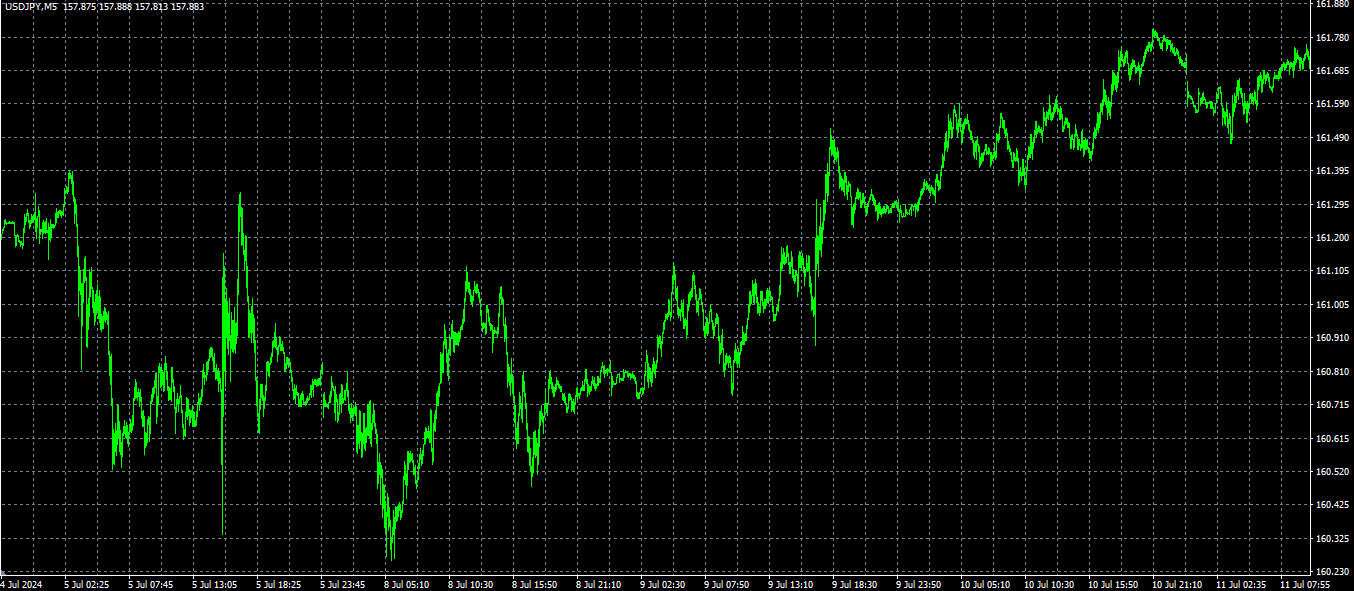

A single-eye reversal and benchmark line can become a trading strategy specialized in capturing intrayen fluctuations with moving averages or more.
The turning line and baseline are styles that make it easy to catch the swing.
Why is that?
Because they differ from simple indicators like an MA cross.
However, since the reaction can be slow, there are times when it appears late,
making it weak in fast moves (markets that break and then break again).
But in a normal straightforward market, these turning and baseline lines are fully useful.
To catch the swaying trends,
trade with a broad, holistic market concept.
These two lines of the Ichimoku Kinko Hyo
are slower than an MA cross, but there is a loss before the cross occurs.
It can also serve as a precise trend supplemental.
Having this makes
timeframe-shifted trading also effective.
For example
Suppose you trade on a 5-minute chart
1) You enter on a trend reversal from the 5-minute timeframe in the direction of the trend.
2) Afterwards, while the 5-minute chart shows a trend, the trend reverses in the opposite direction and the two lines cross.
3) Looking at the 15-minute chart, the trend still continues, so you wait and observe.
4) The trend on the 5-minute chart resumes again.
This is how it can be.
Because of this, compared to a simple trend-following logic,
you can reduce losses and more easily secure profits.
As a trend-following plus trend-swing strategy,
by adding the next timeframe and arrangement of the subsequent time,
you can adopt a trading strategy that more easily extends profits in the trend.
※ For those who want to keep earning in FX, click here ↓
× ![]()