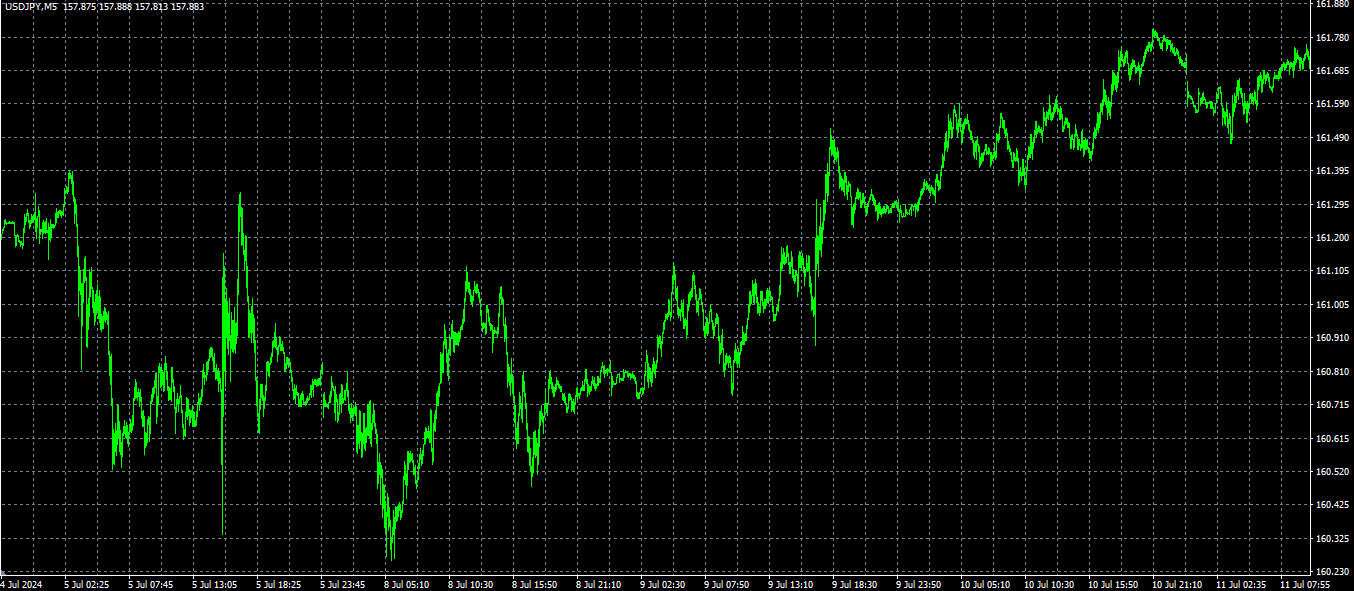

How to Keep Up with Trends
I will display 4-hour charts
I will display the 30-period and 60-period moving averages
We consider MA crossovers as the trend; we will follow the trend with the 60 MA
We will confirm that a trending market appears
We will confirm that the trend is reversing in the opposite direction
As part of that confirmation, we will check the trendlines supporting and resisting
After that, when the trendline breaks, a flag forms, so we enter in the direction of the trend
This entry timing is very effective
The reason is
1) a trending market is actually appearing
2) traders are turning to see a trend reversal
3) but it retraces, so they rush to reverse-trade
4) afterwards the trend resumes (the market has priced in a reversal by large players or something)
That's the situation
There is a proverb that says the market is a trap for fools
In a trending market, a flag break is a method that reliably yields profits
On timeframes, it is easy to confirm on the 1-hour or 4-hour chart
“Easy to confirm” because the moment of confirmation comes from the logic of the trend re-break
That moment is on the longer timeframes
Therefore, the 1-hour or 4-hour timeframes are easier to confirm
In technical analysis, people joke that certain strategies are only for ○○ hours or only for ○○ minutes, but
Technical analysis is ultimately about post-hoc optimization
The markets considered in post-hoc optimization for testing are
Recent markets, and as post-hoc theory it is valid, but
In actual markets it cannot be used; technical analysis itself can freely change its structure later
In actual trading, entry and the analytical test entry on past markets are entirely different
A logic that can be used in the same way as past markets
Is not technical analysis itself, but the main chart chart
We make the logic out of chart interactions; only then does analysis become valid
Understand that analysis in technical analysis is basically post-hoc analysis on past markets
What actually functions and is recognized as functioning is
The main chart—the price range, support and resistance
That is why there is validity in re-breaking the trend in a trending market
If you want to target only the most effective places in the market
These ideas are extremely important
Because markets move in price ranges
If you consider that, you will realize that trend flag breaks are meaningful in the market
At the same time, you will understand why trendlines are effective in trending markets
Ultimately, the market is only about how support and resistance create a field of influence and how they function in the current market
Whether that is a trend market with angled support and resistance
Or a range market with horizontal support and resistance
A stair-step trend is a range market; it is not a trending market, but a range market
In a trending market, you should mainly focus on angled support and resistance
That makes market sense easier; easing your market perception prevents it from becoming distorted
As long as the market moves, you can identify equilibrium points and breakdown locations at all price levels
Support and resistance keep things honest and help with market recognition for entry
For entry, using follow-through and break, just like a flag, is effective
Flag patterns, too,
basically the way to profit in the market is
From support/resistance markets to breakouts in the direction of the trend
And the market is most effective on the long-term timeframes
In other words, support/resistance markets and breakouts are already priced in on the market
Because they are priced in,
Long-term timeframes combined with support/resistance break in the direction of the trend are effective
Earlier I described trend markets plus re-trending flag,
This time, it is the logic of a box market breaking out in the direction of the break
In angled support/resistance and horizontal support/resistance markets
There are many cases where a boxed, enclosing market forms
In such markets, a break of support/resistance makes the trend-following approach work effectively
The sequence is
Box market → breakout → follow-entry outside the box
This is the flow
Support/resistance break with trend-following is a first-move entry, essentially a first-move trend hunting
That is because the long-term timeframe represents the central market movement
This allows for chasing substantial profits
At that time, technical analysis is not necessary
Rather, learn to judge support/resistance using only the chart
Because that will be usable for eternity
This is a logic that seems to capture the market trader’s intent, so it is naturally effective
※ For those who want to keep earning with FX, click here ↓
× ![]()