

Moving Average (MA) about 1
Good morning. I am Kitsune no Me.
Today“Moving Average (Moving Average) (MA)”I will describe it.
Thank you for your cooperation.
1. What is the Moving Average (MA)?
A moving average is calculated from the average of prices over a certain period and represented as a line graph.It is called a moving average because the average value moves as it is calculated daily for a number of past days (or weeks) including today.Therefore, the average moves, hence the name.
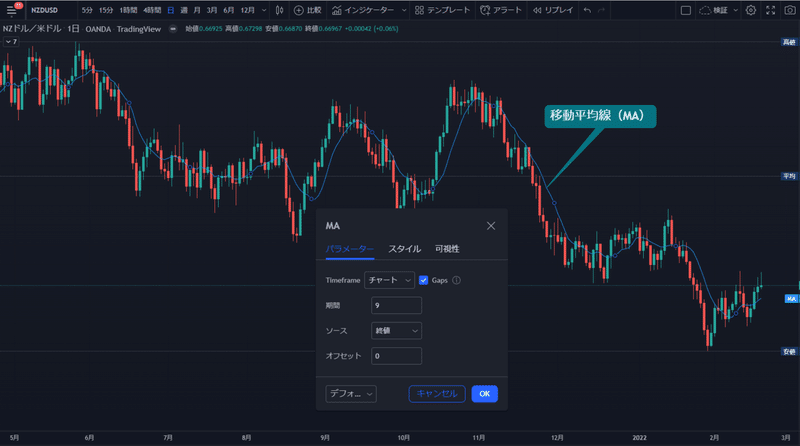
This is the actual moving average line.
Moving averages have a “period.”
As I will explain later,the average is calculated from one period to another.The period can be set arbitrarily.
This time, what is displayed is
“9 days”MA.
It is also called“9MA.”
If the period is 25 days, it becomes “25MA.”
If it is 200 days, the name changes to “200MA.” That’s right.
In other words, when you use MA in conjunction with your trading style,the period you set varies depending on how much of the average you want to display.That’s the idea.
2. Simple Moving Average (SMA)
As the name suggests, the Simple Moving Average is calculated in a simple way and is not good at capturing price moves quickly.
The aim of SMA isto “smooth price fluctuations by taking the average,”which makes the trend of price movements easier to understand.
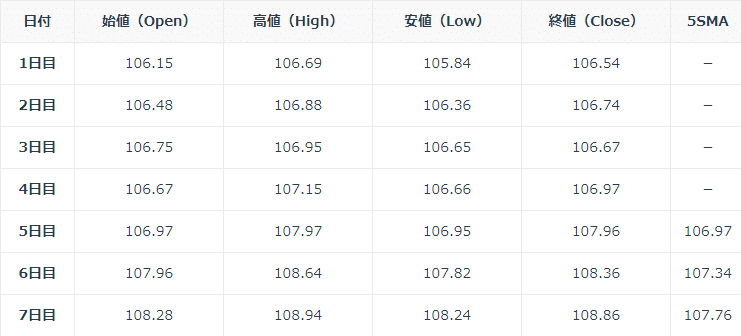
I will explain the basic calculation method of the SMA.
That sounds hard.
The exact formulas are not that important, so just listen casually.
Above isthe SMA for a period of 5(5SMA)
Sum of the last 5 closing pricesanddivide by 5
For example, if the 5-day line has today's close at 100 yen, yesterday’s at 110 yen, the 2 days ago close at 90 yen, the 3 days ago close at 70 yen, and the 4 days ago close at 120 yen, it would be 98 yen (the sum of the five closes divided by 5).
It’s a bit tedious, isn’t it.
SMA represents the “average value.”
That level of understanding is enough.
3. Exponential Moving Average (EMA)
The Exponentially Smoothed Moving Average (EMA) is an improvement on SMA and is a trend-type technical indicator that emphasizes recent price movements.It places more weight on recent price action and quickly reflects changes in the market.
With SMA,price movements during the period are treated equally, but with EMAmore weight is given to recent movements, allowing the market to adapt quickly.What it takes in is to incorporate market changes as soon as possible.
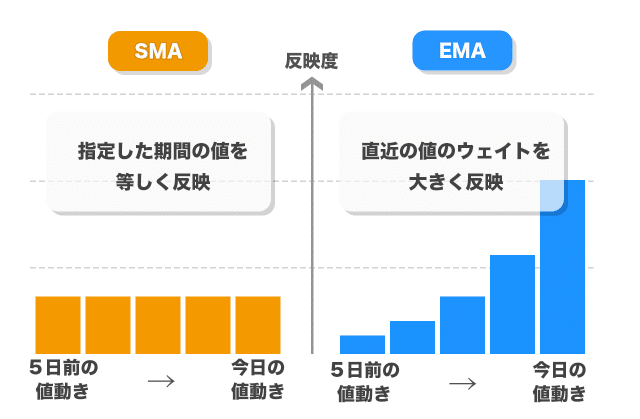
The good thing about EMA is that because it emphasizes recent price moves, you can detect trends earlier.
As a drawback,“false signals”tend to occur more often.
I will explain false signals in more detail later.
In this article“Differences between SMA and EMA”have you understood?
SMA represents“the average value.”
EMA represents“the trend.”
Moving averages are important, so I will cover them in multiple parts.
Tomorrow I will describe how to use them.
Thank you for your hard work today as well!