
【June 12th Trading Strategy】Dollar buying accelerates ahead of the U.S.-North Korea summit【Tetsu Emori's Real Trading Strategy】
June 12, 2018 08:31
Excerpt from Tetsu Emori's Real Trading Strategy
〔EQUITY MARKET〕
Market Commentary and Analysis of US Stocks and European/American Bond Markets
U.S. stocks were largely flat. With the U.S.–North Korea summit set for the next day, risk-off sentiment intensified. President Trump and North Korean leader Kim Jong Un were due to meet in Singapore on the 12th for the first-ever U.S.–North Korea summit. In a press conference, Secretary of State Pompeo emphasized that “complete, verifiable, and irreversible denuclearization” is the only outcome the United States will accept. Meanwhile, given that North Korea’s response remains unclear, markets held back from aggressive trading while waiting to gauge the summit’s outcome. In addition, with the FOMC meeting on the 12th–13th, the ECB’s regular council on the 14th, and the BOJ policy meeting on the 14th–15th scheduled, the policy decisions from major central banks coming one after another further reinforced investors’ cautious stance. The impact of the G7 summit last weekend, which did not yield results, was minimal. The market is paying attention to the possibility that good news could come from the U.S.–North Korea summit.
U.S. Treasuries yields rose. At the FOMC, a 0.25 percentage point rate hike is deemed certain. The auctions conducted that day—$32 billion of 3-year notes and $22 billion of 10-year notes—drew solid demand. The 10-year yield rose to 2.9516%, and the 2-year yield to 2.5243%. The yield spread narrowed to 0.4273%. An auction of $14 billion of 30-year bonds was scheduled for the 12th.
In European markets, London shares rebounded. The weaker pound supported exporters, and merger-and-acquisition (M&A) activity provided additional support. The FTSE 100 rose to its highest in about a week. European equities also advanced. Italy’s new economy minister pledged to remain in the euro area, which spread relief and lifted European banks and Italian markets. The STOXX Europe 600 Banks index rose 2.8%, lifting the overall index. Italy’s FTSE MIB rose 3.4%, Spain’s IBEX rose 1.6%. Additionally, Italy’s major banks UniCredit and Intesa Sanpaolo surged more than 6% as well.
Yields in the euro-area bond market declined. Following comments by Italy’s new economy minister Giovanni Tria that there is no intention for the new government to exit the euro area, the market moved accordingly. Tria said he would focus on reducing debt levels while boosting growth through investment and structural reforms. Italy’s 2-year yield fell 60bp to 1.08%, Italy’s 10-year yield fell 30bp to 2.859%. The one-day drop in the 10-year yield was the largest in about six years. Germany’s 10-year yield rose to 0.494%.
【U.S. Stock Trading Strategy】
Maintain a long strategy. U.S. stocks were moving modestly, but investors in the U.S. stock market were also watching the U.S.–North Korea summit. From today’s market action, the Italian situation appears to have quieted considerably. However, Italian government bond yields remain elevated, so we should wait for them to settle. Deutsche Bank’s shares remained weak but appear to be forming a higher bottom gradually. If this improves, market sentiment should brighten further. While there remains a risk that the European debt crisis of 2010 could re-emerge, the current backdrop is very different from then. Until signs of a potential crisis appear, there is no need to become overly cautious.
U.S. equities have been climbing cleanly. If this trend continues, it will attract more investor attention and capital inflows. The next step is for the Dow Jones Industrial Average and the S&P 500 to surpass their January highs. If this week’s key events pass smoothly, investor sentiment should improve markedly. The Nasdaq index shows overbought conditions, so this week’s gains are likely to be modest. However, in a month’s time there is an 78% probability of a rise, with an average gain of 2.4%. In other words,Even if the week experiences a pullback, buying the dip provides a fairly high probability of additional returns. This is encouraging data.
As reiterated, the U.S. equity market remains tech-led.The Nasdaq index has been making daily higher highs, in line with our previous view. If investing primarily in the Nasdaq 100, profits come regardless of when you buy. The downtrend in stock prices since February has ended. The S&P 500 is firm, and the Dow should follow. Considering past rate-hike cycles, the Dow could rise to about $30,500 and the S&P 500 to about $3,300. It would be better if rates rose gradually; if rates move higher, we will transition into the final phase of a long 17-year bull market into 2020, which could lead to further bubble-like conditions. As before, the order of relative advantage in U.S. equity indices is Nasdaq > S&P 500 > Dow.In trading strategy, it has long been recommended to invest in futures CFDs or ETFs; in concrete terms, Nasdaq index CFDs or Nasdaq-100 ETFs (QQQ) > S&P 500 CFDs or ETFs (SPY) > Dow Jones CFDs or ETFs. For individual stocks, Netflix > Nvidia > Amazon are central. It is advisable to focus on these “blue-chip” names for the time being.
They have delivered superb performance. Holding such names provides confidence. Following that, adding Facebook > Apple > Microsoft > Alphabet as sub-stocks to the portfolio would be prudent.
Today, indeed, is the first-ever U.S.–North Korea summit. However, as explained above, there is nothing to worry about.Whether the United States’ demands will be accepted by North Korea is all that matters. If North Korea fails to reach agreement on the denuclearization method and timeline, the United States will simply walk away. Negotiations have already occurred behind the scenes many times. If North Korea pulls a table-flip this time, it would be “the end.” President Trump wants to mark a historic achievement by ending the Korean War, which has been in a state of ceasefire since 1950–53, but, logically, this should not be too difficult.This summit will begin with a one-on-one format between President Trump and Chairman Kim, then move to an expanded meeting with Pompeo, White House Chief of Staff Kelly, and National Security Adviser Bolton in attendance, and a working lunch is planned. However, North Korea says the talks will be for one day only, and it plans to return to North Korea by the end of the day. Will there be enough time? In any case, let’s wait for the results of the talks.
Pompeo, in a press conference, reiterated that “complete, verifiable, and irreversible denuclearization (CVID) is the only outcome the United States will accept.” This is very clear, and negotiations were presumably premised on that. The media suggest that the question is how far Chairman Kim can concede on denuclearization, and that President Trump’s negotiating skills are being tested; however, it is evident that there is still much that is unknown. The U.S. stance is already decided. At the same time, Pompeo stated that the United States is prepared to offer security guarantees, including economic assistance, in return for denuclearization. If North Korea rejects this, it could end in a single stroke. Although terms like “negotiations” are being discussed in the media, there is little room for concession.
Furthermore, it is unlikely that the details will be hammered out at this meeting. Some view that whether a date for the next summit can be set will be a factor in judging the outcome, but more importantly, do they understand what would happen if North Korea does not accept the U.S. position? Pompeo plans to visit Korea and China on the 13th–14th to explain the results to Japan, Korea, and China. Meanwhile, President Trump and South Korea’s Moon Jae-in spoke by phone. The Korean side reportedly discussed concrete steps to achieve results at the U.S.–North Korea summit and talked about a declaration to end the Korean War. The two presidents are said to have agreed that if the U.S.–North Korea leaders speak frankly, find a common ground, and unite in purpose, great results can be expected. When Trump met with Kim Yong-chol, a close aide to Chairman Kim, at the White House on the 1st of this month, they reportedly discussed ending the Korean War, saying that ending the war would guarantee North Korea’s security and bring no restarting of hostilities. If that happens, this week’s coverage will be all-consuming. Unless something major occurs, events are likely to proceed as planned.
According to Thomson Reuters’ survey, first-quarter 2018 earnings for S&P 500 companies are expected to rise 26.6% year on year. So far, 498 of the 500 companies have reported Q1 results, and 77.9% of them beat analyst expectations, above the long-term average of 64% and the past four-quarter average of 75%. Q1 revenue is expected to rise 8.3%. For Q2 2018 earnings per share, 68 companies are expected to miss or underperform market expectations, while 50 are expected to beat. The S&P 500 companies’ projected P/E ratio for the next four quarters (Q2 2018–Q1 2019) is 16.9x. It may not look cheap, but it isn’t overvalued as it once was.
S&P 500 companies, through March this year, delivered a record $1 trillion in shareholder returns. With the corporate tax cuts, dividends and share buybacks have expanded. Over the year through March, S&P 500 companies paid $428 billion in dividends and bought back $573 billion in shares. For the year through March 2017, dividends and buybacks totaled $939 billion. U.S. companies benefiting from tax cuts are returning record levels to shareholders via buybacks and higher dividends. By the way, Apple delivered the largest-ever buyback in Q1, at $23.5 billion. S&P 500 companies are also expanding investments toward growth and efficiency, with first-quarter capital expenditures at least $159 billion, up more than 21% year over year. Thus, U.S. companies are taking concrete steps to support stock prices and their future prospects. Given these conditions, U.S. stocks are likely to stay at high levels and we expect another leg higher through 2020.
Currently, there are no major changes in economic indicators, interest rate trends, or cycle timing. Looking ahead toward 2020, stock prices are expected to rise further. Earnings growth remains intact, and stock prices should rise further. U.S. long-term rates should gradually rise as well. If rates reach around 3%, the economy and stock prices will enter a particularly strong phase. In the final phase of stock-price advances, rates and stock prices tend to rise together. Consequently, the yield spread should shrink as short-term rates rise. For now, keep a close eye on the 2-year yield.
U.S. long-term rates will eventually peak in the 3.5%–4% range. If the current pace continues, they are likely to peak near 4%. However, given the economy is expected to grow around 2.5%, it might be difficult for long-term rates to rise above 4%. In any case, rates in the 3% range remain historically very low. Rates have ended a 35-year long downward phase and are now in an upward phase. Going forward, rates will continue to rise, so this should be factored into outlooks. Also, if inflation rises, real interest rates will fall. In that case, it is better to invest than to hold cash, and thus stocks and commodities are likely to rise as a result.
The main concern is that housing starts fell for the first time in two months. This indicator is a leading indicator for stocks and tends to peak well before major market peaks. If this softening persists, it would confirm that rising rates are starting to impact the housing market. It’s still early to judge, but caution is warranted.
【U.S. Treasury Trade Strategy】
We will continue with a strategy of shorting the 2-year and longing the 10-year to target a flattening of the yield curve.
Gradually deploy investments in U.S. long-term Treasuries within a portfolio.
The current recommended allocation is: 45% U.S. stocks (20% S&P 500, 25% Nasdaq-100), 40% U.S. long-term bonds, 15% gold.
【Japan Stock Market: Market Commentary & Analysis】
The Nikkei 225 rose 109 points from the previous close, a rebound. With the yen's depreciation continuing, buying confidence spread. Export-related stocks and high-priced names were bought, delivering a solid move. About 57% of stocks rose, 38% fell. The Nikkei turned higher after an initially weak opening. The yen had firmed to around the mid-109s on overseas trading last weekend; in the Tokyo market, it edged toward the 110 level. The Nikkei’s gains expanded in step with this trend. The G7 summit, which highlighted trade frictions, was within expectations for the market and did not become material.
Market attention shifted to the U.S.–North Korea summit on the 12th and this week’s U.S.-Japan-EU policy decisions. The Nikkei’s gains extended by more than 150 yen at times, but the Tokyo Stock Exchange’s First Section turnover did not reach 2 trillion yen, suggesting the gains were likely futures-led and many cash-position investors remained on the sidelines. Active trading will likely resume after assessing the event outcomes.
【Nikkei-225 Futures Trading Strategy】
Continue with a long strategy. Chicago markets moved past 22,900 yen. The USD/JPY was around 110, which is favorable. The contents of today’s U.S.–North Korea summit will be reported as they occur. FX and stock prices will move accordingly. It could resemble the dynamics seen during the UK Brexit vote or the U.S. presidential election; nevertheless, reacting to every development is not prudent. The direction is set, so while carefully assessing the summit’s content, it’s important not to lose sight of a longer-term perspective.
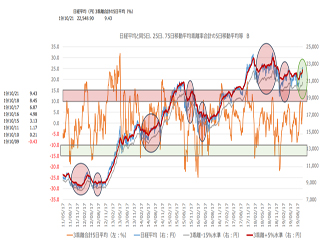
This week is packed with key events, and Japanese stocks are likely to stay range-bound until they pass, after which an uptick is expected.Looking at technical indicators, near-term overheating remains. The 25-day moving average of the advance-decline line is 96%, but the 6-day average is 145% at a high level. The short-selling ratio fell slightly to 39.8%, but buying pressure from shorts remains. The overall trend is not bad. What remains is to clear the 23,000 level. If price closes above this, upside pressure will become quite strong. The lower bound of the June bull scenario range is 23,570 yen. If that is surpassed, it could indicate a shift to a bull market.I have also developed a trading indicator that signals a buy. This indicator will be introduced soon. The presence of this signal provides buying confidence. Of course, I will keep existing longs. In my previous short-term trades on a mini futures basis, I held longs at 23,015 yen, 22,715 yen, 22,330 yen, and 21,985 yen; the longs at 21,985 yen were closed at 22,485 yen, and the longs at 22,330 yen were closed at 22,830 yen for profits. Two profit-taking moves captured a 1,000-yen range. Remaining positions are at 23,215 yen and 23,515 yen, followed by a dip-buys at 22,600 yen. I plan to wait for a pullback to 22,350 yen for another buy. A close above 23,100 yen on the upside from 22,600 yen will be the target. Going forward, I aim for profits in 500-yen increments.
Since the above buying signals are present, if you wish to extend profits, you may keep the longs rather than taking profits. I will inform you when to exit. If further dips occur, I will consider buying again, but I expect the market to continue rising. As before, keep in mind the possibility of a deeper pullback and avoid buying all at once, instead making multiple small purchases (up to 10 times is acceptable). The final upside target is around 23,750–24,000 yen. Of course, the long-term “core position” stays in place. This core position will likely be held beyond 2020. It is better to hold this core position not in futures but in CFDs or ETFs so there is no need to roll over futures, and by keeping leverage low (ideally 1x to 3x), long-term holding becomes feasible.
Next, Prime Minister Abe spoke with President Trump on the 11th following the meeting in the U.S. on the 7th, and apparently secured a commitment to raise the abduction issue at the U.S.–North Korea summit. However, because North Korea’s responses are unpredictable, a resolution scenario has not been drawn. Abe said, “The abduction issue must be resolved during Abe’s administration. Of course, ultimately Japan and North Korea must talk face-to-face, but I hope the U.S.–North Korea summit will be a historic meeting.” Also, in Singapore for the summit, Tanin, the Director-General of the National Security Secretariat, and Kanesugi, the Director-General of the Asia-Pacific Bureau at the Ministry of Foreign Affairs, went to coordinate with relevant countries. Japan has also dispatched people. However, between Japan and North Korea, the basic agreement remains that the abduction issue is resolved. In other words, the above stance is largely a surface-level display for the public.
Since 2002, when five abductees returned home, there has been little visible progress. Of the 12 abductees still officially recognized by the Japanese government, North Korea claims eight are deceased and four did not enter the country. The gap between Japan’s demand for the immediate repatriation of all abductees—including over 800 “specified missing persons” who could have been abducted—and North Korea’s position is large, according to public reports. North Korea promised in 2014 to re-examine abductees, but in 2016 unilaterally halted the process, and since then little progress has been made. However, there has been behind-the-scenes contact. In reality, some abductees have returned multiple times. Yet, as a show, some agreement could be manufactured. Megumi Yokota’s mother Sakie and others held a press conference in Tokyo on the 11th; Sakie said, “Please return my precious child. That is all.” This statement starkly contradicts the actual situation. We cannot dwell on it further here. Eventually, a time will come when we can speak clearly.
〔CURRENCY MARKET〕
With important events such as the U.S.–North Korea summit approaching, the USD/JPY traded in a narrow range around 110 yen as investors took a wait-and-see stance. No major economic indicators were released that day, and there was little new information to guide trading, resulting in subdued price action. Ahead of the historic U.S.–North Korea summit, risk-off sentiment was strong. In a press conference on the 11th, Secretary of State Pompeo reaffirmed that “the objective of completely denuclearizing North Korea remains unchanged.” He stated that, with the aim of ending the Korean War in mind, he was prepared to offer “security guarantees” that differ from the past, while warning that sanctions would not be lifted until the desired result is achieved. Given the uncertainty over North Korea’s response, the market was forced to refrain from aggressive buying or selling.
Meanwhile, after the G7, President Trump instructed the U.S. delegation not to endorse the joint communique. The ongoing rift between the United States—holding a protectionist stance—and the six countries of Japan, Europe, Canada remained evident, but since the dispute over trade policy was anticipated, market impact was minimal. The market is also awaiting the FOMC’s decisions on the 12th–13th. A 0.25 percentage point rate hike this time is largely priced in, but investors want hints on the pace of rate increases for the rest of the year from the FOMC statement and the dot plot. The market prices in two more rate rises this year. This week also includes the ECB Council on the 14th and the BOJ’s policy meeting on the 14th–15th. After assessing these, the market will begin to move more decisively. On the other hand, Italy’s new Economy Minister Tria said there is no intention to leave the euro and that debt reduction will be pursued, sending the EUR/USD toward around 1.1820 in a momentary move—the highest in two weeks. However, the move later retreated toward around 1.1785 ahead of the ECB meeting on the 14th. ECB officials have been hawkish recently, which has strengthened the market view that the ECB will signal an end to its bond-buying program in a gradual manner at this week’s meeting.
【Currency Trading Strategy】
We will buy back the USD/JPY short and go long anew. I anticipated a brief drop, but the dollar has been bought on expectations for the U.S.–North Korea summit. The market direction depends on the summit’s outcome, but it is turning upward, so I will simply follow the trend. Since 109.35 has held as support, this approach helps to ensure the repeatability of trading patterns. Still, after any Fed rate hike, the dollar could weaken. In other words, a “buy on rumors, sell on the news” dynamic could emerge. This requires caution. If European political developments ease, buys of the euro and pound could occur, which would also influence the USD/JPY direction. In the current environment, risk-off is dollar-selling, so there could be selling in cross-yen pairs as well. In any case, this week’s forex market is prone to short-term volatility, so be mindful of higher volatility.
To reiterate,the above target is 110.55 yen. This is not only a long-term chart point but also the theoretical value for USD/JPY. If this is surpassed, the pair could rise to the upper mid-113s. The trend is bullish, but relative to fair value it would be considered overvalued. In any case, surpassing 110.55 would set the stage to target the upper end of the June bearish scenario—around 113.48.And it would rise to around 113.75 yen, approximately the high from last December. In reality, if it exceeds 114 yen, the bullish scenario for a “yen depreciation” would begin.
じて、初めて「円安トレンド」が形成されるということになります。
Right now, amid North Korea tensions, the U.S. side is finding it hard to issue yen-weakening warnings. However, the United States has begun addressing trade issues with Japan. The G7 Summit was contentious, but there is no need to treat trade issues as the sole factor. The United States’ basic strategy is a weaker dollar. Do not lose sight of this. The U.S. will not permit yen weakness beyond 115. The expansion of the U.S. fiscal deficit is another factor contributing to dollar weakness. Repeating: only the United States can control the dollar. It is crucial to understand the U.S. strategy correctly and reflect it in investment decisions. Include the theoretical value from real interest rate differentials in your worldview. Looking at the dollar’s overall movement, the near-term uptrend in the dollar remains intact. However, caution is needed since U.S. long-term rates are retreating due to risk-off flows, which could cap the dollar’s upside. One must keep in mind the rule that “forex moves on interest rates on the surface, but on politics over the larger horizon.”
The EUR/JPY will be newly-long. The trend is turning upward again. The overbought condition has not yet been resolved, but first let’s test 130.50. If it falls below 129.50, consider closing and short-term shorts. Fair value has fallen to around 128.80, so there is a slight overvaluation. Long-term support is around 128, and breaking above that would make further buying easier.
EUR/USD remains long. A pullback is likely, but keep longs until clearly breaking below 1.1775. Fair value has fallen to 1.1650, so it is somewhat overvalued now. However, a long-term trendline sits at 1.1690, and staying above that is bullish.
GBP/JPY is on hold. It looks like it could rise again, but we’ll wait until it clears 147.30. The overbought condition has not yet cleared. The long-term trend point is around 151.90, and only above that will there be a true uptrend. Fair value is around 165.40, which is quite undervalued for the present level.
GBP/USD remains long. It seems to be entering a correction but will stay long until it breaks below 1.3370. The long-term trend point is 1.3860. Fair value is around 1.4960. It has fallen substantially, but the current level remains quite undervalued. However, in the present environment, it is wiser to focus on the trend.
AUD/JPY remains short. There are signs of a rebound. If price moves above 83.75, consider closing. If it moves above 84.20, momentum could strengthen. If it breaks below 83.20, it will turn downward. The long-term trend is around 85.55; until then, selling on rallies is favorable. Fair value is around 83.40.
AUD/USD remains short. It is in an overbought correction. If it breaks below 0.7575, it will test lower levels. The long-term trend remains bearish until it breaks above 0.78. Fair value is around 0.7545. The current level is roughly fair value.
ZAR/JPY remains on hold. After confirming a bottom, we will consider the next steps. There is still a possibility of accelerating declines in emerging-market currencies. Monitor dollar rate movements closely. The base level is 8.6. If it recovers above this, go long.
(...to be continued)
*Seminar Schedule
June 16 (Sat) Toyohashi Trading? Seminar (Osaka)
http://www.yutaka24.jp/?url=/seminars
June 30 (Sat) Nihon Securities Seminar (Fukuoka)
http://www.nihon-fs.co.jp/seminar/seminars/20180630_fukuoka
July 6 (Fri) Monex Securities – U.S. Employment Statistics Seminar (WEB)
https://info.monex.co.jp/news/2018/20180402_02.html
July 7 (Sat) Toyohashi Seminar (Hiroshima)
July 8 (Sun) S-Line Investment Seminar (Tokyo)
July 14 (Sat) Toyohashi Seminar (Yokohama)
July 14 (Sat) 14th International Business Society Charity Forum (Tokyo)
(Special Nonprofit Organization International Consulting Association hosted)
July 19 (Thu) Himawari Securities Seminar (WEB)
July 21 (Sat) Daiichi Commodity Seminar (Osaka)
July 28 (Sat) Toyohashi Seminar (Kanazawa)
Aug 3 (Fri) Monex Securities – U.S. Employment Statistics Seminar (WEB)
https://info.monex.co.jp/news/2018/20180402_02.html
Aug 4 (Thu) Toyohashi Seminar (Sapporo)
Aug 25 (Sat) Okachi Seminar (Osaka)
(In addition to the above, we also offer private seminars. Please inquire if interested.)
*TV appearances
June 14 (Thu) 13:30–13:45 Stock Voices TV “Tokyo Market Wide” (Tokyo MX TV & WEB)
http://www.stockvoice.jp/
June 28 (Thu) 13:15–13:30 Stock Voices TV “Tokyo Market Wide” (Tokyo MX TV & WEB)
http://www.stockvoice.jp/
*Radio appearances
June 20 (Wed) Radio Nikkei “Trade Party♪” (FX Trade Financial provided)
http://market.radionikkei.jp/tradeparty/
June 22 (Fri) 16:00–16:20 Radio Nikkei “GO!GO! Jungle Market” (GogoJungle provided)
http://www.market.radionikkei.jp/gogo/
July 27 (Fri) 16:00–16:20 Radio Nikkei “GO!GO! Jungle Market” (GogoJungle provided)
http://www.market.radionikkei.jp/gogo/
Aug 24 (Fri) 16:00–16:20 Radio Nikkei “GO!GO! Jungle Market” (GogoJungle provided)
http://www.market.radionikkei.jp/gogo/
*Regular Contribution Schedule
“Toyokeizai Online” (irregular)
http://toyokeizai.net/
“Monex Mail” (1st, 3rd, and 5th Wednesdays) (as of June 2018, as above)
http://lounge.monex.co.jp/pro/special1/
“Monex Securities – Monex Gold Report” (every Monday)
The sales page for Tetsu Emori's Real Trading Strategy is here
https://fx-on.com/adviser/detail/?id=8592