
FX Trading Command Room|Episode 1 League Match and Tournament[FX Strategy.com Editorial Department]
From the accumulated data, what can be seen
As Japan’s only monthly FX information magazine, FX攻略.com is entering its ninth year since its founding. During that time, by compiling reader surveys, venue seminars, questions, and inquiries, we have gathered a lot of data about the worries, questions, and common mistakes that readers have.
In this article, based on such data, we will focus on the skills and mindsets that FX beginners should know. In this first installment, we discuss how to think about trading performance.
Tournament thinking is not suited for FX
Do you enjoy watching sports? In ball sports like baseball or soccer, when determining the strongest team among several teams, either a tournament format or a league format is used.
A representative example of the former is high school baseball at Koshien; once you lose, you’re out, and the team that wins all games is the champion. A representative example of the latter is professional baseball’s league format, where the team with the highest winning percentage wins the championship.
If you apply FX trading to either of these, a league-like approach is more likely to allow you to operate for a longer time. Conversely, a strong tendency toward tournament-style thinking tends to cause more problems.
A steady, league-style approach

What is the purpose of FX trading? Probably almost every trader would say, “to increase money.” No matter how the process unfolds, even if you endure 100 straight losses or there isn’t a single profit taking for a month, if your capital increases from the start, that trading is successful.
This is a way of judging overall trading performance, similar to aiming to win in a league. You will win sometimes and lose sometimes, but as long as you ultimately win, that is fine.
If you adopt this mindset, you will begin to judge performance statistically and interpret losses as a necessary expense. Since the overall result is what matters, you won’t be swayed by every single trade.
Furthermore, since you understand that you will inevitably have losing trades, you recover from mistakes quickly. You tend to avoid huge bets with outsized wins or losses, instead repeating many small wins and small losses. This increases trade frequency and helps improve statistical accuracy.
A win-focused tournament-style
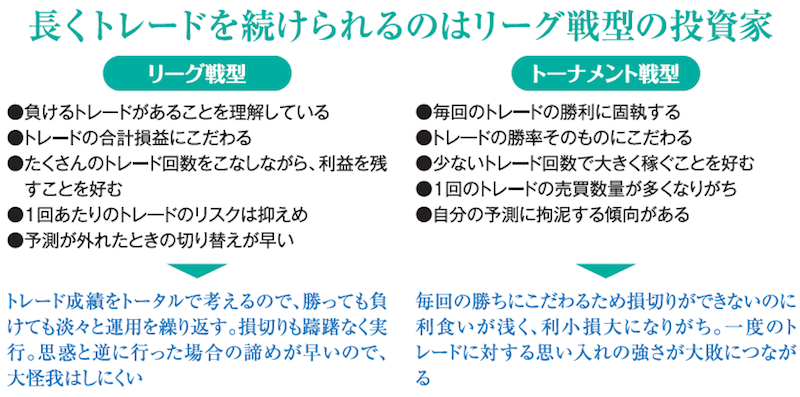
On the other hand, those who lean toward tournament-style thinking tend to approach each trade with the mindset of a final, as if they must win. This stems from a strong desire not to lose, which leads to delayed stop-outs.
Also, the desire not to lose equates to wanting to end trades in profit, so even when there are opportunities to extend profits, they tend to take shallower profits. As a result, even with a relatively good win rate, the total amount of money may decline, ending in a small win and a larger loss situation.
Moreover, when traders become emotionally invested in each trade, they cling to their own analysis, delay stop-outs, and often take big risks.
Bringing it to a total contest is best
So far, we’ve been discussing tendencies, but surely some of you will find them relatable.
In FX, there is no situation that guarantees a win or yields exceptionally high profits. Enter many times with only a slight advantage, win or lose repeatedly, accumulate profits little by little, and bring the overall result to a total contest—this is probably the fastest path to steadily increasing money.
The final’s mentality is a bit too high-strung for statistical FX.
※This article is a reprint and revised edition of FX攻略.com’s June 2017 issue
【FX Trading Operations Room[FX攻略.com Editorial Department]】
・First installment: League vs Tournament
・Second installment: Before starting scalping
・Third installment: Steps to FX mastery
・Fourth installment: How to effectively use various order types