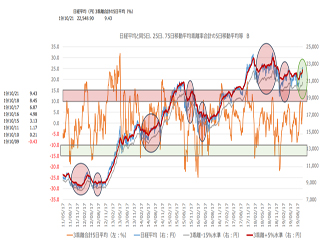

After a high-level advance/decline ratio, the rule of thumb is that the high prices come about one month ahead — from Hiroshi Arano's "From the Technical Room"
Delivery date: 2016/10/28 07:22
Dollar/Yen exchange rate has risen above 105 yen, and with overseas buying continuing, the situation suggests that the April high could be breached.
This means that an update of the April high is in sight.
(April high)
Spot 4/25 17,613 yen
Close 4/22 17,572 yen
140% level of the upside/downside ratio
At present, the market is continuing with a broadening of stock selections, keeping the upside/downside ratio at a high level.
The 1-month moving average (MA) of the ratio had its first this year cross below the line from last week to this week, registering in the 140% range as follows.
Upside/Downside Ratio for Stocks
10/18 140.6% 16,963 yen
10/20 145.4%17,235 yen
10/25 140.0%17,365 yen
10/27 141.0%17,336 yen
It is not always the case that the 1-month MA upside/downside ratio exceeds 140%; it tends to occur only about 2–3 times a year. Last year it happened only in February and October. Looking at last year’s example,
2/19 141.7% 18,264 yen
2/20 146.2%18,332 yen
The lows and highs in this scenario were
Low 1/14 16,795 yen
High 3/23 19,754 yen
When looking at the time factor, from the low to the peak of the upside/downside ratio takes 27 trading days, and from the peak of the ratio to the high takes 21 days.
Similarly, let’s look at the October example.
10/23 145.6% 18,825 yen
10/26 140.8%18,947 yen
10/28 149.5%18,903 yen
Low 9/29 16,930 yen
High 12/01 20,012 yen
Similarly, the time relation is that from the low to the peak of the upside/downside ratio is 20 trading days, and from the peak of the ratio to the new high is 22 days. From the low to the peak of the upside/downside ratio is almost one month, and from the peak to the high is 21–22 days. In both cases, about one month elapsed from the peak of the upside/downside ratio to the high.
According to the data, this time too, the high would likely be pursued up to around 11/20, one month after.
If overseas buyers continue to exceed,
Overseas purchases in the third week of October included futures (mini contracts) at 436,431 million yen, spot purchases at 73,088 million yen, totaling 5,095 billion yen, making it the fifth-large overseas net buy of the year. Since entering October, combined futures and spot purchases have exceeded 1,000 billion yen for three consecutive weeks, which is also the second time this year since April.
Overseas net buying is expected to continue this week as well, and the perspective toward Japan may be changing from what it has been. If overseas net buying persists into November, the above-mentioned upside/downside ratio dynamics are likely to become operative, and a steady market trend will continue.
Since the beginning of the year, overseas net buying has occurred in April, July, and October, in a curious pattern of every three months; if November also sees net buying, the market landscape will have clearly changed.