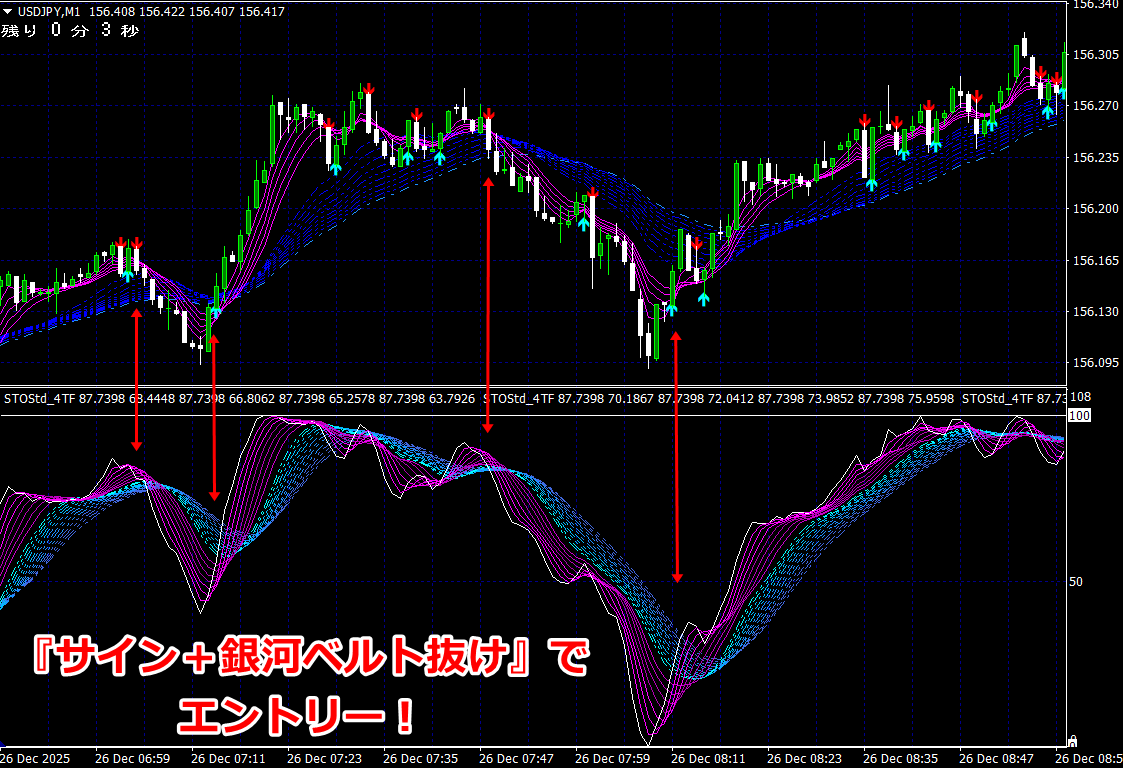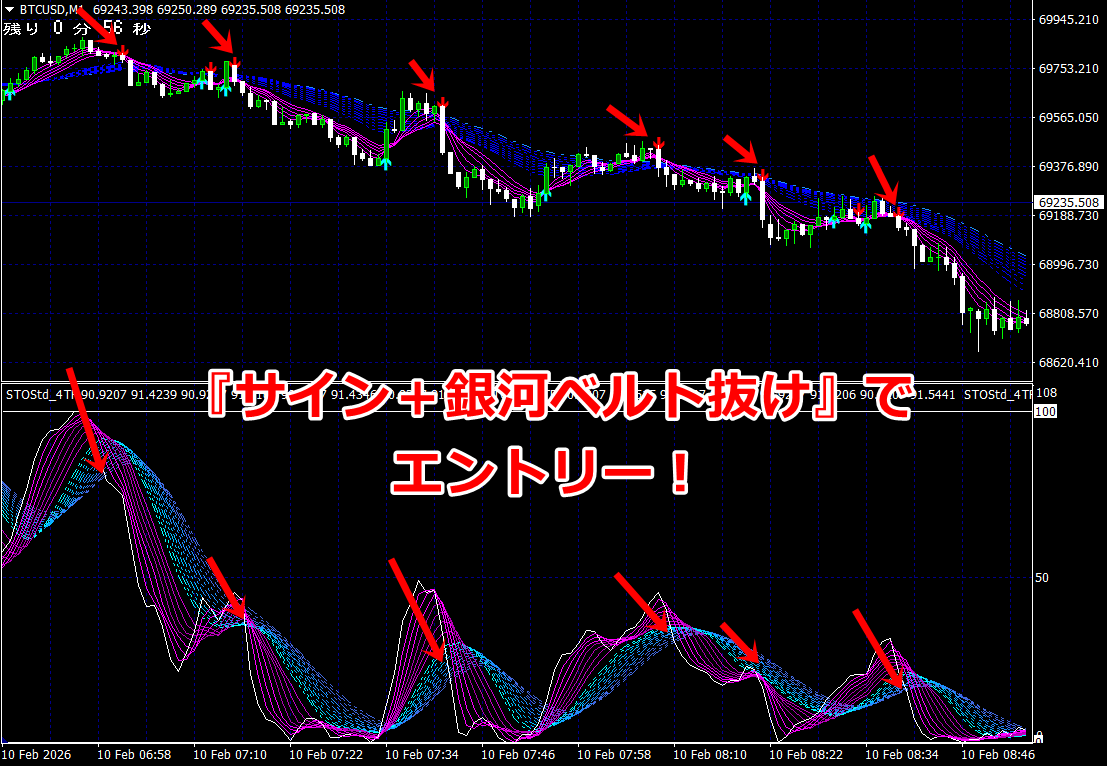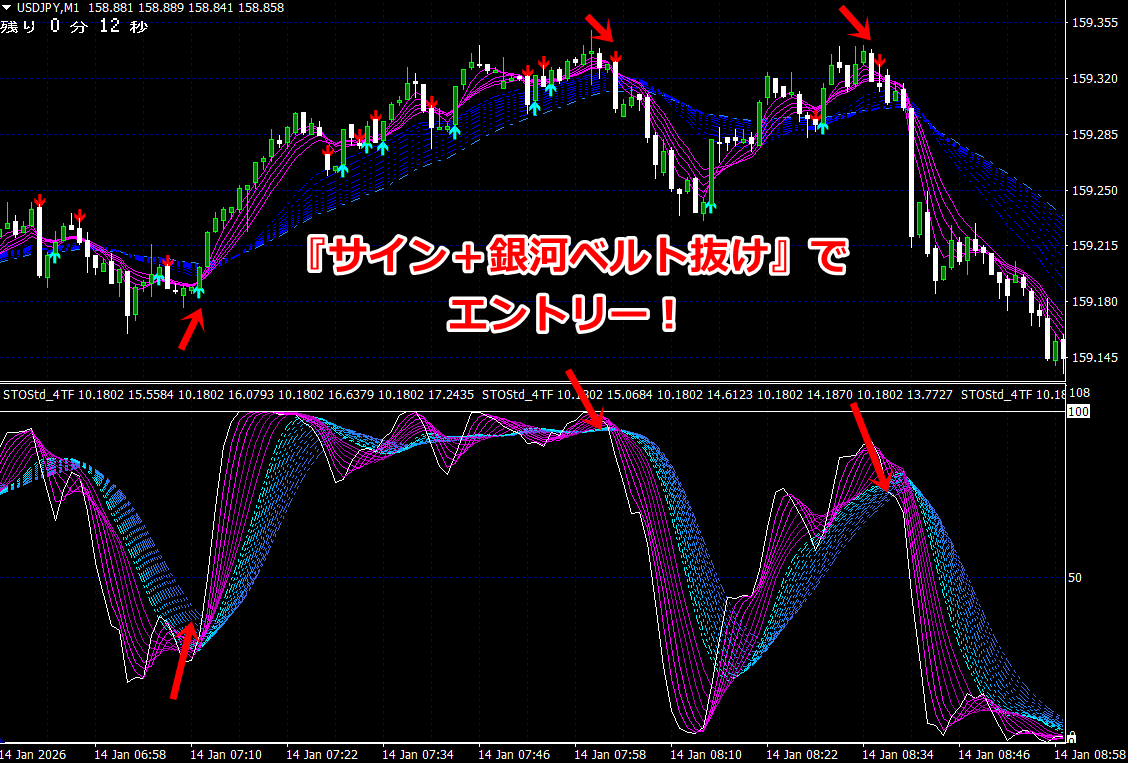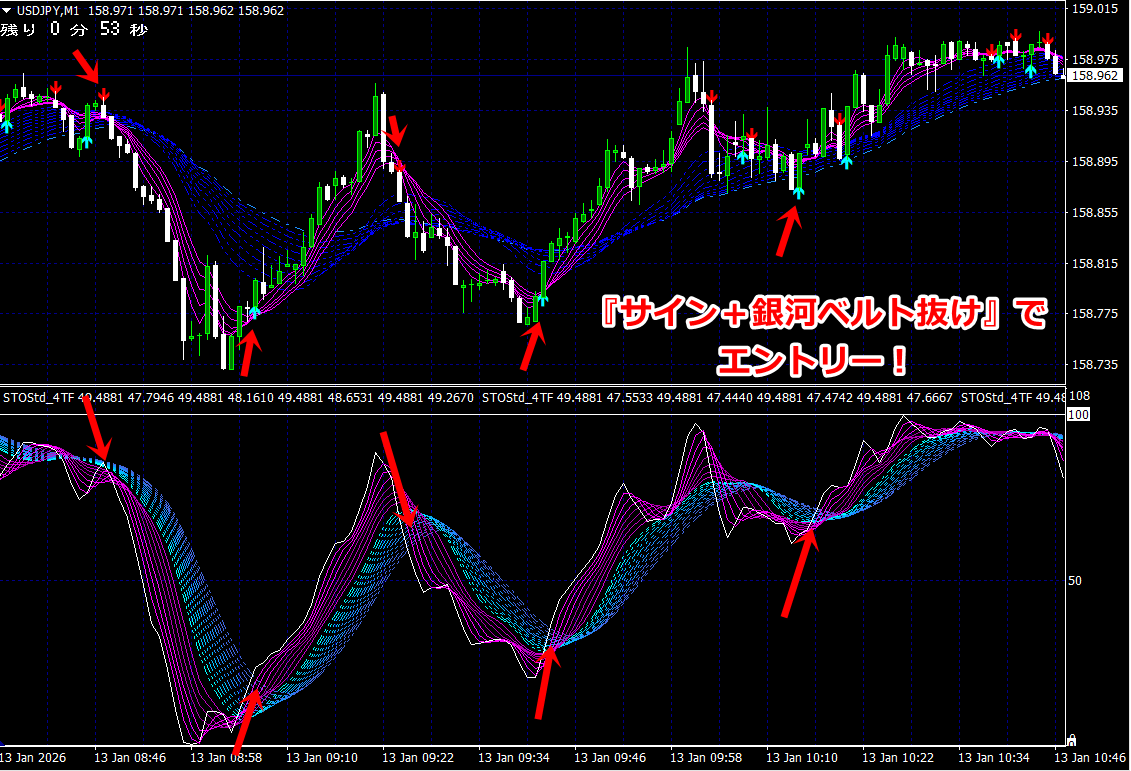

The strongest Stochastic to use as a guide for ceiling and floor price judgments
Using Stochastics in a unique way to identify tops and bottoms! Determine tops and bottoms!
Stochastics itself is a classical, common indicator, but not in its usual usage
If you display about ten lines layered, it becomes quite intuitive and visually clear to identify turning points without relying on reasoning.
From a visually perceived characteristic, compared to other classical indicators like MACD or RSI which have many false signals,
Stochastics has a regular cross between the short-term line and the long-term line at turning points in the market,
that is,
When rising from a bottom, the short-term line crosses above the long-term line, which is a characteristic.
Suppose you take about ten variations by independently changing the Stochastics parameters and overlay multiple lines.
Then at clear upward or downward turning points, they converge densely in a manner exactly like a Möbius band
(a Möbius strip), showing turns as multiple strands converge to the lower or upper bound.
The Tops and Bottoms Chart, as its name suggests, is a chart that captures tops and bottoms by design.
Therefore, I will explain what shapes of the Stochastic lines can serve as the 판단 기준 for the tops and bottoms (equivalently white-arrow signals) with several patterns (concrete examples).
Pattern 1 -Only the white line touches the upper (lower) bound or nearly touches it.
In this case, only when the white line and the three pink lines are significantly apart from the other mid/long-term lines.
The white-arrow signal often does not light up.
Also, after the white line touches the upper or lower bound, it often reverses sharply in the opposite direction.

Pattern 2-At the upper (lower) bound, the white line crosses the pink line.
Various touchpoints of the pink line, such as the first pink line, pink 1st and 2nd lines touchpoints, pink 1–3 lines touchpoints, etc.

Pattern 3 -In large uptrends or downtrends, at the upper (lower) bound, the three pink lines cluster together and touch (cross) the green line.

By observing the simultaneous expansion and contraction of multiple lines from the lower bound to the upper bound, or from the upper bound to the lower bound, you can roughly infer what phase of the rising wave the market is in, or what phase of the falling wave it is in.