
FX essential information 4 Exchange rate and interest rate differential The yen undergoes a change
Investment environment is changing.
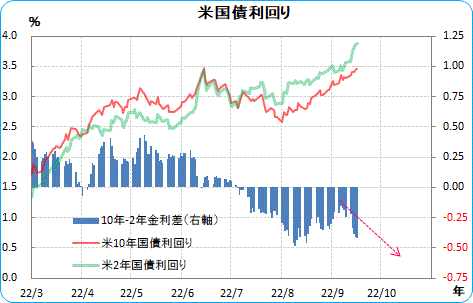
In the United States, concerns about stagflation are rising. To curb current inflation, aggressive rate hikes will continue, but long-term interest rates are beginning to stay low due to concerns about future recession (since a significant rate cut is expected far in the future). Specifically, an outwardly inverted yield curve is expanding.
How will this affect the exchange market?
・Will recession concerns in the United States weigh on the dollar?
・Will rising policy rates push the dollar higher?
・Even if the US and Japan have a wide interest rate gap, is it the short-term rate gap or the long-term rate gap that matters?
In the following “Relationship between exchange rates and interest rate differentials,” I will touch on this a little and also examine the inverted yield curve separately.
Besides that, from the “Last week’s review,”
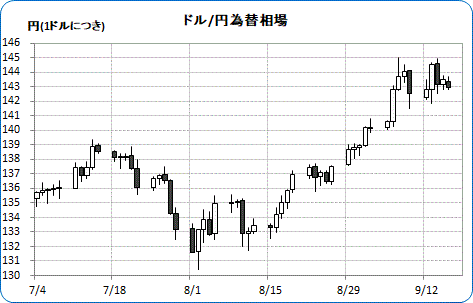
・USD/JPY: In the previous report, it was stated that ‘The interest rate differential suggests a fair level for USD/JPY at around 142.5. Directionally, the dollar’s strength should continue. Take a long dollar position.’
At the start of the week on the 12th, dollar bought at 142.50. It later moved Yen higher, but after the US CPI release on the 13th, the dollar surged. However, despite the 2-year yield rising further, the dollar did not advance. Feeling puzzled, I closed at 144.50. (That’s the good thing about individuals. Even if the dollar continues to rise afterward, you can just shrug it off.)
Two possible reasons: (1) concerns about currency intervention. (2) stagflation in the US economy, expansion of inverted yield curve. It’s not clear yet, but I think the latter is possible.
In the end, last week also yielded large gains.
The background for this strength was the roughly one month from mid-July to mid-August when the yen appreciated, which I describe as: My view and the market view differ. But markets move the market, so I cannot go against the market. Therefore, I have refrained from taking positions. At some point, the market’s thinking will adjust, so I will wait until then. My view and the market view differ. But markets move the market, so I cannot go against the market. Therefore, I have refrained from taking positions. At some point, the market’s thinking will adjust, so I will wait until then.』 I believe this means I paused investing.
・EUR/USD: ‘The trend is euro weakness. However, given the odd relationship between EUR/USD and the US-German interest rate differential, I will refrain from taking positions.’ I did nothing according to this policy.
The euro temporarily weakened but mostly moved sideways.
ECB President Lagarde said on September 16 at an event with high school students in France, ‘There is a possibility that inflation containment measures could weigh on growth; however price stability is fundamental and the most important, so the risk that must be borne is necessary.’
・GBP/USD: ‘The trend is pound weakness. However, given the odd relationship between GBP/USD and the UK-US interest rate differential, I will refrain from taking positions.’ I did nothing according to this policy.
The pound fell sharply. It is likely due to deteriorating fundamentals: slowing economy, rising wages, and rising prices. Rising rates alone cannot support the currency.
If the US moves toward a state like the UK, concerns about dollar weakness will strengthen.
・AUD/USD: ‘The trend is AUD weakness. Since MACD is negative, continue shorting.’
The AUD fell sharply. It yielded considerable gains.
For me, making money with the AUD is rare. I used to do the opposite and end up losing, so this is somewhat pleasing. Before, I traded on instinct, but writing this blog has made me think more and act more deliberately, which may be good.