
Trade balance worsening even with a weak yen
In August, the trade balance was a deficit of 2.8173 trillion yen. The deficit amount was the largest on record.
The trade deficit has lasted 13 consecutive months, the second-longest in history next to the 32 months up to February 2015.
The main cause is that imports of mineral fuels (crude oil, natural gas, etc.) have expanded because crude oil prices rose due to Russia's invasion of Ukraine.
However, the problem is not limited to that alone.
Even excluding mineral fuels, the trade balance has not improved. The trade balance excluding mineral fuels is on a gradual downward trend.
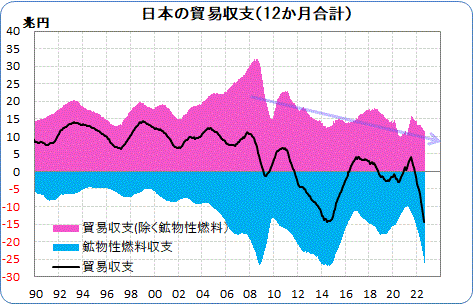
Normally, when the yen weakens, import prices rise and imports are restrained, while exports become more favorable and rise, resulting in an improvement in the trade balance. There are two problems, though.
(1) After the U.S. housing bubble burst, U.S. policy rates were cut sharply, -> yen appreciates -> Japan’s production shifted overseas. Since there are no production bases in Japan, exports do not increase even if the yen weakens.
(2) Production bases are overseas and the system is to produce abroad and ship to Japan, but overseas prices rise and import amounts increase. News says import amounts are rising due to the weak yen, but the real problem is that prices of overseas-produced goods have risen in the first place.
Both (1) and (2) stem from overseas production shifting. While it’s too late to regret, the continued yen weakness recently has led to some domestic relocation of production.
The Japanese government probably does not want further yen depreciation, but it likely also does not want a rapid appreciation that would hamper domestic production relocation. They would like to see production return domestically at least once. If that happens, the economy of growth in the past could be regained.
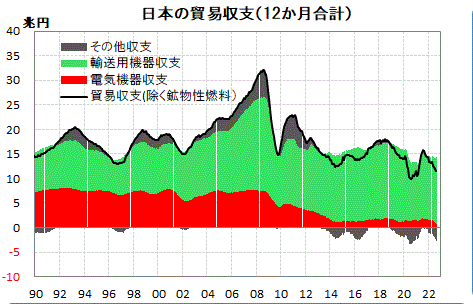
The next graph shows Japan’s trade balance excluding mineral fuels. Among the two major elements that had supported Japan’s trade surplus (cars and electrical equipment), electrical equipment has fallen behind. Other aspects have also worsened.
For caution, overseas relocation of production did weaken the Japanese economy, but since companies earn profits overseas, there is no problem from the perspective of corporate earnings.