
Will currency intervention be effective? Probably Yes
What is currently acting to push the yen weaker is the carry trade. As investors, they want to buy dollars cheaply against the yen. If you execute a large carry trade, you end up lifting the dollar yourself and buying dollars at a high price.
However, when the Bank of Japan intervenes (yen buying / dollar selling), the BOJ wants to execute at as high a yen level as possible, which is favorable for carry-trade investors. They can obtain dollars cheaply. BOJ intervention becomes prey for investors. Thus, the effect of BOJ intervention is nullified. This is the usual pattern.
In 2003, during the dollar-buying intervention, there was an unbelievably large-scale dollar-buying intervention that swallowed up all the investors’ dollar selling. At that time, yen funding was used to buy dollars, so such a thing was possible. This time, selling dollars from holdings (foreign exchange reserves) is limited. Moreover, such a large-scale foreign exchange intervention would not be allowed internationally. In the first place, intervention itself is not allowed.
This time,
・It is a pro-yen-raising intervention
・If the yen depreciation is left unchecked, prices in Japan could rise, potentially spreading spirally to the world.
・If funds flow into the United States via carry trades, it would hinder the US QT (quantitative tightening).
・Japan is increasingly moving production overseas, so even if the yen strengthens, it is unlikely to lead to higher import prices in the United States.
For these reasons, is it that Japan’s intervention would be tolerated without reproach? Each of these four reasons is weak and not really a reason, but if Japan is in trouble, they may be tolerated as makeshift justifications.
I have never worked at a foreign exchange bank, nor been a trader in currencies, so the BOJ’s “rate check” does not resonate with me. What could it be? However, according to the reports, “the BOJ on the 14th conducted a ‘rate check’ to ask market participants about the level of the exchange rate in preparation for intervention in the market.”It is reported that.And that “the rate check is part of the preparatory stage for yen-buying intervention.”
Now, given the above situation (especially that yen-buying intervention funded by foreign exchange reserves has a limited scale, and the fundamentals such as the interest-rate gap between the US and Japan), can yen-buying intervention change the yen’s downtrend?
Common sense would say, as described above, that it only preys on investors and cannot succeed. Both Japan’s Ministry of Finance and the Bank of Japan understand this. They must have studied quite a bit about what would make it effective.
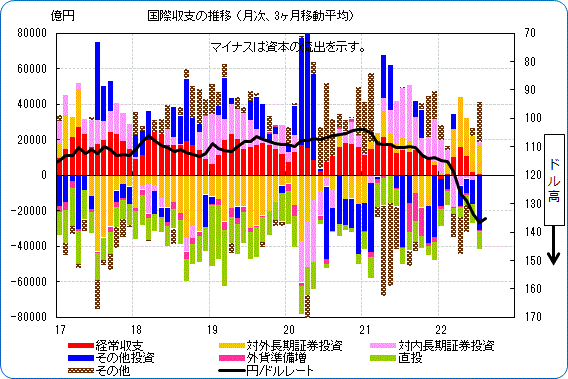
The next graph shows Japan’s balance of payments. It is very technical, so explanations are omitted, but it seems possible to suppress the yen-down trend.
The blue area reflects carry trades, among other things.
With no current account surplus and no yen-strengthening factors left, carry trades are causing dollar strength. However, what is causing dollar strength is mainly only that. It is not that domestic Japanese investors are buying US Treasuries. If we can just outmaneuver carry trades, the yen could be kept from weakening further to a certain extent. Merely selling dollars recklessly would just be pushed back. How to outmaneuver carry trades is the BOJ’s moment to shine.