

FX Essential Information 3: Exchange Rate Trends and Interest Rate Differentials The trend does not change, but takes a breather
This year (since last year) was a dream year for FXers (people who trade FX).
If you bought dollars and held them, you made money steadily. If you shorted dollars, the negative swap points would swell, and you couldn't endure it. In the end, people ended up holding dollars, and the dollar rose.
If you bought dollars and held them, you made money steadily. If you shorted dollars, the negative swap points would swell, and you couldn't endure it. In the end, people ended up holding dollars, and the dollar rose.
By the way, what is hardest for professional fund managers is not holding during a market upturn (especially stocks). Clients entrust funds to profit from the market. If you are holding when the market falls, clients understand there is nothing you can do, but not holding when the market rises is inexcusable.
What am I trying to say. If you are a individual investor, you might think, “This year I made a lot in the FX market. If I step out here and the dollar rises further, I can accept that.” That is the good thing about individual investors.
That said, from the ,
・USD/JPY:
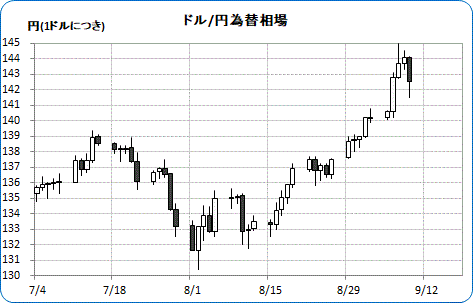
In the previous report I noted, “The interest rate differential suggests the USD/JPY fair level is around 140. Continue long USD. However, it will be difficult to expect a substantial dollar rally/yen depreciation.”
If it exceeded around 141.50 I planned to sell some, but the dollar rose too quickly, so I sold one-third at 142.80, one-third at 144.00, and one-third at 143.80. Currently, the position is zero.
Last week also produced large gains. The gains over these three weeks have been very large.
・EUR/USD: “The trend is euro weakness. However, because the euro/dollar and the US-European interest rate differential relationship is unusual, I avoided taking positions.” As per that plan, I did nothing. The euro rose slightly contrary to expectations.
・GBP/USD: “The trend is pound weakness. However, because the pound/dollar and UK/US interest rate differential relationship is unusual, I avoided taking positions.” As per that plan, I did nothing. The pound rose slightly contrary to expectations.
・AUD/USD: “The trend is AUD weakness. With MACD negative, continue shorting.” Implemented as planned. The AUD rose slightly, with a small loss.
Last week was after Labor Day (Sometimes market sentiment changes), and sentiment shifted somewhat, then there was weekend position adjustments, leading to a somewhat choppy session.
What triggered the position adjustments was
・ECB decided on the 8th to raise policy rates by 0.75%. It was the first time since the euro’s birth in 1999 that such a 0.75% increase occurred. People wondered if the ECB would back down, but it proceeded to curb inflation with an eye on recession risks.
・BOJ Governor Kuroda said rapid yen depreciation is undesirable, and Chief Cabinet Secretary Matsuno stated that he would not rule out any measures against excessive exchange rate fluctuations. (The effect is limited, but it served as a trigger for position adjustments.)
Getting to the main topic. The relationship between the FX rate and the interest rate differential, and future developments.
The relationship between the FX rate and the interest rate differential is essential information for anyone watching exchange rates.
Markets are driven by supply and demand, but a major factor moving FX demand is the interest rate differential.
The relationship between the FX rate and the interest rate differential is the most important and fundamental aspect for FX trading.
It is necessary to constantly keep track of that situation.
That relationship is not permanent. It often changes shape.
Regularly, I follow information on that relationship.
Below is the regular graph set (USD/JPY, EUR/USD, GBP/USD, AUD/USD, EUR/JPY and the correlations with their respective interest rate differentials).