

The month of hardship September begins. 【Shun Nakahara's Today's Saying】 Updated September 1
The苦難 of September has begun.
September is, anomalously, a bad month, and in fact the monthly returns for both the S&P 500 and the Dow Jones Industrial Average are the lowest of the year. (Figure 1)
<Figure 1 Dow Jones Monthly Average Return>
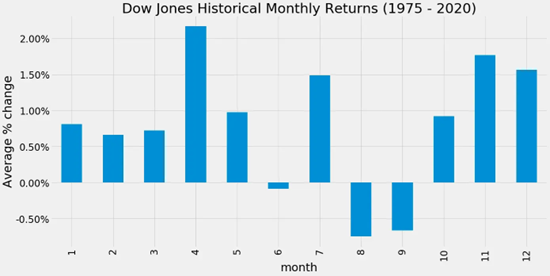
This year's Dow, after a sharp decline in the first half due to a strong Dow cycle, has moved as the anomaly would predict since June. In other words, the decline ended in mid-June, July rose strongly, August rose until mid-month and hit a peak before a sharp drop.
If the anomaly plays out, September, and October and November become extremely important. Ideally, a bottoming out in September would occur, but things are not that simple.
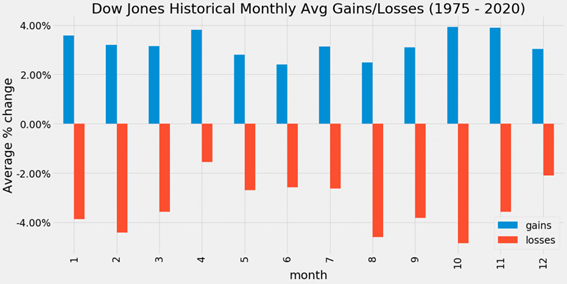
<Figure 2 Dow Jones Monthly Average Rise and Fall>
Historical Stock Market Returns by Month - The Babylonians (theancientbabylonians.com)
Looking at the monthly average rise and fall (Figure 2), the幅 of both declines and advances expands notably from August to October.
While the幅 of gains is smaller and the decline幅 is larger in August and September, October shows the maximum both for rise and fall. In other words, October has historically high volatility, with a large drop and a reversal.
To be frank, in the 21st century—especially after the Lehman crisis—the environment was extremely accommodative for monetary easing, so the notion that “stocks generally go up” was common. In such a state, it was more effective for the market to head toward sharp declines than to follow the anomaly.
However, considering that interest rates are rising and investors compare stocks to bonds in a “normal market” or a market that is not accommodative, it is prudent to view stock market movements as returning to a classic pattern.
History teaches that the low in September may not be the absolute low. It may merely be a rally in the bear market, suggesting that a final downward wave could occur in October or, in the worst case, November—which, when overlaid with the “Year 2” pattern of Gann theory, implies that the June low is not stable and could even be broken toward October–November.
Technically, since the rise since June has already retraced to half of its gains, a possible temporary rebound could occur depending on this week's employment statistics. However, the anomaly and Gann theory both suggest that further tragedy could follow.
That said, conversely, the autumn low of the “Year 2” could historically present an excellent buying opportunity. A tragedy is near, but an excellent opportunity is also near.