
FX Essential Information 1: Exchange Rate Market and Interest Rate Differential - Developments after Jackson Hole
0
<Last Week's Review>
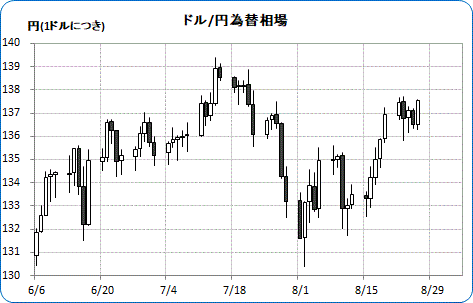
・USD/JPY:
・USD/JPY:
Started at 136.90, high 137.70, low 135.80, close 137.50
We started with the policy: “Because Powell’s Jackson Hole remarks will not indicate a drop in U.S. rates, we will go long the dollar.”
On August 23, U.S. PMI and New Home Sales were worse than expected, causing a sharp dollar decline.
As I have written repeatedly, I expect Chairman Powell to prioritize inflation containment over the economy at Jackson Hole, so I saw this as a dollar-buying opportunity and purchased dollars at 136.10. It happened to fall while I was looking at my iPhone, so it was lucky.
So including the carry from the previous week, it became a large gain.
Also, since I continued the USD/JPY long, the swap income has become quite substantial.
・EUR/USD:The trend is euro weakness. However, the relationship between EUR/USD and the US-German interest rate differential is odd, so I am avoiding taking positions.
・GBP/USD:The trend is pound weakness. However, the relationship between GBP/USD and the UK-US interest rate differential is odd, so I am avoiding taking positions.
・AUD/USD:The trend is likely AUD weakness. I started with a plan to sell AUD when MACD turns negative. MACD fell below 0 on the 23rd, so I sold AUD at 0.6930. Result was a small gain.
The difference between institutional investors and individual investors is that individuals can continue not to take positions. Institutions (especially those managing client funds) have difficulty remaining in no-position mode for long. If they don’t take positions, they risk client complaints. Even when not taking positions, advisory fees still accrue. “If you do nothing, there’s no point in outsourcing investment.” If the client understands, they might say, “Doing nothing is also an investment decision” or “Even taking a break is an investment.” But such clients are few.
Right now, I have no positions in euro or pound, but dollar positions alone are yielding ample profits. There is no need to force positions. Until about three weeks ago, there were weeks with no positions at all.
We should aim to profit from a few opportunities each year. It is hard to keep making profits nonstop. There is no need to challenge ourselves to do that.
Additionally, although not written here, I actually operate stock indices as well. In the past I invested in ETFs, but now I use CFDs. Since around March I have been short the Dow Jones and the DAX. I would like to go short the S&P 500, but the service I use does not offer it.
Around June, profits were substantial, but later rallies eroded most of them, and last weekend's stock decline yielded a small profit again. June had the U.S. CPI shock; this time, a Powell shock. I expect the big move toward year-end. At that time, I also plan to short the Nikkei 225 (225).
The Dow short is due to expecting U.S. stagflation. The DAX short is due to considering a collapse of the German economy. I cannot understand why the world (especially Germany) has become so involved in the Ukraine conflict.
Around June, profits were substantial, but later rallies eroded most of them, and last weekend's stock decline yielded a small profit again. June had the U.S. CPI shock; this time, a Powell shock. I expect the big move toward year-end. At that time, I also plan to short the Nikkei 225 (225).
The Dow short is due to expecting U.S. stagflation. The DAX short is due to considering a collapse of the German economy. I cannot understand why the world (especially Germany) has become so involved in the Ukraine conflict.
Now, the key points from Powell’s Jackson Hole speech are:
・On monetary tightening for inflation suppression, he said, “We must continue until we achieve it.”
・He stated that “to curb inflation, some pain will be inflicted on households and businesses, and that is an unavoidable cost,” clearly prioritizing inflation containment over the economy.
・He noted that “history warns strongly against premature monetary easing,” meaning he will likely not adopt a forward-looking easing approach and will avoid a repeat of the 1970s.
Predicting future developments remains extremely difficult.
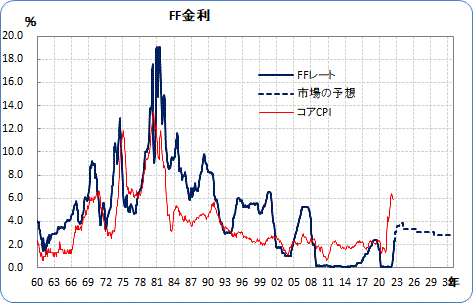
Getting to the main topic: the relationship between exchange rates and interest rate differentials, and the future outlook.
The relationship between exchange rates and interest rate differentials is essential information for anyone watching currency markets.
Markets are determined by supply and demand, but one major factor driving demand and supply in FX is the interest rate differential.
The relationship between exchange rates and interest rate differentials is the most important and fundamental concept in FX.
It is necessary to constantly keep track of this situation.
This relationship is not permanent. It often changes shape.
We regularly follow information on this relationship.
Below are the regular graphs (USD/JPY, EUR/USD, GBP/USD, AUD/USD, EUR/JPY and the correlation with their respective interest rate differentials).
× ![]()