
Reasons Japanese stocks are firm/robust
Even though it is solid, it isn’t on an upward trend, but since it isn’t falling like U.S. stocks, it somehow feels stronger.
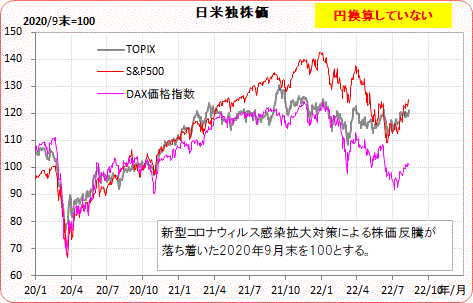
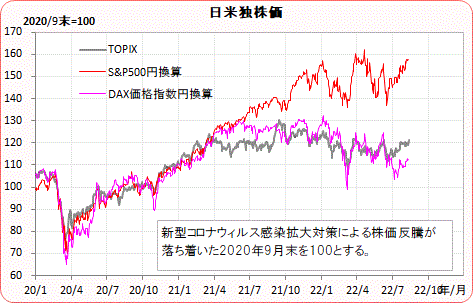
When you look at currencies, on a yen basis here, U.S. stocks are still the strongest. One reason is that the U.S. is rolling out economic measures one after another. This time it’sInflation Reduction ActIt’s billed as an inflation reduction act, but its contents include climate change measures, drug price reductions, and a raise in some corporate taxes. By the way, it also includes imposing a 1% tax on corporate share buybacks. Japan should adopt this too. There has been a ridiculous debate in Japan about internal reserves taxation, but taxing share buybacks is a good idea. It is a bit negative for stock prices directly, but positive for the Japanese economy. Ultimately, it should also be positive for Japanese stocks.
So, why are Japanese stocks solid?
Obviously, corporate earnings are expanding (EPS increasing) and the P/E ratio is not falling significantly.
For a basket like TOPIX or the Nikkei Stock Average, the P/E is determined by monetary policy. That policy, unlike in the U.S., does not tighten.
Regarding the former company earnings, the market’s view is
(1) profits in yen are boosted by a weaker yen. For example, Honda.
(2) unlike the United States, the recovery has not yet fully returned to pre-pandemic levels. Consumption, etc., tends to recover gradually.
That would be the likely explanation.
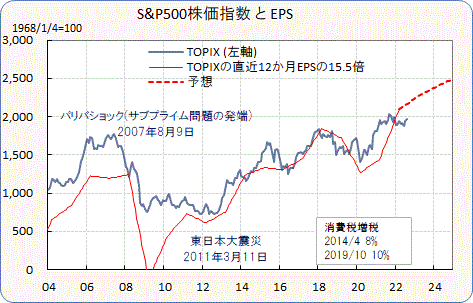
In the next chart, TOPIX is below its current fair value (empirically 12-month EPS times 15.5), and EPS is expected to continue expanding. The reason is as stated above.
It is somewhat undervalued due to concerns such as the U.S. recession risk, the uncertain Chinese economy, the Russia-Ukraine war, recent energy price rises (global inflation, worsening Japan’s trade balance, fears of European economic collapse).
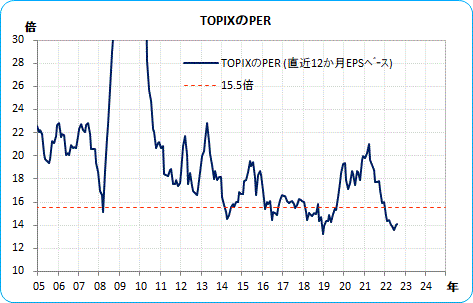
The reason Japanese stocks remain solid is as explained above. So what will happen next depends on how earnings evolve.
As noted above,
(1) U.S. recession concerns,
(2) unstable Chinese economic trends,
(3) developments in the Russia-Ukraine war,
(4) the impact of energy price rises (global inflation, worsening Japan’s trade balance, fears of European economic collapse), which have recently eased somewhat
How to think about these matters is the question. In particular, (1) is likely the biggest concern.
In macro indicators, the question is whether the ISM index will fall to around 47 from October to December.
Next, we will discuss corporate earnings of Japanese companies.