
FX must-have information: exchange rates and interest rate differentials 2022/07/29
0
Last week (July 25–29) I basically decided not to take positions.
“The current Fed policy objective is not maximum employment, but solely inflation control.”
Although the price of raw materials, which had been pushing inflation, has fallen substantially, wage growth continues. There is no sign of price stabilization.
Therefore, rate hikes will continue, all interest rates face upward pressure, and the dollar appreciation trend continues.
I thought so (or was considering), but actual mid-to-long-term rates have fallen, and at the close on July 22 the exchange rate was 136.0 yen, yet the rate differentials suggested a dollar/yen of 134 yen, so I refrained from taking a position.
Wage-push inflation has not lasted 40 years, so the market seems to have a low recognition of it. It was a term I often used when I was younger, but now I hardly hear it. It seems that Chairman Powell’s emphasis is being ignored. And the market seems to simply think “rate hikes ⇒ recession & price stabilization ⇒ rate cuts.”
FOMC members and regional bank presidents are desperate to correct the market’s view, but it is to no avail.
・Minneapolis Fed President: It’s a long road to restraint on hikes—NYT - Bloomberg
On the contrary, the market is starting to call a technical recession by looking at GDP for Q4-Q1.
(Officially, the National Bureau of Economic Research decides after considering a broad range of economic indicators)
On the contrary, the market is starting to call a technical recession by looking at GDP for Q4-Q1.
(Officially, the National Bureau of Economic Research decides after considering a broad range of economic indicators)
Even if it enters a recession, if inflation does not calm, hikes will continue, but the market does not see it that way; U.S. interest rates fall, and the dollar weakens/yen strengthens.
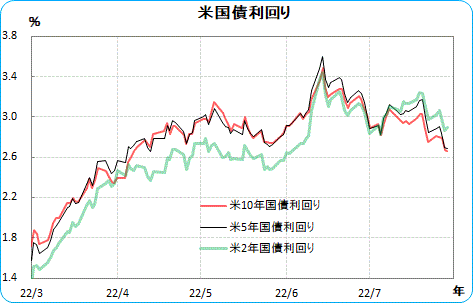
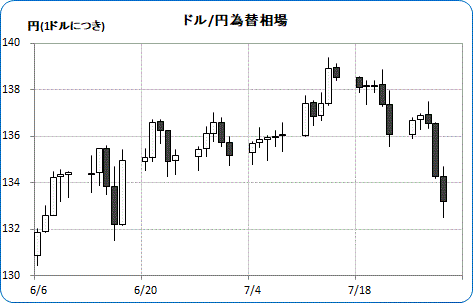
Last week I wrote that the market view was that the current theme was rising U.S. recession fears leading to lower U.S. rates and a stronger yen, and that indeed happened. While I wrote so, my own true feeling remains as stated above: ‘rate hikes continue, upward pressure on all rates, and a continued dollar strength,’ so I did not take a position.
Getting to the main point.
Basic information essential for those watching the foreign exchange market.
The market is determined by supply and demand, but one major factor driving FX supply and demand is the interest rate differential.
The relationship between the exchange rate and interest rate differentials is the most important and fundamental concept in FX.
It’s essential to constantly keep track of that situation.
That relationship is not permanent. It often changes in form.
Regularly, information about this relationship is followed.
Below, we present the standard graphs (USD/JPY, EUR/USD, GBP/USD, AUD/USD and their corresponding rate differentials). This time, we also add graphs of EUR/JPY and the rate differentials.
(1) USD/JPY
× ![]()