

How to Read the Nikkei Newspaper in the Nakahara Style [Nakahara Shun's Word Today] Updated July 25
When a rare product graces the front page…
<US 10-Year Treasury Yield Daily Chart>
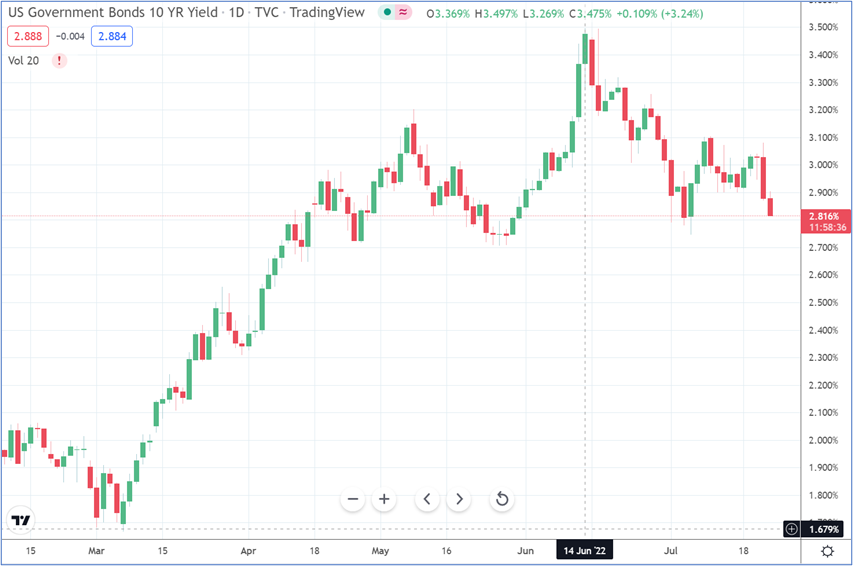
“When something that rarely makes the papers—let alone the front page—appears on the front page, it marks a ceiling or a bottom.” I still believe this market sentiment aphorism remains valid. Examples include crashes, bearish views prevailing, or a pessimistic view of a recession—cases that fit this saying. In that sense, I feel Japan stocks have not yet swung to that degree of pessimism. On the other hand, at least over the past year or so, prices of bonds have hit lows (or yields have reached highs) that may already have been seen—though this is somewhat old news, the front-page article in July 19’s Nikkei on “Bond values fall by 2300 trillion yen worldwide in January–June.”
Well, there are a few things to discount. After the three-day weekend, there wasn’t any provocative news. Still, it’s rare for a bonds article to become a front-page story in the Nikkei. The content is, in a sense, an ideal pessimism: “The global economy that has relied on debt is at a turning point,” “financial institutions holding lots of government bonds face higher management risks,” and it is packed with concerns such as rising Italian auction yields within the EU, elevated corporate bond spreads, and instability in emerging market financial systems. It even mentions the IMF’s claim that declines in domestic government bonds can erode equity capital in the “doom loop.” The closing line notes that “rising bond yields will increase global interest payments by about 1.25 trillion dollars.”
In reality, credit spreads and credit risk have not fully materialized, and while some parts are plausible, the article’s tendency to list nothing but pessimism intentionally distorts balance—an obvious editorial aim.
The appearance of such articles signals that, regarding U.S. long-term Treasuries, the market may have largely found a bottom. In fact, the yield on the U.S. 10-year fell from around 3.5% on June 14 to more than 0.6 percentage points lower, and bond prices rose. Of course, even after this article appeared, the rally continued.
A downturn and the associated widening of credit risk are likely yet to come, but as far as sovereign risk-free U.S. Treasuries, especially in the 10-year zone, most of the rate increases this year may already be over.