
FX must-have information: Exchange rate and interest rate differentials 2022/07/15
Last week (July 4–8), I basically decided not to take a position.
Furthermore, the yen continued to weaken, and I wish I had sold yen, but I hesitated, so it cannot be helped.
The fun of investing lies in “what if.” When I was young, people around me used to say the rule of “it goes up when you sell, it goes down when you buy,” joking about themselves.
However, while it’s enjoyable to think “… I would have made money if I had done it,” I want to avoid thinking “… I would have avoided losses if I had done it.”
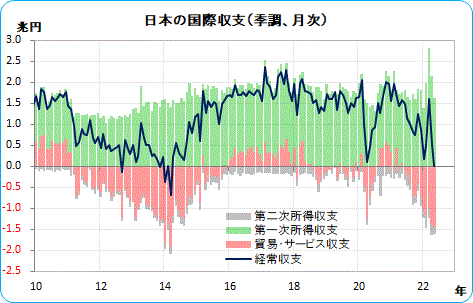
The current fundamental point to watch is that, apart from oil-producing countries (the United States is oil-producing as well), the trade balance is running a large deficit.
Previously I looked at the international balance of the euro area, and Japan is similar. In seasonally adjusted terms, it’s nearly in deficit. In terms of forex demand and supply, the net yen buying disappears in the current account, while in the capital account, yen selling occurs due to carry trades, so the yen is being sold overall. However, in the capital account, profits from yen-selling positions will lead to some yen buying eventually.
In terms of purchasing power parity, the yen is abnormally weak. However, for PPP to hold, yen depreciation must lead to an improvement in the trade balance, and that hasn’t happened, making it hard to find reasons for a reversal of the yen’s weakness.
Recently, prices of industrial commodities in general, especially crude oil, have fallen, so if this continues and the U.S. rate-hiking cycle ends, the yen may reverse to strengthen, but that is still in the future.
Recently, prices of industrial commodities in general, especially crude oil, have fallen, so if this continues and the U.S. rate-hiking cycle ends, the yen may reverse to strengthen, but that is still in the future.
So, are the currencies of oil-producing countries strong? Many Middle Eastern currencies are pegged to the dollar. Canada and Norway are oil producers as well, but that alone cannot outpace the United States. They may not be raising rates as aggressively as the U.S. (unconfirmed)?
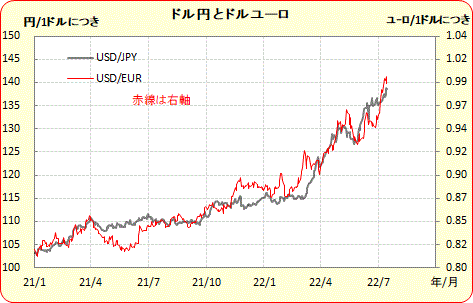
Dollar strength is the trend. In the next chart, the euro is not in its usual euro/dollar form but in dollar/euro. When it goes up, the dollar strengthens (the euro weakens).
Getting to the main topic.
Essential basic information for those who monitor the foreign exchange market.
The market is driven by supply and demand, but one major factor that moves the supply and demand for exchange rates is the interest rate differential.
The relationship between exchange rates and interest rate differentials is the most important and fundamental for FX.
It is always necessary to keep track of that situation.
That relationship is not permanent. It often changes its form.
Regularly, information about that relationship is followed.
Below, I will post the regular graphs (dollar/yen, euro/dollar, pound/dollar, AUD/dollar and their respective interest rate differentials correlations).
(1) USD/JPY
U.S. medium- to long-term interest rates reflect a potential economic slowdown. The interest rate differential that best reflects the Federal Reserve’s monetary policy is likely the 2-year yield differential.
× ![]()