
FX Essential Information: Exchange Rates and Interest Rate Differentials 2022/07/01
Basic information that is essential for those watching the exchange rates.
The market is determined by supply and demand, but a major element that moves the supply-demand in foreign exchange is the interest rate differential.
The relationship between exchange rates and interest rate differentials is the most important and fundamental for FX.
It is necessary to always grasp that situation.
That relationship is not permanent. It often takes on different forms.
Regularly, information about that relationship is followed.
The market suddenly became hard to understand.
From 1980 to recently, the world economy had been deflationary for a long time.
U.S. monetary policy aimed primarily at maximizing employment and preventing an overheating economy.
U.S. monetary policy aimed primarily at maximizing employment and preventing an overheating economy.
However, now, curbing inflation has become the top priority.
Something that had not happened for 40 years is happening.
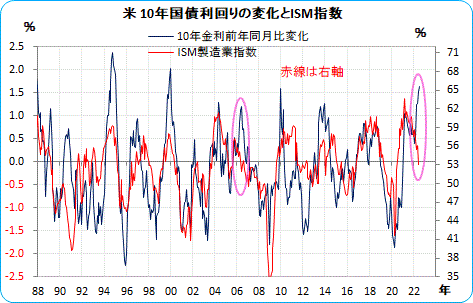
The ISM index fell to 53, and ten-year Treasury yields were more than 0.5% higher than the same period last year, which was rare. It happened twice: in 1990 and 2006. Before entering a recession. Those times were not normal. 2006 was the beginning of a housing bubble collapse. In both cases, yields subsequently fell significantly.
However, this time we cannot tell. We cannot determine how inflation after 40 years will unfold. In the 1970s to 1980s, financial policy shifted from interest rate control to money supply control. Interest rates were left to market forces, so rates rose endlessly.
It is so long ago that memories are faint, but as I recall, the release of M1 in the U.S. on Thursday at 9:30 PM Japan time would move the currency, bond, and stock markets significantly. I was an external stock fund manager, and the neighboring department was the FX team. They would go to karaoke for lunch around 6 PM, return around 9 PM, glare at the Reuters monitor and TeleRate (Bloomberg didn’t exist then), coordinate with FX banks, and be in a state of readiness.
The release of M1 (not the Japanese M-1 Grand Prix) was a bigger event than today’s employment statistics release.
In any case, the FX and interest rate markets became hard to read all at once.
Inflation remains strong, but on the other hand, due to signs of economic slowdown, interest rate trends are not settling down.
Against this backdrop, how are the exchange rates moving?
Below, we present the regular graphs (USD/JPY, EUR/USD, GBP/USD, AUD/USD and their respective interest rate differentials) and their correlations.
× ![]()