
The Nikkei Average has completed its long-term 50% retracement and is freed from the "22-year curse"~From Tetsu Emori's Real Trading Strategy~
【Trade Strategy for February 7】
Yesterday's bottom in US stocks hit the mark
〔EQUITY MARKET〕
【Market Commentary and Analysis: U.S. Stocks and European Bond Markets】
U.S. stocks rebounded sharply after the previous day's plunge. The Dow Jones Industrial Average rose by 567 points from the previous day, the largest gain in about seven and a half months since June 24 of last year. The Nasdaq Composite also gained 148 points. Because the US jobs report was stronger than expected, concerns about inflation from an overheating economy intensified, and the previous day's Dow fell by 1,175 points—the largest one-day drop on record. Following weakness spreading to Asia and European markets, the Dow opened about 567 points lower, but with the rebound from the previous day’s plunge and solid corporate earnings backing the fundamentals, activity became choppy with moves between positive and negative territory. However, with no particular catalysts later, buying pressure strengthened toward the close, and the Dow rose to as high as 600 points. The day’s intraday range reached 1,167 points. Such movement can be viewed as a ritual pointing toward the next move. Investors at this stage are unsure whether to sell or buy. Expect continued volatility for the near term. On the other hand, the volatility index (VIX), considered a gauge of investor fear, declined, indicating some reassurance. However, this is a lagging indicator, and whether volatility will settle depends on market trends.
According to 2017 US trade statistics, the international accounts-based trade deficit for goods and services totaled $566.0 billion, up 12.1% from the previous year. This was the largest since $708.7 billion in 2008, the first increase in nine years. The trade deficit with Japan for goods alone rose 0.1% to $68.8 billion, ranking third among country deficits behind China and Mexico. The Trump administration has pledged to reduce the trade deficit, but robust US growth supported imports, widening the deficit. By country, the deficit with China rose 8.1% to a record $375.2 billion; the deficit with Mexico was the second largest at $71.1 billion, up 10.4%. The deficit with Japan was largely in automobiles, at $53.5 billion. On the international-trade basis, goods trade deficit rose 7.6% to $810.0 billion, while services trade surplus fell 1.5% to $244.0 billion. Exports of goods and services rose 5.5% to $23,293.0 billion, and imports rose 6.7% to $28,953.0 billion, both at record highs. December trade deficit rose 5.3% month-over-month to $53.1 billion; November was revised down to $50.4 billion. Ahead of this autumn’s midterm elections, the Trump administration may pressure Japan and China to address imbalances. While the administration shows willingness for bilateral talks with Japan, it also indicated willingness to return to renegotiations of the Trans-Pacific Partnership (TPP) on the premise of rejoining, making the policy direction unclear.
On the 5th, when Fed Chair Jerome Powell officially took office, U.S. stocks posted the largest one-day decline on record. Heightened caution about rising interest rates was in the backdrop, and Powell faced an immediate test in gauging the pace of rate hikes. U.S. stocks had continued to hit new highs buoyed by low rates and abundant investment money from the Fed’s easing measures. However, long-term U.S. interest rates rose briefly into the high 2.8% range—the highest in four years—sparking market concerns. The rise in long-term rates, along with concerns over increased Treasury issuance due to Trump’s large-scale tax cuts and rising inflation from a cooling period, suggested overheating in the economy. Markets anticipate a faster pace of rate hikes than expected, contributing to selling in risk assets. The Fed is expected to raise rates three times this year, but March’s anticipated hike already priced in may be postponed. Market-implied probability of a rate hike has fallen sharply from 90% to 70%. If stock prices remain volatile, it would be prudent to delay rate hikes. Merely signaling such a stance would strengthen the perception that the new chair is “market-friendly,” prompting investors to buy stocks again for confidence. In the past, former Chair Greenspan faced Black Monday soon after taking office in 1987. Leaving rates too low risks asset bubbles; raising them could trigger further stock declines. Yet, at this stage, a hawkish tilt would likely push prices lower. Powell will face difficult policy choices, but the most necessary action now is to clearly signal a hold on rate hikes.
U.S. Treasuries rose. Amid stock volatility, some funds flowed into Treasuries. However, with inflation indicators improving, the fear that the Fed will adopt more aggressive rate hikes remains strong. Meanwhile, liquidity tightness and high-frequency trading have increased volatility, and prices in stocks and yields are not moving solely on inflation factors. The 10-year yield at 2.755% is higher than the previous month’s 2.654%, and the 2-year yield rose to 2.109%. However, the 2–10 year yield spread remains at a low 0.696%. Markets also see uncertainty as the Fed’s balance sheet reduction could prompt the Treasury to issue significantly more debt. Meanwhile, concerns over raising the debt ceiling have pushed up the yield on Treasury bills maturing in mid-March. The Congressional Budget Office (CBO) warned last week that funding could dry up by early March. The yield on the March 8 T-bill maturing is 1.45%, about 7 basis points higher than the yield on the March 15 maturity.
Euro-area financial and bond markets saw yields retreat. Amid a global stock slump, funds shifted into bonds deemed safe assets. Germany’s 10-year bund yield fell to 0.691%, the day’s decline being the largest in two months. It was well below the 0.774% high reached on the 5th. Domestic bond yields across the region also fell by about 5–6 basis points. With stock prices unstable, risk-off flows are likely to support government bond prices in major economies. If growth accelerates or inflation rises, rates may rise again, but while stock prices are unstable, yields are likely to stay low or be restrained. As central banks normalize policy, longer-term debt sales will continue, but the near term will remain volatile for the bond market as well.
【U.S. Stock Trading Strategy】
There is no change to the long strategy. In after-hours trading, Dow futures fell by more than $500, briefly hitting 23,088. The indicator from Bank of America Merrill Lynch (BAML) proved correct again. The “bull-bear index,” which measures risk appetite, flashed “sell,” and risk assets did indeed fall. This indicator’s reliability has grown. According to BAML, the average drawdown when the market turns lower is about 12%. On the Dow, that implies roughly a drop to around 23,500. Also, with the 144-day moving average at 23,300, it suggested the Dow could fall as far as 23,500 at most; falling below this threshold would be seen as oversold. Looking at today’s action, that view appears correct. On the other hand, the common view is that a 20% drop from a peak would signal a bear market, which would require the Dow to fall below 21,300 (the June last year level). While the probability is not zero, a decline that deep would be too extreme and would imply an ultra-cheap market. Investors unlikely to abandon buying at such a level would be few.
The day recovered, but looking at the futures market, 24,800 is a high level. The 55-day moving average sits there. It was hit yesterday, and if it cannot surpass it, there’s a chance of another decline. Things are not yet settled. Dow futures tend to move with technical indicators; surpassing 24,800 would target the 34-day moving average at 25,400. The levels are neatly lined up, so keep these numbers in mind. Of course, if you cannot surpass 24,800 and drop below the 89-day moving average at 24,200, the possibility of heading back toward 23,300 is not zero. Today’s rebound reduced that likelihood, but given that market participants may be AI-driven investors, it’s hard to know what they’re thinking. Reading the psychology of this opportunity is difficult. Even after experiencing the Lehman crisis and the tech bubble, the moves feel somewhat different. For that reason, there is still no reason for optimism.
Many analyses attribute the decline this time to trading that uses AI and other technologies to read price-variance patterns and act on them, amplifying the downside. That may indeed be the case. Such sharp volatility changes can occur, and the range is clearly wider than before. What this implies is that you should always manage your positions and invest within a rational range. As repeated, one cannot predict the future. And you certainly cannot know where the bottom is. If you could, it would be easy. It is all speculation. If you are uneasy, reduce your position and, if it declines further, gradually buy more. It is possible to anticipate a bottom to some extent as in this instance. The forecast that the Dow would endure a drop to 23,500 and hold was accurate. Panic and easy selling at the lows is the most regrettable. If you invest in stocks, sharp declines are part of the game. How you take advantage of them will shape future profits. Above all, you must stay in the market; otherwise it won’t work. If you are uneasy, reduce your position by half or even one-third. But keep buying on dips and wait for the eventual rebound. Ultimately U.S. stocks will rise. It may be next week or next year. But in five to ten years, new highs will surely be set. That is the appeal of U.S. stocks. That is why my book “U.S. Stocks Will Triple!” emphasizes the importance of investing in U.S. stocks and shows how to structure a portfolio.
Some say the decline was triggered by rising interest rates, and some say not. At the very least, the acceleration of the decline after the initial drop was the result of mechanical trading going too far. Some say it mirrors Black Monday, but markets can behave this way. The rule is to participate with this understanding. The U.S. 10-year yield is in the high-2.8% range at its peak. In 2006, before the Lehman crisis, it was 5%. Since 2009, it has traded below 3.8%, but during this time rates have been kept too low. It’s the result of quantitative easing; if the economy truly strengthens and rates move back toward normal, the target would first be about 3% by the end of 2013. After that, if rates rise to 4% and then 5%, consider the impact on corporate earnings. Of course, the key is the 2–10 year yield spread. It has not narrowed; on the contrary, it has widened. As long as it does not flatten, concerns are unwarranted. There have been times of instability, but I have continued to say “just watch the yield curve,” and that stance has allowed positions to be held at these high levels. This policy will not change. In such a historic rally, one should stubbornly stay with the trend until the regime changes. By checking daily catalysts and maintaining a long-term perspective, it is crucial to preserve the big-picture view.
The rally’s upward trend, repeatedly pointed out, is believed to continue from mid-2019 through 2020, and that view remains unchanged at this time. This rise is likely a replay of the tech bubble up to 2000. What happened as stock prices rose up to the 2000 peak was that from July 1998 to September, the Dow fell 20%, the S&P 500 fell 22%, and the Nasdaq fell 33%. After this substantial correction, a historic rally followed, and in March 2000 it reached the then historic high.At that time, up to July 1998, the percentage deviation from the 20-month moving average for each index was: Dow 22.1%, S&P 500 28.2%, Nasdaq 25.5%; deviations from the 60-month moving average were 69.0%, 74.2%, 72.3% respectively. That was clearly excessive. This time, the deviations from the 20-month moving average are Dow 19.5%, S&P 500 14.5%, Nasdaq 18.9%; and deviations from the 60-month moving average are 39.6%, 32.3%, 45.2%. In this light, the current surge may not be labeled as excessive. Still, as BAML notes, excess buying by hedge funds and others suggests a pullback is reasonable. Focus on where that adjustment ends, and that is enough to consider.Ultimately, prices should rebound, with the expectation that this pattern could resemble the 2000 scenario; therefore, this adjustment might be a mere waypoint. If so, the movement could be a prelude to a major uptrend.
February performance, based on historical data, is not particularly strong. Among 12 months, the Dow ranked 8th, the S&P 500 9th, and the Nasdaq 7th in terms of gains. The average gains were modest: 0.3%, 0.1%, and 0.7%, respectively. However, in years with midterm elections, the gains jump to 1.0%, 0.7%, and 1.0%. If this is emphasized, there isn’t much to worry about.
This year’s biggest theme for the Trump administration is infrastructure spending. This fuels expectations and expands hopes for economic expansion, which in turn sustains stock price gains. As a result, the first bubble is expected to arrive around the mid- to late 2019 to 2020 period. And stock prices could rise further into 2028–2029. The 17-year-long bull market is now entering the final stretch of its initial eight to nine years of gains. This is when stock prices rise the most. Think of it as the preceding adjustment. Over the next two years to two and a half years, the gains could be the largest. Nasdaq, in particular, moves with the same price behavior as during the tech bubble; the timing is similar. When the adjustment ends, a major rally may follow. The last two years of the tech bubble were rapid, and this time could follow a similar pattern, suggesting a tremendous bubble is coming. I had previously warned that 18 years would involve volatility, and it has arrived suddenly. But one should not be deterred. U.S. stocks have historically recovered to new highs after big declines. They will recover eventually. If you know that, it doesn’t matter when you buy.
【Dow Jones Average: 2018 Expected Range】
Bull Case: 24,236–28,287 (end of 2018: 27,996) / Bear Case: 20,995–25,130 (end of 2018: 22,790)
【Dow Jones Average: February Expected Range】
Bull Case: 24,541–25,717 / Bear Case: 23,473–24,733
【S&P 500: 2018 Expected Range】
Bull Case: 2,614–3,107 (end of 2018: 3,076) / Bear Case: 2,255–2,734 (end of 2018: 2,419)
【S&P 500: February Expected Range】
Bull Case: 2,649–2,781 / Bear Case: 2,556–2,695
【Nasdaq Index: 2018 Expected Range】
Bull Case: 6,747–8,375 (end of 2018: 8,282) / Bear Case: 5,348–7,199 (end of 2018: 5,702)
【Nasdaq Index: February Expected Range】
Bull Case: 6,878–7,267 / Bear Case: 6,479–7,078
【U.S. Treasuries Trading Strategy】
Continue the strategy of shorting the 2-year and longing the 10-year, betting on flattening of the yield curve.
【Japan Stocks: Market Commentary and Analysis】
On the 6th, the Nikkei Average plunged sharply, down 1,071 points from the previous day. The decline was driven by escalating inflation concerns triggering a selloff in U.S. stocks. 98% of stocks fell, while only 2% rose. It was a true broad-based decline. Following the Dow’s record one-day drop in the U.S. market the previous day, Tokyo traded in a selling atmosphere from the opening. The yen strengthened to the mid-108s per dollar, dampening investor sentiment. In the afternoon, the Nikkei’s decline widened to 1,603 points versus the previous day. However, the slide was deemed excessive, and bargain-hunting appeal increased. Still, with such a decline, buying was sparse and selling was dominant. Additionally, speculative selling by funds in the futures market, taking advantage of the stock price drop, appeared to have amplified the decline. Until U.S. rate-hike concerns ease and prices reverse, Japanese stocks are bound to remain fragile. In reality, bottom discovery will not be known until later.
【Nikkei 225 Futures Trading Strategy】
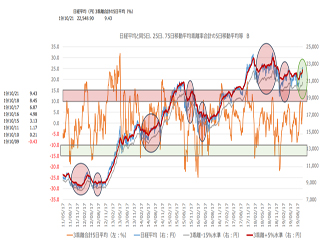
Continue the long strategy. Even so, the moves are extremely volatile. If you’re leveraged in futures, you cannot withstand this decline. It’s a reminder of the importance of proper risk management. Yet this is the market and you must accept it. To achieve results, you must consider how to capitalize on such downturns. Yesterday I noted that, considering the possibility of U.S. declines, a drop to around 21,500 yen could not be ruled out; that indeed seems to be playing out. If it finds a bottom here, there could still be a rebound. However, the lower bound of the February bear scenario is around 21,900 yen. That level must be reclaimed at a minimum. On the other hand, the 25-day moving average’s 7.5% downside deviation sits at around 21,750 yen. A 10% downside deviation is 21,150 yen, and a 12.5% downside deviation is 20,500 yen. In that sense, a 10% deviation has already been hit, confirming a substantial adjustment.
The Chicago market has recovered to around 22,000 yen. Whether this is a relief is unclear. Ultimately, the focus remains on U.S. stocks, not Japan. If you’re concerned about moves, closely monitor U.S. stock futures during the day. But doing so would hinder performance. You should scale back to a level where you are hardly bothered. That said, with moves like these, you won’t be completely unconcerned.
In any case, yesterday’s decline left the Nikkei’s P/E ratio in an undervalued range from a corporate-earnings perspective. This indeed presents a buying opportunity.Buying below 22,000 yen is clearly too cheap given current earnings. As I’ve repeated, now is the time to use cash to buy dips. Plan to gradually accumulate in 250-yen steps, aiming to buy around 21,500, 21,250, 21,000, 20,750, and 20,500 yen at the lows. Yesterday’s decline likely allowed buying around the 21,500 and 21,250 levels. Buying on dips like this should yield substantial gains when the price eventually recovers. There’s no need to assume Lehman-like declines at this stage. Of course, the possibility isn’t zero, but the current situation is far different from then. If so, there’s no excuse, but you cannot base your strategy on that. Look at valuations and buy on dips if cheap.
The Nikkei has clearly surpassed 23,000 yen with its gains, completing the long-term retracement to half. This breaks the “22-year curse” of the long-term downtrend, and a genuine uptrend has begun. Now the earnings backing remains to be confirmed to see whether stock prices rise accordingly. In the long run, stay the course. In 2017, a historic bull market shift was observed. We have entered the “22-year rising trend.” From 1968 to 1989, the asset bubble spanned 22 years of rise; from 1990 to 2011, 22 years of decline. Now, since dipping in 2012 and rising, we entered the “22-year rising” period. Freed from the “22-year curse,” we are entering a true bull market.Will the next high occur in 2033? It will likely surpass the Tokyo 2020 Olympics and exceed the U.S. stock high targets for 2028–2029. In any case, it is certain that we have entered a remarkable market. In such a historic turning point, those who participate early have the edge.
【Nikkei 225: 2018 Expected Range】
Bull Case: 22,089–27,115 yen (end of 2018: 26,839) / Bear Case: 18,745–23,688 yen (end of 2018: 19,392)
【Nikkei 225: February Expected Range】
Bull Case: 22,367–23,929 yen / Bear Case: 21,930–23,586 yen
【TOPIX: 2018 Expected Range】
Bull Case: 1,779–2,168 (end of 2018: 2,150) / Bear Case: 1,523–1,883 (end of 2018: 1,578)
【TOPIX: February Expected Range】
Bull Case: 1,806–1,915 / Bear Case: 1,736–1,868
〔CURRENCY MARKET〕
The USD/JPY rose. With the previous day’s plunge in U.S. stocks, the yen—traditionally considered a safe asset—was sold, pushing the pair into the mid-109s. The selloff in U.S. stocks prompted selling across stock markets worldwide, but as U.S. stocks that had been whipsawed closed sharply higher, risk aversion eased, contributing to dollar buying. However, the lingering aftereffects of the prior day’s plunge remain heavy, and investors’ risk appetite has not fully recovered, so the dollar did not strengthen much against the euro. Nonetheless, the rebound of the Dow from a near 1,600-point drop provided some relief and helped curb the dollar’s decline. Market focus remains on equities, and until prices stabilize, it will be difficult to discern a clear direction in the forex market.
【Currency Trading Strategy】
… Continued in the main article
◆ About Global Macro Strategy
The investment strategy introduced in this newsletter falls under the “global macro strategy” category in the hedge fund industry.
This strategy is the most familiar approach among global hedge funds, the so-called “cornerstone” of hedge fund management.
In this strategy, you keep an eye on all markets, seeking investment opportunities while aiming to generate profits.
Regardless of whether market prices rise or fall, you bet on price movements when they are expected.
The higher the volatility, the greater the potential profits, so we aggressively pursue opportunities as they arise.
In this uncertain global environment, price movements in major markets such as foreign exchange, equities, interest rates, and commodities are becoming even more volatile.
As a result, forecasting for each market has become extremely difficult.
In such market conditions, a global macro strategy that operates across a broader range of markets from a macro perspective is advantageous.
Of course, we also plan to provide concrete trading timings to ensure that we can compete effectively in individual markets.
Let us compete in the market together with the global macro strategy, the quintessential hedge fund approach.
======================================
『Tetsu Emori’s Real Trading Strategy』
is available for free!
Account opening campaign is here
USD/JPY spread 0.2-pip campaign underway: Monex FX × account opening; includes a 1-month newsletter/tie-up campaign (featuring Tetsu Emori)