
The Bank of Japan's Background for Leaving Consumer Price Inflation Unaddressed
0
・
・
・Compared with other major advanced countries, price increases are still subdued.
・Current inflation is not accompanied by a virtuous cycle of rising wages and demand.
・The causes of inflation are the spread of the novel coronavirus and Russia's invasion of Ukraine. Government inflation measures require understanding.
BOJ, at this opportunity, is likely aiming for: inflation ⇒ rising public demand for higher wages ⇒ higher wages ⇒ further inflation. Probably considers this its last chance to spur inflation.
The 2013 ultra-loose monetary policy failed. It aimed to escape deflation, but simultaneously raised consumption tax, which weighed on the economy. It will not repeat that. Even though prices are rising, it shouldn’t act to suppress prices now. Public dissatisfaction is rising, but that itself could power wage increases.
Moreover, Japan is unlikely to reach an uncontrollable state unlike the United States and others.
Already, international commodity prices such as crude oil have stopped rising. If wage increases are not excessive, a balanced state (2% price growth) will likely emerge.
Now wages are not rising, so even small price increases are hard for citizens to tolerate, but if wages rise, about 2% price increases would be desirable. If prices rise, consumption tax will also go up, which the Finance Ministry would welcome.
Really, prices aren’t rising; there is no other country like this
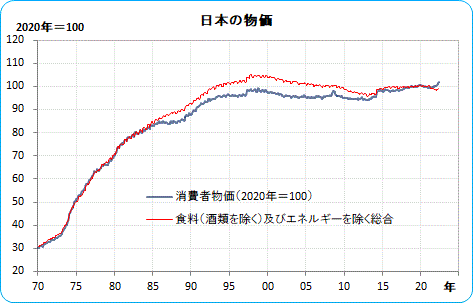
Different from the United States and Europe
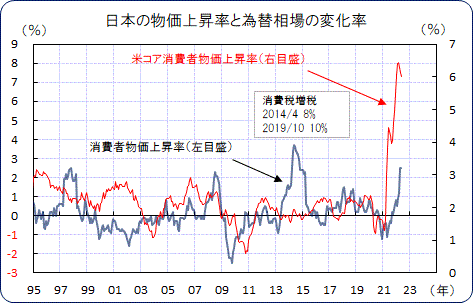
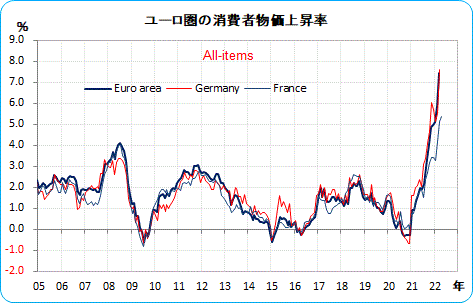
Two main factors driving Japan’s price rise are rising crude oil prices and a weaker yen
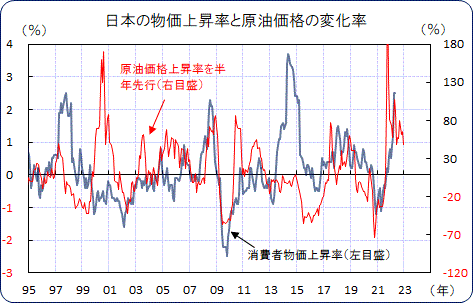
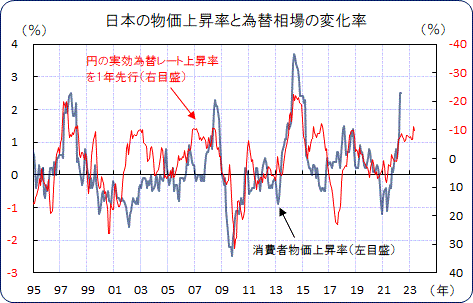
If you estimate inflation from these two (crude oil price and effective exchange rate),
oil prices lead inflation by about six months and the exchange rate by about one year, so you can project inflation about six months ahead.
Thus, current inflation is near its peak. Actual data are above estimated values due to (1) momentum, (2) transmission of overseas price increases., (3) inflation caused by supply-side issues that were long absent, likely.
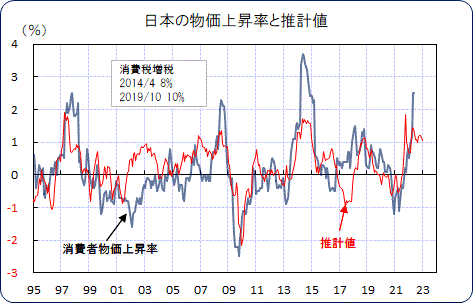
Japan’s current inflation is characterized by noticeable increases in essential living costs such as food, which makes households feel more stingy than the overall price index suggests. However, this will likely further raise the wage-raise sentiment, which the BOJ may privately welcome. Of course, if this lasts too long it would be problematic, but given slower global economic growth, it should ease sooner or later. There already appears to be a shift downward in international commodity prices.
The above is, perhaps, an overly cynical view. That is not how I personally think.
Leaving inflation unchecked to inflame public discontent to drive wage increases would be an inappropriate move.
That aside,
However,
Is a weaker yen good or bad?
For external industries, profits rise.
For domestic industries, costs rise, making things tougher.
For consumers who are the counterparty to domestic industries, it’s painful.
Whether the total is good or bad is another matter.
In the past, a weaker yen boosted exports and production, leading to economic growth and a stronger yen, making everyone happy.
Now, even with a weaker yen, exports do not rise. External industries gain currency profits only. The economic mechanism is broken.
Many people point this out, and if left alone, the economy will collapse.
BOJ’s passive policy is a tightrope walk.
But perhaps this is all that can be done.
I think Japan’s economy is pushed that far.
Wishing for success.
Two main factors driving Japan’s price rise are rising crude oil prices and a weaker yen
If you estimate inflation from these two (crude oil price and effective exchange rate),
oil prices lead inflation by about six months and the exchange rate by about one year, so you can project inflation about six months ahead.
Thus, current inflation is near its peak. Actual data are above estimated values due to (1) momentum, (2) transmission of overseas price increases., (3) inflation caused by supply-side issues that were long absent, likely.
Japan’s current inflation is characterized by noticeable increases in essential living costs such as food, which makes households feel more stingy than the overall price index suggests. However, this will likely further raise the wage-raise sentiment, which the BOJ may privately welcome. Of course, if this lasts too long it would be problematic, but given slower global economic growth, it should ease sooner or later. There already appears to be a shift downward in international commodity prices.
The above is, perhaps, an overly cynical view. That is not how I personally think.
Leaving inflation unchecked to inflame public discontent to drive wage increases would be an inappropriate move.
That aside,
However,
Is a weaker yen good or bad?
For external industries, profits rise.
For domestic industries, costs rise, making things tougher.
For consumers who are the counterparty to domestic industries, it’s painful.
Whether the total is good or bad is another matter.
In the past, a weaker yen boosted exports and production, leading to economic growth and a stronger yen, making everyone happy.
Now, even with a weaker yen, exports do not rise. External industries gain currency profits only. The economic mechanism is broken.
Many people point this out, and if left alone, the economy will collapse.
BOJ’s passive policy is a tightrope walk.
But perhaps this is all that can be done.
I think Japan’s economy is pushed that far.
Wishing for success.
× ![]()