

Sell-off driven by anxious psychology to clear positions
Main exchange Coincheck was hacked580billion yen worth of virtual currencyXEMbled out, and the market sentiment deteriorated again.1/16from the low, it briefly rose to the140thousand range, but selling pressure at the low resumed, and the upside remained heavy with prices not advancing easily.2/2once again updated the lows950,000yen, and now6figures are being consolidated.
■ Sentiment bad, selling at key points continues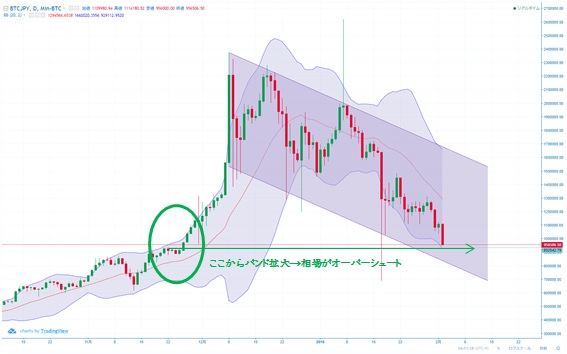
First, this decline is the first full-scale drop for many market participants, so market anxiety has not improved, and the strength and speed of the rebound are lacking. Until now, investors who traded with aggressive leverage and the like were bold when things were rising, but after experiencing a downtrend, they become bearish about a 50-50 bet and can no longer make the same bold trades as before. If we assume leverage ratios and investment in cryptocurrencies are decreasing, there is room to understand this level of decline.
Looking at the chart, volatility remains high and the downtrend channel is not overturned. In the high-price range, there is a heavy feel that weighs down, and many investors seem to be in the process of returning, so at least until the center line of the band is broken, a slow decline seems likely.
■ Main news
This week's market-moving news consisted of2 items.
・1/26Hacked cryptocurrency at CoincheckXEM
At the domestic major exchange Coincheck, where altcoins are actively traded, one of the major altcoinsXEMwas hacked. The damage amount was close to600billion yen,2014year’s Mt. Gox Bitcoin damage in yen was115billion yen, about5times greater, making it a cryptocurrency shock that will go down in history. At one point, ordinary clients gathered in front of Coincheck’s headquarters shouting, and the employees could hardly go outside, but the company held a press conference that day to explain the situation, and within just11day announced countermeasures, restoring market confidence and erasing the drop immediately.
However, after this, Coincheck began accepting further deposits while stopping yen withdrawals, and when a former employee leaked that Coincheck was planning bankruptcy, the situation turned tense again. This changed the outlook, with expectations of renewed selling pressure, and the price failed to reach its target of130万円, then reversed again, and this time the suspicion around a stablecoin called Tezos re-emerged, leading to another sharp decline.
・ Tezos suspicion
Reports involving Tezos have been ongoing since last year, but the latest downturn revived them. In such a market with deteriorating sentiment, a common pattern is to “find any reason to push the price down and force selling.” It is a reflection of human nature: “you don’t hear bad things about someone you like, but as soon as you dislike them, you hear their bad things.”
Now, with Tezos, the cryptocurrency USDT, tied to the US dollar, circulated in the market as an altcoin. The reason it is tied to the dollar while being a cryptocurrency is simply that it is the best place to park money.
For example, if you pause virtual currency investments and return to fiat currencies like dollars or yen, you need to withdraw from exchanges. Withdrawals incur fees and administrative processing time because you are exchanging virtual currency for fiat.
However, if exchanging between cryptocurrencies, such costs do not arise. Also, when BTC or others suddenly move and you want to resume investment, there is no time loss to fund. Therefore, there is no more convenient instrument for investors who do not want to take price fluctuation risk than altcoins that carry the property “priced in fiat but in cryptocurrency.” This is precisely the background under which Tezos was born.
By the way, if Tezos held the exact value of the dollar, then the number of Tezos purchased would require an equivalent amount of dollars by customers. Needless to say, if that were not the case, it would be the same as issuing paper currency without a central bank, which is just alchemy. In other words, a fraud.
The Tezos suspicion refers to market rumors that the Tezos issuer may not actually hold the dollars corresponding to Tezos issued, and this has recently resurfaced as material for markets.
To reiterate, this has been reported since last year, so it should not be treated as new material. The author believes that sensationalizing it now is a reflexive reaction to the market psychology that seeks to divert attention from Coincheck coverage and accelerate the downward trend.
■ Will this be the final stage of the decline?
When the market sells in response to rumors that do not settle, it is often a final squeeze to shake out those currently buying.
The decline does not stop and sentiment does not improve, but I expect a bottom to be reached soon. I have noted on the chart that the volatility was high last year and the market overheated to levels close to the current level, so positions bought in a panic at that time are likely being cleared. A number of players, especially overseas, say they would like to buy around8,000-9,000USD, so if a pullback buys there, selling players may flip and rapidly turn to buying.
In times like these, we should return to basics, butBTC remains attractive precisely because the blockchain technology is innovative, and altcoins and issues with individual exchanges that derived from this do not negate the fundamental appeal of BTC and blockchain. These reports are just material for balance-schemes and should be viewed in light of your own market sense to calmly execute investment decisions.
The energy for stop-loss selling at the point of reversal has accumulated sufficiently, so we should calmly place long positions. The author will buy at800,000yen and900,000yen respectively.
-------------------------------------------------------------------------------------------
【Author】
Nishiwo Kawada(Kawada Saiou)
Trading Department, Market Division, Traders Securities
Born in Geneva, Switzerland. Graduated from Keio University.
His experience traveling to many countries lends practical, grounded fan mentality analysis.
Applying behavioral economics learned in school to analyze traders’ psychological biases theoretically and apply them to trading.
Hobbies include shogi; amateur high dan level. The midgame maneuvers are also useful in reading the next move in the market.
“The masses are always wrong” is his creed.
【Disclaimer】
The cryptocurrency market information and other content provided on this site reflect the author’s personal opinions and do not guarantee the accuracy or safety of the content by the author, Traders Securities Co., Ltd., or our company. This information is intended as reference material and does not constitute recommendations for specific investment actions or management methods regarding cryptocurrencies. Please make investment decisions based on your own judgment. Any gains or losses from investments belong to the investor. The author, Traders Securities Co., Ltd., and our company do not bear responsibility for any damages incurred based on this information.