

Can you win with a “Jump-in”? ~Bayes' Theorem~
Last time we talked about the N waves.
There we introduced cases where a position would be cut if you “jump in.”
Of course, it’s just one example, so even with “jumping in,” if the trend is strong there are times when you can make money.
Therefore, from the experience of buying, you inevitably want to “jump in” so you don’t miss out?
Moreover, when news or social media hype arises, you want to jump in even more.
This isthe ‘Bandwagon Effect’.
It’s a term heard not only in psychology but also in economics, political science, and sociology. Have you heard of it?
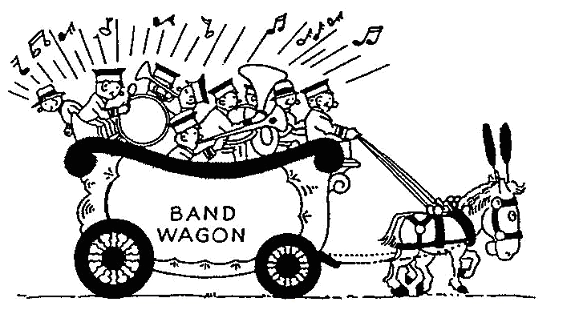
What is the ‘Bandwagon Effect’?
Bandwagon refers to the front of a parade or marching band in Western countries, namely the“bandwagon wagon”“bandwagon wagon”.
Now let’s look at that story.
The band leads a parade through the town, with a wagon playing lively music.
Then a jubilant crowd gathers.
“It’s a festival! It’s a festival!” “Let’s all enjoy it together!!”
Graduallyoneperson,anotherperson join in.
People gathered at the bandwagon think to those who haven’t joined yet,
“Why aren’t you joining? It’s so much fun, isn’t it??”
“If you don’t join soon, it’ll be over—come on, join!”
they call out.
Hearing that, the people feel“I’m the one being left behind?”.
Then what happens to the crowd’s psychology?
They feel they mustn’t miss out and jump in.
It’s the same as the market. This is the psychological basis of “jumping in.”
As participants increase, it becomes impossible to tell who is who.
It becomes chaotic.
Whether the timing was predicted from the start or they have already had enough fun,
those who were enjoying from the beginning suddenly aren’t there anymore.
They probably left because they were satisfied.
Though some gradually retreat, the crowd still jumps in, thinking they mustn’t miss out…
The tension reaches its peak?
The bandwagon is on an upward slope, but the festive crowd pushes it up one after another.
Even when it can’t advance any further, those in the back still push up, unaware.
The sharp-eyed ones likely notice. It’s the mechanism of the “overshoot”!
Then what happens?
The bandwagon can’t be climbed anymore and starts to roll backward in a reverse rush.
It tramples the crowd and slides down the hill.
When does the wagon stop? When it ceases to move on a mountain of corpses in the crowd.
This is said to be the Bandwagon Effect’s story.
※There are different opinions on thisw
Now, psychologically“Jumping in” might be understood now, right?
Then, actually when you jump in, what is the probability that it leads to a big market and profit?
I love mathematics, so I’ll try to compute it using formulas.
But note this is only a hypothesis, not a claim that this calculation is correct!♂️
Just my own view.
① Probability of a breakout happening:50%
(Whether it breaks through or reverses—assume a 50/50 chance.)
② Probability of a big market occurring:3%..%
(In a year (200 days), about 2 to 4 times a big market may occur, so set a bit larger—approximately 3%.)
③ Probability of breakout accompanying a big market:80%..%
(Most big markets are cases where price jumps out of a long energy range.)
*This is just a hypothetical discussion, but I don’t think the probabilities are that contradictory.
The above shown in formula is as follows.
① occurs with probability: P(①)=0.50
② occurs with probability: P(②)=0.03
③ occurs with probability:P(①│②)=0.80
Then, what is the probability that a breakout leads to a big market P(②│①)?
Using Bayes’ Theorem, a theorem of conditional probability, let’s compute.P
(②│①)=P(①│②)*P(②)/ P(①)
=0.80*0.03 / 0.50
=0.048(4.8%)
Now, change the numbers and recalculate.
① Probability of occurrence: P(①)=
② Probability of occurrence: P(②)=
③ Occurrence probability:0.80
P(②│①)=P(①│②)*P(②)/ P(①)
=0.80*0.05 / 0.50
=0.08(8.0%)
Change the numbers again and recalculate.
① Probability of occurrence: P(①)=
② Probability of occurrence: P(②)=
③ Occurrence probability:0.90
(Assuming the probability of breakout accompanying a big market is higher when a big market occurs)
P(②│①)=P(①│②)*P(②)/ P(①)
=0.90*0.03 / 0.50
=0.054(5.4%)In other words“Jumping in” and its connection to a big market may be less than
10%I think.
I think so.
※This is just a hypothetical discussion, so there may be objections.
Please think about it yourself as well.
With that in mind, should you jump in? Is it better not to?
I“Absolutely not”is my conclusion.
※This is just a hypothetical discussion, so there may be objections.
(Just to reiterate, haha.)
This is a personal rule, soI have followed it strictly for many years.
AndIf jumping in can lead to a good risk-reward and a positive balance,then jumping in is also a valid entry method.
Trading methods are not limited to one.
The method that fits your personality and lifestyle lasts longer and reduces stress, which often leads to better results.
In my case, my goal is to play golf on a golf course as much as possible when my child grows up, and I want to keep playing rounds!
In other words, I look at charts in the morning or at night, place orders (limit orders, stop orders), then leave the rest to earn money, aiming for a mid- to long-term trading style, which I continue today.
And mid- to long-term trading suits my relaxed personality and child-centered lifestyle very well?
With mid- to long-term trading, you may hear that you can’t make money, that its capital efficiency is poor, that funds don’t grow easily,
but that is not at all true?♂️
I’m earning a substantial enough profit to live on and I was able to buy a house.
Let’s establish your own trading without being influenced by biases of unknown sources ( ・ㅂ・)و ク゛ッ !
That wraps up for today.
Thank you for reading until the end. m(_ _"m)

※ I’m always grateful for your kind words, which gives me great joy.
Thank you very much indeed.
Below is the paid section, but please note there is no article there.
A few people wanted to show their thanks, so I’ve created this.
To those who purchased, thank you so much?