
German companies' May sentiment index at a low level
0
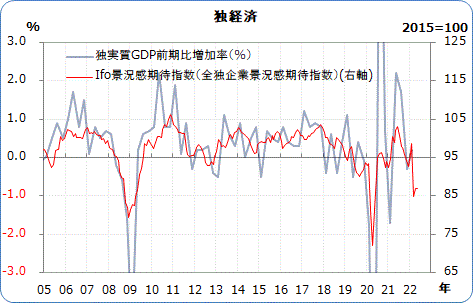
The May Germany Ifo economic expectations index released by the Ifo Institute stood at 86.9, up from the previous month’s 86.8. Ifo President Clemens Fuest said, “Despite inflation concerns, supply bottlenecks, and the war in Ukraine, the German economy has shown resilience,” and pointed out that, “for now there are no visible signs of a recession.”
That said, it remains difficult to say that the German economy has proven resilient, as it remains at a low level not seen since the Lehman Brothers collapse and the COVID-19 pandemic.
In the foreign exchange market, inflation is drawing more attention than the economy.
- ECB President Christine Lagarde said on the 23rd that there is a high likelihood that negative interest rates on bank deposits will be eliminated by the end of September. She also noted that if inflation stabilizes at 2%, further rate hikes could be possible.
- ECB Governing Council member Francois Villeroy de Galhau said on the 23rd that rate hikes at the ECB meetings in July and September are essentially decided.
He also stated that the euro area's economy is resilient and that the short-term main challenge is inflation; because inflation is rising, the ECB needs to normalize policy. He indicated that the ECB will normalize policy but will not tighten it further (slightly different from Lagarde).
As a result, German interest rates have risen and the euro has strengthened.
Pay attention to the euro/dollar exchange rate and the Germany-U.S. 5-year interest rate differential.
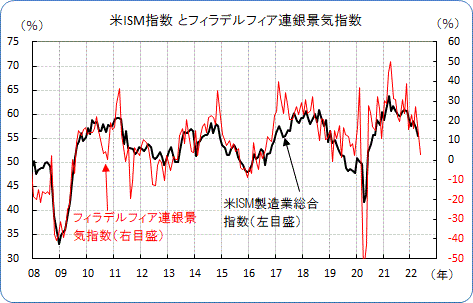
Meanwhile, in the United States,the Philadelphia Fed's May manufacturing index was 2.6, down much more than expected from 17.6 in April and the lowest since May 2000. The New York area Federal Reserve manufacturing index also fell into negative territory again, indicating manufacturing remains weak.
In the United States,manufacturing is heavily affected by the slowdown in activity abroad in places like China and Europe, and by supply chain disruptions. China’s economy is expected to grow only 2% this year, and as a result, labor market tightness may ease and demand may slow, reducing the need for the large-rate hikes initially anticipated, which has led to a pause in dollar buying.
× ![]()