
Good yen depreciation, bad yen depreciation?
Is a weaker yen good or bad for the Japanese economy?
Because there isn’t a suitable quantitative yardstick, there is no clear answer.
Would economists define a weaker yen as good if real GDP per capita increases, and bad if it decreases?
However, wouldn’t that be unsatisfactory to most people?
Whether a weaker yen is good or bad basically depends on whether you hold foreign currency.
Suppose there are Pension Fund A and Pension Fund B.
Pension Fund A holds 20% in foreign currency deposits.
Pension Fund B does not hold foreign currency deposits.
If the yen weakens, it is good for Pension Fund A. It does not affect Pension Fund B.
Suppose there is Person A and Person B. Here, let’s think in terms of real estate prices, not exchange rates.
Person A owns a house. Person B rents a house.
When real estate prices rise,
Person B finds it increasingly difficult to purchase a home and becomes unhappy.
Is Person A happy? They would feel glad to own a house. If they sold, they would profit. However, selling does not mean they can buy an even better house, because real estate prices are rising. They may be excited, but their living conditions won’t necessarily improve.
A weaker yen makes it unhappy for companies planning to expand overseas.
Two years ago, they could build a factory overseas for 50 billion yen; now it would cost 75 billion yen.
For companies that produce overseas and sell overseas (local production for local consumption), they are happy. If they remit profits earned overseas as dividends to Japan, the yen amount increases.
For companies that produce overseas, export to Japan, and sell products in Japan, they are unhappy. It’s unlikely that the product price can stay at a flat 100 dollars.
What about households?
They might think prices of imported goods rise, which is unhappy...
Even if annual expenditures rise by 100,000 yen due to a weaker yen, if you hold 1,000,000 yen in foreign currency deposits, you might gain 100,000 yen in exchange differences. Net to zero.
I think few households hold foreign currency deposits, but some hold foreign stocks or foreign currency investment trusts. Additionally, even if you don’t own them directly, public pensions and life insurance can hold foreign-currency bonds.
In the end, what is the overall effect of a weaker yen on the Japanese economy?
As above, it’s a riddle-like discussion.
Japan is a net creditor nation with current account surpluses, so, overall, a weaker yen is not bad.
However, Japan’s manufacturing sector benefits from a weaker yen through higher profits and higher dividends. Indirectly, through pensions, this reaches citizens, but not many can directly enjoy higher dividends. Wealth gaps widen.
Moreover, a weaker yen leads to a relative shrinkage in the nominal scale of economies compared with other countries.
Ultimately, a weaker yen is not bad overall, but it isn’t good either.
Moreover, if the yen continues to weaken, the opposite occurs when it strengthens.
Holding foreign currencies can cause a decrease in asset value.
On a separate note, I would prefer prices to be stable; in other words, zero inflation would be ideal, but
for moderate economic growth, 2% inflation is considered good.
Similarly, a gradual appreciation of the yen is preferable.
Economists generally believe that the exchange rate should move in tandem with price movements.
If inflation is lower than in other countries, a gradual appreciation of the yen is favorable.
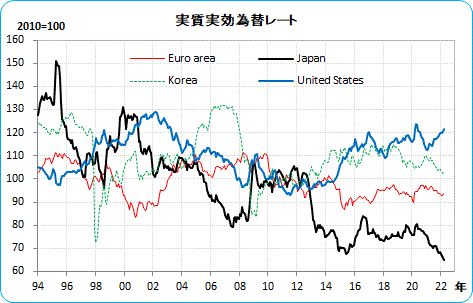
Quantitatively, it is desirable for the real effective exchange rate to remain stable.
In that sense, I think the current yen depreciation is bad.
That said, pursuing monetary policy to deliberately cause yen appreciation would be misguided.
Japan’s structure tends toward yen depreciation (offshoring production).
You cannot change the structure through a single period of exchange-rate control.
This discussion would be lengthy, so it is omitted below.
The euro area is ideal regarding exchange rates.
The dollar is strong partly because the United States is a key economy, but also because it is a resource-rich country.
Japan, lacking natural resources, must maintain a substantial trade surplus with countries other than resource-rich ones.
This is inconsistent with a stable relationship between prices and exchange rates.
× ![]()