
Will the airplane crash?
0
The safest vehicle is considered to be the airplane. In particular, large passenger aircraft are strict not only in design but also in their operating manuals.
An aircraft with four engines can still fly if three stop, but even a single malfunction in one engine makes them decide to land at the nearest airport just to be safe.
Even when autopilot is engaged in the sky, the pilot is not lounging in the cockpit; they are continually checking the aircraft’s status and thinking, “If a problem occurs at this very moment, how should we handle it, and where could we land if needed?”
Through meticulous safety management, it is almost certain that the destination will be reached; to put it dramatically, they are always imagining the possibility of “falling.”
Not only are various switches designed with operability in mind, but they are also installed on the premise that “humans make mistakes.”
Come to think of it, for example, at everyday meetings, it is common sense to anticipate unforeseen circumstances by arriving early.
Planes can crash, cars can be involved in accidents (hence the insurance), announcers stumble over words, drunk people miss events... actually, all of these are ordinary realities.
Nevertheless, in trading,“a way to avoid losses”is sought after.
Even though you understand the logic, even a small miscalculation cannot be accepted by your emotions.
The image of “doing it well” stimulates human creativity, but if you become fixated on “hitting the mark,” blind spots tend to appear.
Narrowing your range can improve precision and you can expect quality improvements from experience. However, you should keep a broad view.
While believing in yourself to “make a profit,”“mistakes will happen”“it is essential to think about how to respond”and not discard that understanding.
Solving these complex issues by debating them solely in your head is the most important activity in the market.
Stocks aren’t just about buying; there is also “short selling” to profit from declines, and the strategies can expand infinitely depending on how you take positions.
However, let’s consider it in terms of a simple “how to buy.”
For someone with zero experience, you’d ask, “Which stock should I buy?”
Of course, even in serious trading, stock selection matters; beginners see it as a mere guessing game, asking “which one?” However, because they lack the knowledge and experience to develop their thinking, they rely on others’ information.
But once the concept of a “method” arises,“where to buy”will come to mind. In other words,“what situations to act in” “what criteria to start buying from”becomes the approach.
Pursuing these ideas gradually broadens your perspective.
Questions like “where is it appropriate to deliberately take a break?” arise, and even in selective investing, ideas such as “adjust the operating rate of capital across the whole portfolio” emerge.
Web (Online) Seminar
FAI Investment Method Master Program
~For adults to manage assets, taught by professionals~
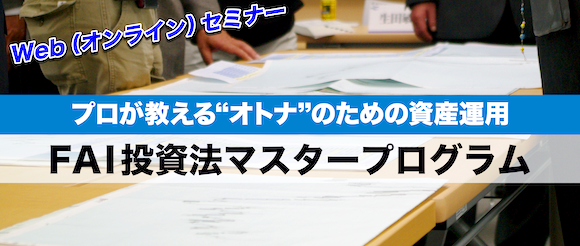
※Limited to small groups; attendance at the seminar venue is possible.
If you wish to attend in person, please apply early.
× ![]()