

From regulatory concerns, will it move toward a long-term downtrend?
Concerns about stronger global regulation deteriorated investor sentiment, and the stagnant market finally collapsed as it could no longer sustain.
BTC briefly fell below1,000,000 yen, erasing nearly half of the gains from the previous year, marking a sharp drop.
■ Investor sift
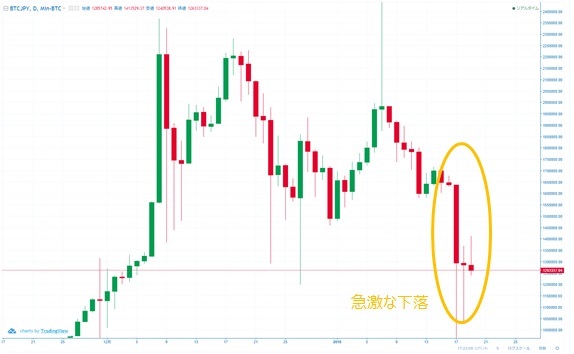
When looking back at the rapid rise in the market, investors took on excessive leverage and bought at high prices without solid price backing.
However, when Treasury Secretary Timothy Geithner announced on12th that regulation of cryptocurrencies would be pursued at the G20,16, Reuters reported that the deputy governor of the People's Bank of China indicated continued tightening of cryptocurrency trading, gradually worsening market sentiment. As it fell below the lower-bound level of1,500,000 yen, the decline accelerated, and when stop-losses from leveraged trades were swept in, it dropped to below1,000,000 yen, producing a domino-like collapse.
Under these circumstances, many investors are expected to have suffered principal losses in this drop. While the full picture remains unclear, this event reminded us of the immaturity and incompleteness of cryptocurrency systems. Taking this as a good opportunity, exchanges’ self-regulation on leverage and a stronger investor-protection stance are likely to advance further.
■BTC dominance decline
From the chart, the shock of this drop can be seen. Given that investors’ capital conditions have deteriorated significantly and there are no other catalysts besides the above regulations, a rebound is not expected soon.BTC tends to fall once and then trade sideways for a while before resuming an upward trend, so until the favorable momentum returns, it may stay cold for a while. In the near term, I expect a continued downward trend as markets defend around1,000,000 yen.
Regarding suggested support lines to watch,20-week moving average around1,100,000 yen, the extended reference line around1,000,000 yen, and around875,000 yen where last year’s market overshot began, are noted.
■ Rebound in dominance?
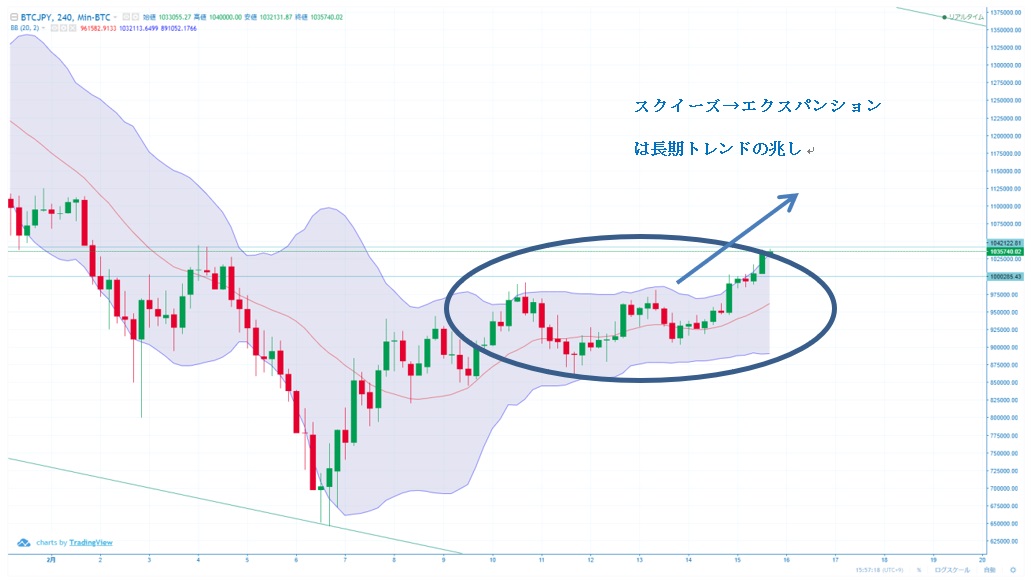
CurrentlyBTC dominance is decreasing, and with this drop the market shows a slight retracement tendency (as altcoins fell more). If concerns about trading venues (systemic risk) arise due to declines, BTC—whose regulatory and investor-protection considerations are prioritized—will likely have higher social adaptability, so funds may flow back from altcoins toBTC.
In a still underdeveloped cryptocurrency market as a means of payment, the remaining share of BTC is perplexing. Currently funds are flowing out of minor coins due to themes, but it's not too late for altcoins designed to fill BTC’s gaps to gain real prominence after BTC becomes established as a means of payment.
■Cryptocurrency at the G20 agenda
2018 yearG20 is increasingly rumored to include cryptocurrencies on the agenda. This is likely to be regulation-focused, potentially covering every aspect including trading, mining, and settlement.
However, regulation does not necessarily mean excluding investors. Tightening too much could undermine the inherent decentralization of BTC, increasing the risk of capital outflows and illegal trading. This is now an unavoidable pattern in modern economies, and the balance is a challenge for the leaders.
For example, restricting cryptocurrency trading to certain means and obligating exchanges to disclose information could make transactions outside the jurisdiction of developed countries mainstream, potentially turning crypto into a haven for money laundering. Numerous emerging economies actively pursuing cryptocurrency trading could complicate tax-haven-style regulatory evasion. Therefore, even if discussed at the G20, there may be less need to worry about over-tightening.
G20 discussion marks a mature stage for cryptocurrency; it may be reasonable to view this as a historic milestone, in the author’s view.
-------------------------------------------------------------------------------------------
【Author】
Nishiō Kawada(Kawada Saio)
Traders Securities Market Trading Division
Born in Geneva, Switzerland. Graduated from Keio University.
Having traveled to many countries, his fanmental analysis is grounded in real experience, giving it persuasiveness.
Utilizing behavioral economics learned in school, he analyzes participants’ psychological biases theoretically and applies them to trading.
Hobbies include shogi; a high amateur level player, his mid-game tactics also inform anticipating the market’s next move.
“The masses are always wrong” is his creed.
【Disclaimer】
The cryptocurrency market data and other content provided on this site reflect the author’s personal views and do not constitute guarantees of accuracy or safety by the author, Traders Securities Co., Ltd., or the company. The information is intended as a reference only and does not constitute investment recommendations for specific actions or strategies. Final investment decisions are the responsibility of the reader. All gains and losses from investments belong to the investors. The author, Traders Securities Co., Ltd., and the company shall not be liable for any damages arising from reliance on this information.
-------------------------------------------------------------------------------------------