
FRB monetary policy objective
0
The Federal Reserve raised its target range for the federal funds rate from 0.25–0.50% to 0.75–1.00% on May 4, 2022.
Quantitative tightening (QT), which will shrink the size of the Fed’s balance sheet, will begin in June.
The reasons for rate hikes and QT are: “the current situation shows the labor market is extremely tight and inflation is running too hot,” and “to curb inflation.”
The policy objective is “to curb inflation and slow the pace of wage growth without substantially raising unemployment.”
Progress toward the objective would be indicated by the peak and subsequent flattening of the core Personal Consumption Expenditures (PCE) price index, excluding food and energy.
The market movement in securities occurred at the press conference after the FOMC, when Chair Powell stated,
“Regarding a 0.75% rate hike, participants have not had an enthusiastic discussion.”
This was the market’s main focal point at this FOMC.
In response, hedge funds’ triggers were pulled.
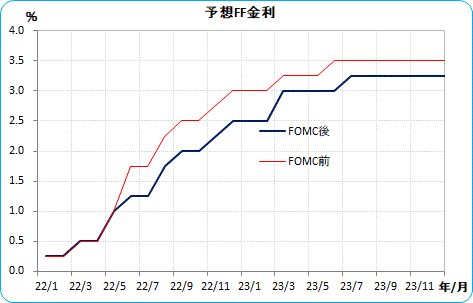
Moreover, the Fed, by its mandate, watches inflation and employment, but
inflation is the rate of increase in the core PCE price index (excluding food and energy),
and in terms of employment, now it is not the number of nonfarm payrolls, but
① the unemployment rate,
② the pace of wage growth,
③ the Job Openings and Labor Turnover Survey (JOLTS) Job Openings rate (ratio of job openings to unemployed individuals)
that are focused on.
②③ indicate an interest in a wage-price spiral in rising inflation.
Chair Powell said, “There are about 1.9 job openings per unemployed person in the labor market. Job openings demand is extremely high and rarely seen in modern times.”
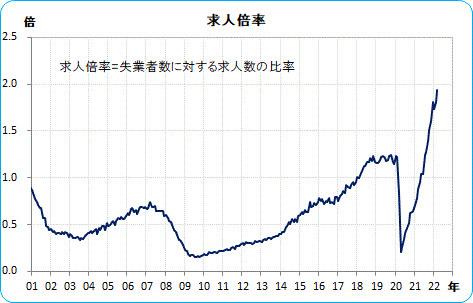
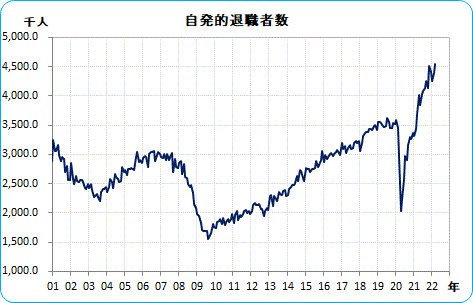
As the job openings ratio shows, there is confidence in switching jobs. Many people are voluntarily leaving. Even if nonfarm payroll growth slows, it may not mean that employment is deteriorating. For the time being, the focus is more on inflation indicators than on employment.
× ![]()