

The Basics of U.S. Stocks: Right now, a clash between strong profit growth and monetary tightening
The basic premise of US stocks (S&P 500) is 20 times earnings (EPS). Whether it will be higher or lower than that, in other words, where stock prices stand relative to EPS, is viewed by the price-to-earnings ratio (PER), which is stock price divided by EPS. If it exceeds 20 times, it is considered high; if it is below 20 times, it is considered low.
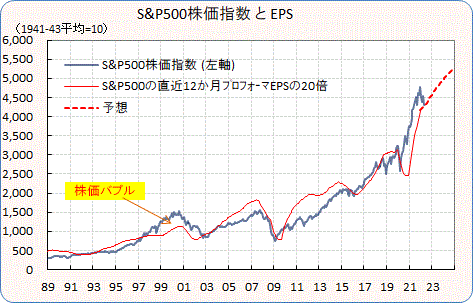
Looking ahead, (1) how will EPS (the red line) develop? (2) where will stock prices position themselves relative to that red line?
(1) The forecast in the above figure is generally the market’s current expectation for EPS multiplied by 20. If this is correct and moves in line with it, stock prices should remain firm.
Some strategists are more bullish than the red dashed line in the above figure. I believe that the impact of the rate hikes so far will start to show with a lag, and from autumn the red dashed line in the above figure will begin to wobble.
(2) PER is measured by (A) changes in the FF rate and (B) the growth rate of the money supply.
(A) Changes in PER and the FF rate
As of yesterday, the PER was 19.6 times, and is expected to decline further.
Note that two-year and ten-year interest rates lead the FF rate, so such rates should also be consulted. (Omitted here)

(B) Changes in PPER and the money supply (M2)
The year-over-year growth rate of the money supply (M2) was 8.61% as of April 4. At the next FOMC meeting (May 4), the Fed is expected to decide to shrink holdings of government bonds at a pace of up to $95 billion per month. Market money will be absorbed, and the growth rate of money will slow further.
Right now, even if rates rise, the growth rate of money is still high, so a rapid drop in PER is avoided, but if the growth rate of money also slows, PER will fall further.

This time I will leave it here, but I will write another article adding forecasts to the figure above. In that article I will also show the predicted stock price.
Last year in March, (on Diamond Online) I predicted that US stock prices would move toward a decline since autumn of last year, but in this year’s article I repeatedly forecast that US stock prices would experience a substantial decline starting in autumn (or by year-end) of this year.