
China's Zero-COVID measures have led to an adjustment in the yen depreciation
On the 25th (Mon), the Chinese stock market fell sharply. The Shanghai Composite dropped as much as 5.13%.
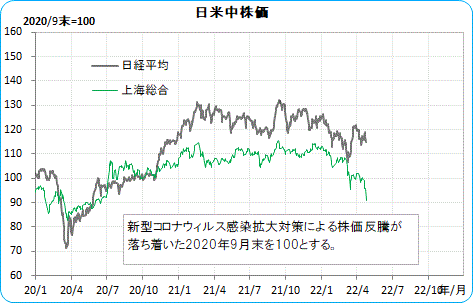
Lockdowns began in Beijing as well. An apartment building lockdown.
As the Chinese economy slows, oil demand is decreasing, and imports are starting to fall.
This is leading to a drop in crude oil prices.
Oil price declines ⇒ Improvement in Japan's trade balance ⇒ Correction of the yen depreciation = yen appreciation
Oil price declines ⇒ Easing in U.S. inflation ⇒ Narrowing of U.S. interest rate hikes ⇒ Correction of the yen depreciation = yen appreciation
That said, as long as the Ukraine/Russia situation exists, there is a supply-side problem for resources, so crude oil cannot stay cheap for long.
In the United States as well, with wage and price spirals rising, it will be difficult for inflation to subside merely from falling crude prices.
Nevertheless, if oil prices stop rising, the yen depreciation is likely to pause.
How far will the yen depreciation go?As shown, in the long run, the current USD/JPY level has already reached the limit of yen depreciation.
In the short term as well, if the May 4 FOMC raises rates by the expected 0.5%, long-term yields and the USD/JPY pair are unlikely to move much.
In the short term (since July 2021), the USD/JPY and the U.S.-Japan 10-year yield gap have shown a correlation as in the following graph. However, the correlation between exchange rates and interest rate differentials keeps changing. The correlation in the next graph should end soon.
Even so, U.S. 10-year yields are expected to rise to around 3.5% by the year after next, so the dollar is expected to stay firm.

Regarding USD/JPY, the oil price threshold is $60. Above $60, the yen tends to depreciate; below $60, the yen tends to appreciate.
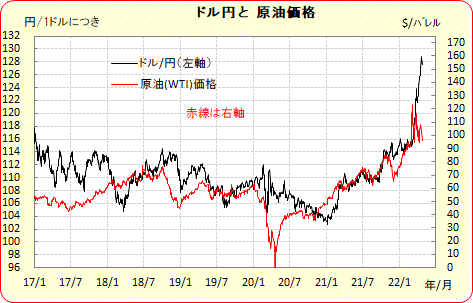
Conclusion: The yen depreciation will continue, but for now the current USD/JPY level is at the near-term limit for further yen depreciation.
As for whether the dollar will continue to strengthen, focus on the following three points.
(1) China’s economic situation (especially imports)
(Note) China’s import situation also has a significant impact on the Australian dollar. The AUD may also wobble somewhat in the near term.
(2) U.S. wage trends; more concerning than rising raw material prices and inflation is the wage-price spiral.
(3) U.S. housing prices; at present, it is not often discussed, but the housing price-to-disposable income ratio has become quite high. It should not be ignored.