
What is pushing up the dollar/yen is not primarily carry trades.
The explanation of carry trades is omitted.
Broadly speaking, one type is also aiming for FX swaps. With margin and leverage, buying dollars against the yen. Daily swaps come in. If you maintain the position (carry), the swap profits accumulate.
Buying dollars via a forward contract is another form of carry trade. With margin, now (@128.57), buying dollars a year ahead can be bought at 125.27. If the exchange rate does not change, you can sell those dollars at 128.57 after one year, earning a profit of 3.3 yen. FX swaps are overnight, but this has a longer period, so the profitability is higher.
There are various carry trades, but the main one is likely where hedge funds borrow yen by using dollar deposits as collateral and buy dollars, carrying that position. In practice, the prime broker (such as JPM, GS, Nomura, etc.) handles it. Details are omitted, but it's a total return swap approach, where you receive the earnings from the dollars you bought in exchange for paying interest on the borrowed yen. As with the Alekgoz incident, this data is completely unknown. We don't know how much carry trades are actually being conducted. Therefore, we have no idea how much carry trades influence the market.
However, there are clues. By looking at speculative positions in currency futures, we can infer how much they intend to bet on the market.
So, let's look at speculative traders' positions.

What is clear is that speculators (hedge funds, etc.) are not that heavily committed. This is evident from the next chart. The yen short position is not as elevated as the current market suggests.
However, there is virtually no yen long position. The current USD/JPY market is racing into a vacuum without yen buying from profit-taking (excluding such buying).
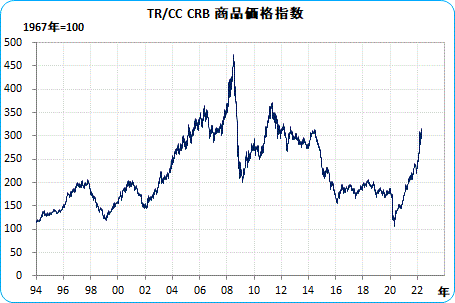
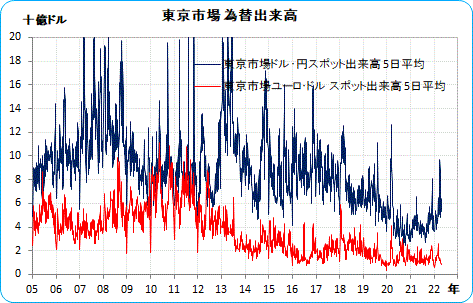
Speculators, importers (real demand), and pension funds and other investors are all moving in one direction, but this does not appear to be creating a very large demand for dollars. If prices of crude oil and other commodities stop rising, yen selling will eventually slow down as well.
From the Ukraine crisis, the supply side for resources is hard to read, but on the demand side, China's imports are tending to shrink, so perhaps sooner or later commodity prices will stop rising.