

“Self-interest” and “Market-friendly timing”
Something you often hear“Stop loss fixed at XX pips”
Is this really correct?
To write the conclusion firstIt’s a huge mistake!
Nowadays many people offer products, salons, and notes claiming to teach their methods and selling them.
However, when you look closely at stop losses“Stop loss fixed at XX pips”is what you’ll see described.
Now, my question.
“The market moves in various price swings. But why is the stop loss a fixed width?”
Can you provide a convincing explanation for this question?
Are you deciding something vaguely because you were told so, without being able to explain it?
This is‘self-centered’to decide Protective Stop.
Put bluntly, it is an act that ignores the market (the counterpart)‘selfish’in intention?
(※There are various ways to refer to loss-cut lines.
S/L・Stop Loss・Protective Stop・stop-out, etc…
I prefer to use “Protective Stop” that makes you feel you’ve protected your funds, but you can use whatever you like.)
Having a stop loss in place is something to be praised.
Trade without a stop loss is out of the question?
(※However, this does not apply if there is a clear intention. I hedge, so I do not use a stop loss.)
But without a clear intention, that stop loss will not function well?♂️
For example“Fix stop loss at 20 pips”we decide.
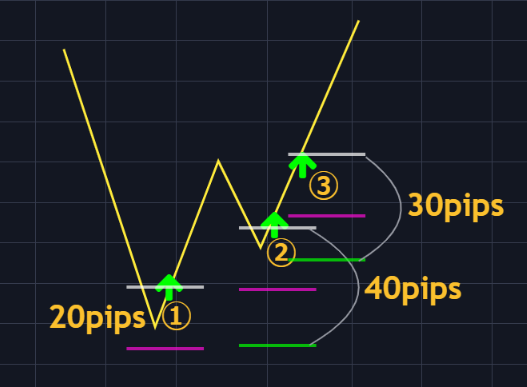
? Look at the schematic.

The white horizontal line is the Entry-point. The pink line is the Protective Stop. Its width is 20 pips.
① Entry as a reversal from a downtrend.
Protective Stop just below the recent low.
This works at 20 pips too, doesn’t it?
② Entry on a pullback.
This also has the Protective Stop just below the recent low.
But is this Protective Stop appropriate for a pullback trade?
If it breaks the recent low, you can place it tighter, and
wouldn’t the position in (①) be better for a pullback trade?
③ Entry on a breakout.
If you place a Protective Stop here, the location of the Protective Stop in (②) seems better?
“Stop loss fixed at 20 pips”When decided, only (①) works well.
(②・③) do not align their Entry meaning and Protective Stop?
They may align by chance, but then from the startyou should set Protective Stop according to the marketinstead of forcing it.
Yes.
“Set Protective Stop according to the market”is‘market convenience’that’s what it means.
For example, for the①-③ Entry earlier, if you trade all with 100k units, and the stop loss is 20 pips, the loss amount would be 20,000 yen.
If the Entry-point is the same,‘market convenience’how should you think about it?
Set the Protective Stop for ② at the position of ①’s Protective Stop (green horizontal line)
In that case, make the stop to 40 pips from the entry.
Set the Protective Stop for ③ at the position of ②’s Protective Stop (green horizontal line)
In that case, make the stop to 30 pips from the entry.
Then from ②.
Protective Stop to 40 pips.
The loss amount remains the same 20,000 yen.
In that case, you should adjust the Lot size.
(20,000 yen / 40 pips) × 100 = 50,000 units
ThereforeTrade with 50,000 unitstomake a Protective Stop trade that aligns with the market.
What about③?
Protective Stop to 30 pips.
Loss amount remains the same 20,000 yen.
(20,000 yen / 30 pips) × 100 ≈ 67,000 units
Trade with about 67k units—a protective stop aligned with the marketAny method of calculation is fine.
You can calculate thinking “1 pip equals 10,000 yen at 1 million units,” etc., or
you can use a fund management calculator.
What’s important is
“Calculate Lot size by backwards from where the Protective Stop should be placed!”
That’s the point.
Most amateurs who consistently incur losses
“Set the Lot, and if you can gain XX pips you’ll make XX yen!”
They only look at profits and ignore losses.
That’s why they look at floating losses and get scared? turn pale? and can’t cut?
The result is“being held in limbo”right?
The worst state?
You’re left praying to be saved (*˘人˘*)
Even if you are saved, that is“an incorrect successful experience”right?
Again, the worst?
As I wrote before,professionals manage losses.
Trends may go up or down. No one knows.
Profit potential is also unknown. Therefore, before trading you cannot calculate profit (though you set targets such as First-Target-Zone, Second-Target-Zone…).
Thenwhat can you determine yourself in the market?Is only
That isloss managementonly.
The market is absolutelyso if you’re selfish you’ll be disliked?
Then the market will smile and reward you with profits, that isprofit.
“Adapt to me, you hear?”
It’s important, so I’ll say it again.
The chart is fair. And it is absolute.
Those who say it’s a deception are‘selfish’in how they view the market.
There are no deceptions in the market.
‘Selfish’and‘self-centered’are how you end up feeling deceived by the market.
If you’ve read this article, from now onlook at charts according to the market’s own tendency.
I sincerely support the growth of everyone who is seriously trying ( ・ㅂ・)و ク゛ッ !
That is all for this time.
Thank you for reading to the end. m(_ _"m)

※ I’m always grateful for your kind words.
Thank you very much.
Below is the paid section, but please note there is no article in the paid portion?
A few people have asked to thank us, so I’ve prepared this.
To those who purchased, thank you truly.