Financial Instruments Business Operator Kanto Finance Bureau Director (Kinsho) No. 1960 / Membership Association Japan Investment Advisers Association Membership No. 012-02323Go to GogoJungle Home
We believed that gathering investors' wisdom regarding investment would surely make a useful site, so we started a site within our own social network where EAs and e-book e-commerce exist.
2008年のサブプライムショック直前に、多くのメディアで有名なアナリストと言われる人達が、証券化商品サブプライムは北米の資産のほんのごく一部であり北米経済に影響を及ぼすことはあり得ないと主張していましたが、直後に北米どころか世界のマーケットが急降下、日経平均は18,000円から7,000円台に急降下する様子を目の当たりにする中で、実戦で鍛えられ強かに活躍する投資家、個人投資家の中に本当の投資スキル、知識を持つ人が居ることを知りました。
There were many opinions that those who truly earn investment returns would not disclose such information, but people's values vary, and among them are investors who disclose their own trading and investment information.
『日本の投資家の英知をすべての人に』
We have set this as one of our corporate philosophies.
トレード結果をリアルタイムに表示する『みんなのトレード、みんなのMT4』
A service that displays EA(シストレ)のトレード結果をそのまま表示する『システムトレード』
みんなのトレード、みんなのMT4上位の方が出版する『電子書籍』
We will center these services on word-of-mouth and social networks and expand our offerings.
ご利用誠にありがとうございます!
お問い合わせは、よくあるご質問(FAQ)よりお願いいたします。
[With bonus video] What is the US stock index system trading investment strategy that increases assets rapidly and stably with leverage?
Series Episode 1
[With Bonus Video] What is the leveraged, rapid and stable asset-growth investment strategy for US stock index system trading?
Hello! This is Rei-ni from GogoJungle..
How are your trades going?
In a word「Investment, there are numerous financial products such as stocks, FX, CFDs, mutual funds, cryptocurrencies, real estate, and more, with some being relatively high-risk and others relatively stable with lower risk, so there are truly many options. It can be quite perplexing and difficult to determine what to invest in and how to allocate it.
Also, when engaging in high-leverage, high-risk investing, you tend to feel compelled to stay glued to the charts, which is a major source of concern.
In this video, we speak with Rei-ni, a renowned investor and system-trade (EA) developer who, for many years, has watched countless financial products as an engineer for a foreign-based financial information provider, and who holds solid theories on which financial products to invest in and how, achieving great success.Longtime experience, and more
The composition of Rei-ni's investment portfolio is
・Stable stocks and mutual funds, etc. 70%
・FX and other high-leverage, high-risk financial products 30%
That’s right.
She allocates most to stable financial instruments and aims to grow assets aggressively with 30%. That is the kind of investing she practices.
For both part-time and full-time investors, it is better to base 70% of assets in stable financial products that may temporarily decrease during financial crises, but will grow over the long term, and to allocate 30% toward aggressive growth.
On the other hand, for the 30% allocated to aggressive growth in high-leverage, high-risk financial products, investments involve FX, gold, and S&P 500 and NASDAQ (derivatives of major U.S. stocks).
When you hold positions, you naturally want to stay glued to the charts, which can cause issues for part-time traders who have to juggle a day job, and for full-time traders it can be hard to sustain long-term due to fatigue.
The problem of having to keep constant attention on the charts is a real challenge.
For both part-time and full-time investors,
this is a problem that all modern investors face.
That’s right.
Rei-ni is not the type to wait idly in front of charts, and while she sought a way to liberate herself from that, she faced significant hardship.
However, the breakthrough came from her engineering background, shifting her thinking toward automating with system trading (EA) and dedicating herself to system-trade development.
In developing system trading (EA), she faced considerable challenges in improving trading performance, but what helped boost the EA’s accuracy was historical data (past price movements) stored for every tick move—data used in EA development, provided by
Tick Data Suite (TDS)
which is an overseas system.
Not related to a famous theme park, though! (lol)
Using this TDS, she has achieved almost fully automated investments in fiat FX, S&P 500, and NASDAQ via MT4-based system trading.Moreover, to minimize risk, most of her allocations are toward S&P 500 and NASDAQ.
That’s right. Even with 30% of assets allocated to aggressive investments,
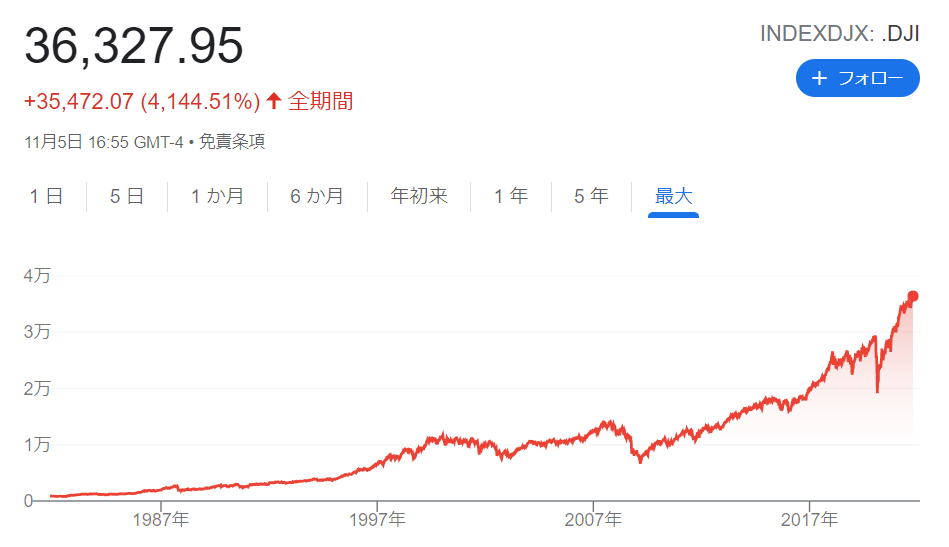
Much of it is directed towardS&P 500 and NASDAQ to ensure steady asset growth.So, why S&P 500 and NASDAQ??There is a saying that even Warren Buffett, arguably the greatest investor, would choose S&P 500 first when asked what to invest in by a relative.The following image shows the Dow Jones Industrial Average (a leading U.S. stock index similar to the S&P 500). Since its inception in 1896, it has briefly fallen during crises such as the Great Depression and the Lehman collapse, but it has recovered and continues to rise.
So, why S&P 500 and NASDAQ??
There is a saying that even Warren Buffett, arguably the greatest investor, would choose S&P 500 first when asked what to invest in by a relative.
The following image shows the Dow Jones Industrial Average (a leading U.S. stock index similar to the S&P 500). Since its inception in 1896, it has briefly fallen during crises such as the Great Depression and the Lehman collapse, but it has recovered and continues to rise.
(Source: GOOGIe stock price chart)
S&P 500 and NASDAQ include many of America’s top-performing companies by market cap, and are composed of companies that are eligible for inclusion with annual reconstitutions. There is no better investment target; if you don’t invest here, where would you invest? This is the quintessential king of financial investments.
Rei-ni
With the rising S&P 500 and NASDAQ, Rei-ni develops a very solid EA trading method and continues to profit
In this interview, both part-time and full-time investors can gain valuable insights from Rei-ni’s practical investment approach.
In particular, the bonus video attached to the second installment will not only introduce Rei-ni’s system-trade (EA) but will also explain detailed parameter settings tailored to the FX broker and to different capital levels.
A practical, real-world system-trade (EA) usage guide
that will help you understand
While the U.S. stock markets that form the S&P 500 and NASDAQ, and the global stock markets, may undergo corrections around late March 2022 or nearby,
the idea is to understand and start investing with the EA in S&P 500 and NASDAQ as soon as possible, to secure solid profits, and to resume activity after a market correction when prices resume rising—this approach is supported by the long-term trend of the Dow as shown above and is recommended.
In this video, first review the details, grasp the key points for achieving stable success with 30% aggressive investment whether part-time or full-time, and begin taking actions toward actual success.
What to expect from the interview
■ Rei-ni’s background and history
■ What is the investment-portfolio composition for assets growth, whether part-time or full-time?
■ What dramatically improved the accuracy of system-trade (EA)?
■ S&P 500 and NASDAQ as the gold standard in financial products
and more!
Episode 1
“[With Bonus Video] What is the leveraged, rapid and stable asset-growth US stock index system-trading investment strategy?”
Here
↓↓↓
“Rei-ni’s development, the system-trade (EA) used for investing in theS&P 500 and NASDAQ
investments
Here
Now that Rei-ni’s portfolio is understood,
the next installment will delve deeper into specific stable trading strategies!
By the way, Rei-ni’s interview will be the final one in the series.
If you want to build stable assets, this is a must-see!!