

Funds management ~Amateurs are quite risk-takers~
A frequent consultation
“I melted away XX% of my funds. What should I do?”
“There is an unrealized loss of XX% of funds. Please help.”
suchan already hopeless situationfor consultation?
These kinds of consultations are trulyreally...common
Especially during COVID, several tens of people came per day?
There were days when just replying to emails would take all day?
Some even asked, “Please cover the losses.”
If you traded according to my viewpoint and ended up in the red, then fine… but…
Before COVID, I warned that GBPUSD would crash,
and in reality I was short GBPUSD… (that was my inner voice, lol)
These people tend to
“If you hold on, it will come back up!”
and want that kind of encouragement, but… they are already in a losing state?
There are miraculous cases where one is saved, but actually it’s better not to be saved.
If miraculously saved, it leaves in your psychology a
‘wrong success experience’
in you.
Also, because the situation feels like you might die (complete capital loss),
the memory is burned into your brain as a very intense experience.
If you are saved from it, you are likely to think, “I’ll be saved again,” and
almost inevitably do the same thing again.
If you don’t get saved, you’ll be determined to
“make sure next time there will be no total loss!”
and then only can you take the first step toward becoming a professional.
Professionals trade in a way where they almost never incur large losses or go bankrupt.
(Well, that’s obvious, isn’t it? lol)
That leads to…
‘Wrong success experience’which makes that first step more distant.
An example of an introduction to trading experience, which is truly common as a preface…
“In a few months I made XX to XX million, but I melted it.”
The person writing it
“I have the ability to turn XX into XXX”they probably want to say,
to professionals,“You can’t manage funds, can you?”would be the takeaway. Moreover,
“Just trying to show off”
“Total amateur”
“Why are you exposing yourself as bad at this?”
That’s how they are viewed.
I also wrote about this on Twitter before…
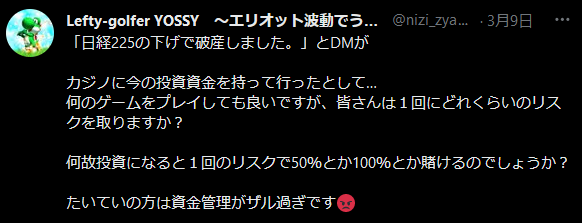
When you gamble at a casino, how much do you bet per round?
There are minimum bets, but let’s set that aside for now…
Suppose you have 1,000,000 yen.
Do you bet 500,000 yen per game? 1,000,000 yen?
Some reckless gamblers might do that,
but what about someone who isn’t a pro?
You’d win or lose, and perhaps think, “Shall I bet 10,000 yen?”
The reality is that non-professionals may bet 500,000 or 1,000,000 yen per trade.
Can you call that “investment”?
Rather, isn’t it more appropriate to call it a“gambler”?
And yet they come asking, “I’m about to go bankrupt. What should I do?”
Conversely, someone who bets 500,000 or 1,000,000 yen per trade and just happened to win
“In a few months I made XX to XXX million, but…”
The usual continuation is, however, that they melt it.
“In a few months I made XX to XX million, but…
rather than writing that,
“I increase by about 1% each year.”
I’d rather praise someone like that.
Now that you’ve heard this much, you may understand what I’m getting at: amateurs take more riskrisk-takingthan professionals.
When I was teaching in a salon before,so many people went bankruptthat I created and distributed a
“Fund Management Table”to help them manage.
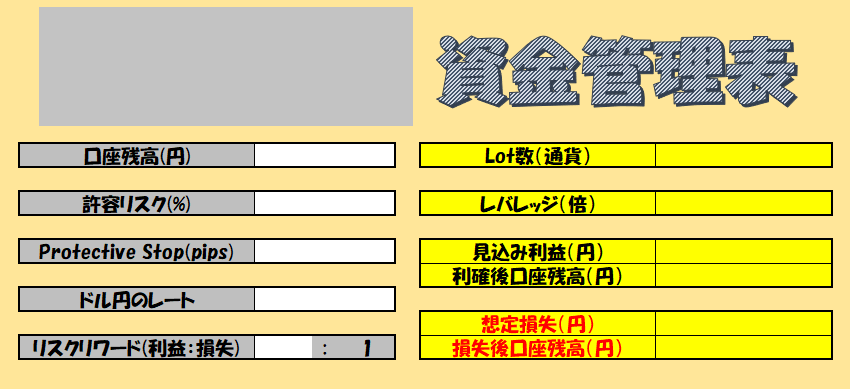
※The large gray box hides the salon name, that’s all LOL
・Account balance
・Risk tolerance (recommended up to 2%)
・Protective Stop width
・Risk-reward (this will be discussed later, so left out for now)
(※The USD/JPY rate is entered to convert to yen)
By entering this, you can visualize stop-loss amount and profit amount, and it simply shows the Lot size you should take, but what surprised me most were the opinions from everyone
“You can’t place a Lot that small?”
“With this, profits don’t come at all”
“Trading with such a Lot is dumb”
“It’s only 1/10th of the Lot I used to trade!”
In other words, they were placing 2% or more of their Lot per trade.
“1/10 of their previous Lot” means they were taking about 20% risk.
Now please look at the table below.
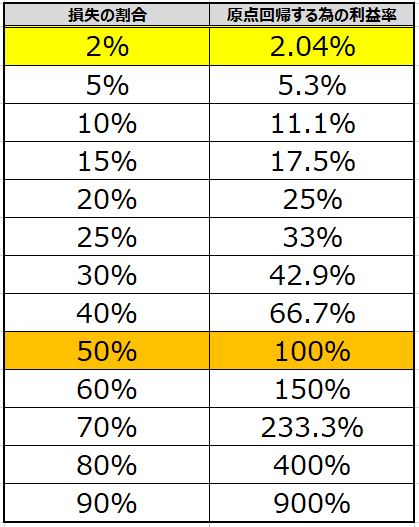
This is a table that shows, for what percentage of assets lost, what percentage of profit is needed to recover.
To illustrate with actual numbers for easier understanding, let’s discuss real amounts.
If you have a 1,000,000 yen investment and incur a 500,000 yen loss,
to recover, you would need to generate a 500,000 yen profit with the remaining 500,000 yen assets.
In other words, you would need 100% profit rate.
It becomes a higher hurdle than gaining 500,000 yen from a 1,000,000 yen capital, doesn’t it?
For those not earning regularly, the conditions are even tougher.
Do you think you can make it?
So what about my recommendation2% loss?
(※The 2% stop method“2% rule”)
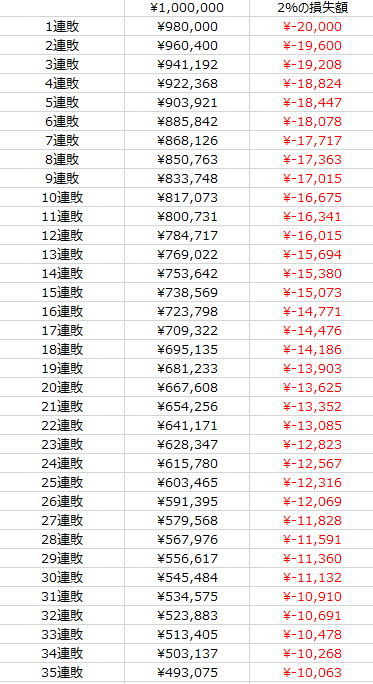
for example,even after 35 consecutive lossesyou would have only halved your principal.
By strictly adhering to the 2% rule up to this point, you can see thatbeing bankruptis far away from you, right?
There are other money-management methods besides the 2% rule, but for those who aren’t earning yet, why not try adopting the 2% rule?
In some US prop firms, monthly loss rates are set and strictly supervised by management.
Anyone who loses a certain percent in a month is prohibited from trading.
It’s said they are humiliated by studying and reflecting in a jail-like room.
Individual investors do not have anyone managing their assets for them.
First, implement solid money management (Money-Management).
Even after hearing this, there are many who still give the same preface as an example of trading history…
“In a few months I made XX to XXX million, but I melted it… (I melted it)”
What would you say in such a case? lol
Isn’t that embarrassing?
That’s all for now.
Thank you for reading until the end. m(_ _"m)

※I’m always grateful for the kind words you share.
Thank you very much.
The following is a paid section, but be aware that there is no article in the paid portion?
A few people have asked to contribute, so I’ve prepared this.