
This week's forecast
Market Observation from a Technical Perspective
The Nikkei Stock Average started with a small decline today and then widened its loss to 26,262 yen as of 9:17. After a round of selling, it reversed on a rebound to 26,644 yen by 10:18, rising nearly 400 yen from the low, but after the buying round ended, selling pressure pushed it back and the gain narrowed into negative territory, ending with the Nikkei at 26,526 yen (up 50) and the TOPIX at 1,886 (up 10). It finished with a slight gain, but the day showed no clear direction, with a struggle between bulls and bears throughout the session. It feels as though, for a while, daily fluctuations will hinge on Ukraine-Russia ceasefire negotiations, with investors watching every move and reacting. The Western-led Western bloc announced intensified financial and economic sanctions against Russia, creating concerns that President Putin could hint at using nuclear weapons, causing the situation to escalate more than anticipated. China has expressed economic support for Russia, and concerns about deteriorating U.S.-China relations are rising as well.
Following intensified financial and economic sanctions, Russia’s currency, the ruble, plunged, and the stock market also collapsed. Going forward, Russia’s economy will face a large blow. The Western bloc’s sanctions are viewed by Putin as an attack on Russia. Although the likelihood is low, there is no guarantee that Russia won’t consider a limited nuclear strike. In such a scenario, in today’s 24-hour U.S. session, U.S. stock futures briefly fell, then recovered some losses, but the outlook remains uncertain, and today’s Nikkei action shows a clash of bullish and bearish tones. Additionally, today the EU signaled its welcome for Ukraine joining the EU. This is a statement that could provoke Putin and possibly disrupt the Ukraine-Russia ceasefire talks. While a ceasefire is being pursued, it remains a tense standoff, and even a small miscalculation could escalate into broader war, especially since Russia is a nuclear power; merely beginning ceasefire negotiations is not a reason for optimism. It is plausible that Russia and the Western-aligned countries will reach an impasse, worsening the situation further. If ceasefire talks break down, there is a need to be vigilant about the risk of a deeper crisis.
In addition to Ukraine, this week also features the release of the U.S. February jobs report, which will have a major impact on Federal Reserve policy. On March 2–3, midweek, the testimony of Fed Chairman Jerome Powell is scheduled, and as investors seek to gauge the content, risk-off selling is likely to continue, affecting stock demand negatively. The Nikkei 225’s 25-day moving average sits around 27,000 yen, leaving about 500 yen of rebound potential, but technically the chart favors selling on rallies. For now, the market is susceptible to swings depending on new developments, and while buying on dips toward the lows is reasonable with a forward-looking approach, buying during rising price phases is discouraged; buying should be considered only when prices have fallen sharply.
Market Observation from Shibata Kaisen
This week, last Thursday the 24th, Russia invaded Ukraine. The Dow Jones fell to 32,272 (down 859) before sharply rebounding to finish up 92 points at 34,058, signaling a strong continuation through the week. The Nikkei, following last week’s decline of 505 yen to 26,476, may begin near the 27,000 level.
However, as this is a rebound largely driven by short-covering, the Ukraine invasion remains uncertain, and the market is gradually returning to a level where it tests the upside.
Amid these conditions, this week marks the start of March trading, with inflation fears and the Federal Reserve’s actions again in focus.
The FOMC is scheduled for the 15–16th. Previously, many believed higher crude prices would spur inflation, and a 5% rate hike was priced in. In the U.S., COVID-19 cases are falling and supply-chain disruptions are easing, so the impact on interest rates remains unclear.
In March, Powell’s congressional testimony will occur, and on the 4th the February jobs data will be released, likely keeping inflation in the spotlight.
Domestically, de-escalation of COVID-19 measures is in focus, but even as infection rates decline, progress is slow. However, in line with Western trends, efforts to ease economic activity restrictions are moving forward.
The Nikkei is expected to trade range-bound around a rebound, though a gradual shift toward taking on risk is emerging. Until the Ukraine-Russia developments become clearer, maintaining a wait-and-see stance remains a prudent risk-management approach.
If the 27,000 yen level is breached higher, upside could be constrained and, depending on Ukraine’s situation, a sharp decline remains possible. U.S. equities have shown two consecutive days of recovery, but February and January declines from last year suggest a two-stage drop following a rebound, implying another potential drop after a substantial rebound. A sharp reversal could occur, though not immediately.
Indicator Analysis
Nikkei Average
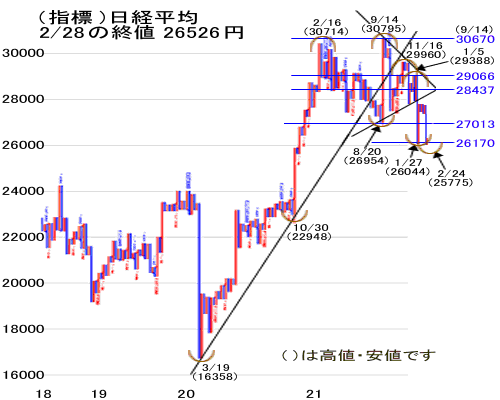
In last week’s forecast, the market was expected to trade with the continued concern over Russia’s invasion of Ukraine and the direction of U.S. stocks. If the Dow hadn’t stabilized, a range of 26,500–27,500 and a consolidation around 26,500 were anticipated.
However, as the risks of Russia’s invasion of Ukraine increased, February 22 (Tue) saw a fourth consecutive drop, breaking below 26,500. On February 23 (Wed), the market was closed; following Russia’s recognition of Donetsk and Luhansk as independent and the order to deploy troops, the Dow fell sharply to 32,272 (down 859). After a rebound, the Nikkei ended up 505 yen at 26,476 on the next trading day. By the weekend, the Dow dropped to 32,272 (down 859) and then rebounded to 33,223 (up 92), while the Nikkei rebounded strongly by 505 yen to 26,476 after the previous day’s event.
Last week, on February 24, the Dow fell below January 27’s 26,044 to 25,775. In the near term, this is a rebound from an excessive decline, but given the pattern after a triangular consolidation, the chart shape suggests a bearish signal. The week ahead is expected to range between 26,300 and 27,300.
NY Dow
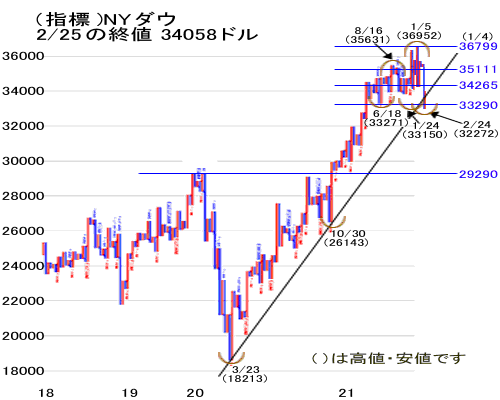
In last week’s forecast, a nervous market was anticipated due to Ukraine developments and the pace of Fed hikes; if the Olympics ended and Russia invaded Ukraine again, it would imply a further drop.
As predicted earlier, concerns about Ukraine resurfaced on February 16 (Wed). On the 17th (Thu), pro-Russian separatists attacked a nearby village, and the Dow fell by 622 points, the largest daily drop of the year, after which declines continued. On the 23rd (Wed), it had fallen for five consecutive days by 464 points to 33,131. Then on the 24th (Thu), Russia finally invaded Ukraine, dropping to 32,272 (down 859) intraday, before a sharp rebound to 33,223 (up 92). Over the weekend, the news that Russia may send a delegation to Minsk for ceasefire negotiations led to a strong rally, with the Dow up 834 points to 34,058.
This week, given Russia-Ukraine developments and Fed rate hikes, expect a cautious, range-bound market seeking direction.
With Powell’s semiannual congressional testimony, geopolitical risks and rising crude prices, and the first official Budget Address on March 1, attention will be on the market’s response.
Forex (Dollar/Yen)
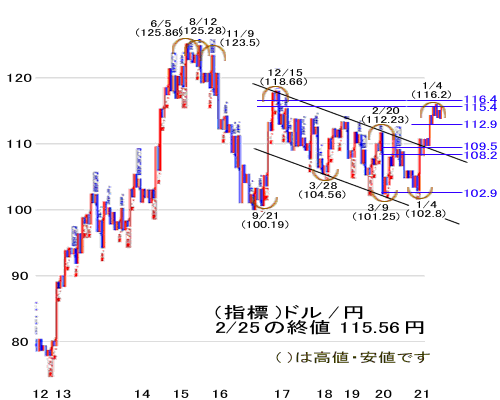
<Last Week’s Movement>
Until February 24 (Thu), when Russia effectively invaded Ukraine, the dollar strengthened as a safe haven, with the USD/JPY falling from the 114–115 range to 114. However, after the invasion, the dollar dropped to 114, then recovered to 115.76 by Friday, closing at 115.56.
<This Week’s Outlook>
This week, safe-haven buying of the dollar is unlikely to ease much, and the dollar is expected to hold firm. Although the end of Russia’s invasion is not in sight, President Putin indicated an intention to hold high-level talks with Ukraine. Discussions toward a ceasefire may progress, but immediate reduction in dollar buying is not expected.