

サインツールの精度=勝率を極限まで上げるための明確な裁量判断基準とは?
Good evening, everyone.
This is Ryumi Sora.
Well, another week has started today!
I also finished recording and editing the video commentary Volume 3 for “Aji-nicchi” over the weekend, and it was uploaded today.
Recording is a simple task, but editing takes time, so the video commentary is quite a struggle><。。
Last week there was a big price movement, and as I wrote in the previous Investment Navigator, the sign-to-high move on USD/JPY surpassed 300 pips—a remarkable feat.
However! Today, even amid that large price movement, I’d like to preface that the win rate of the signals is not 100%.
Why talk about the disadvantages of a signal tool that could be detrimental to sales?
Because before selling such a signal tool, I think it’s necessary to explain the strengths and weaknesses of this tool in advance.
In all the signal tools I’ve encountered, no author has told me the drawbacks from the outset.
So after purchase, questions like “Wait, it’s going to go counter-trend here!?” etc. started to multiply...
Huh? A entry signal here?
There were many doubts.
And since I had to judge the deception-avoidance logic myself, it took time and was cumbersome because the author wasn’t me, so I ended up not using the indicator again... repeating this cycle.
I think many of you have had similar experiences to some extent.
So now that I am the author, I decided, from the buyer’s perspective, to explain the disadvantages of indicators before purchase.
As in the previous article, there are good points as well, but there are times when the signals miss.
To improve signal accuracy, you must inevitably make discretionary judgments in line with the trading logic.
This video commentary touches on that.
1. The signal is notified to your smartphone
2. Open and observe charts of nine currency pairs
3. Determine the consistency between the signal-pair and related pairs
4. If the correlation and逆 correlation indicate a high probability, place the entry.
5. Leave the settlement to the EA and neglect it (or CC settlement)
I will explain in detail the above criteria for judging signals.
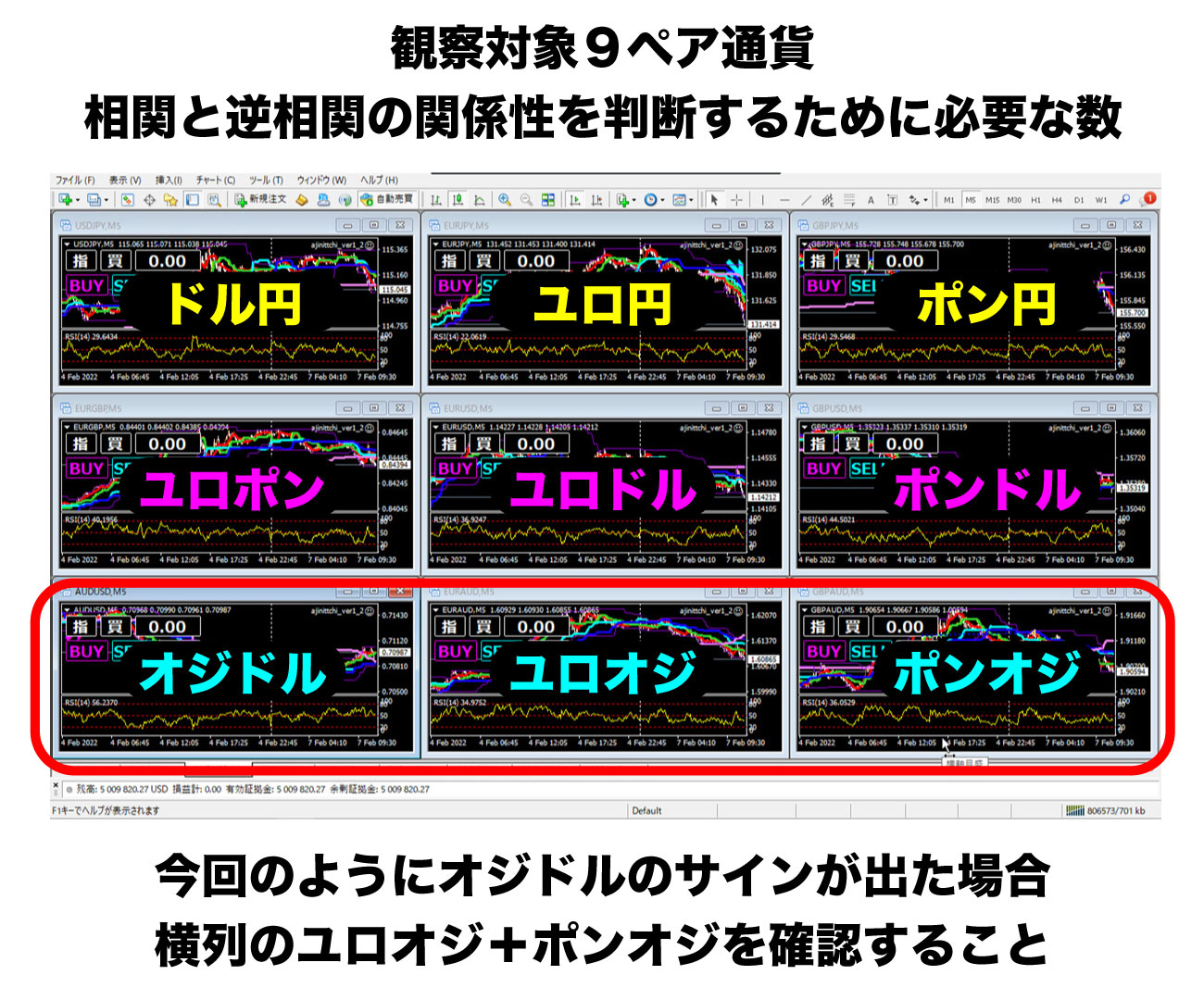
The AUDJPY signal was a short as shown below.
What is important here is the backing.
The signal isn’t 100% accurate, so I place nine currency pairs side by side as shown above for comparison.
There is meaning in every one of the nine meanings and in their arrangement, so you can instantly judge correlations and reverse correlations.
Now please look at the next figure.
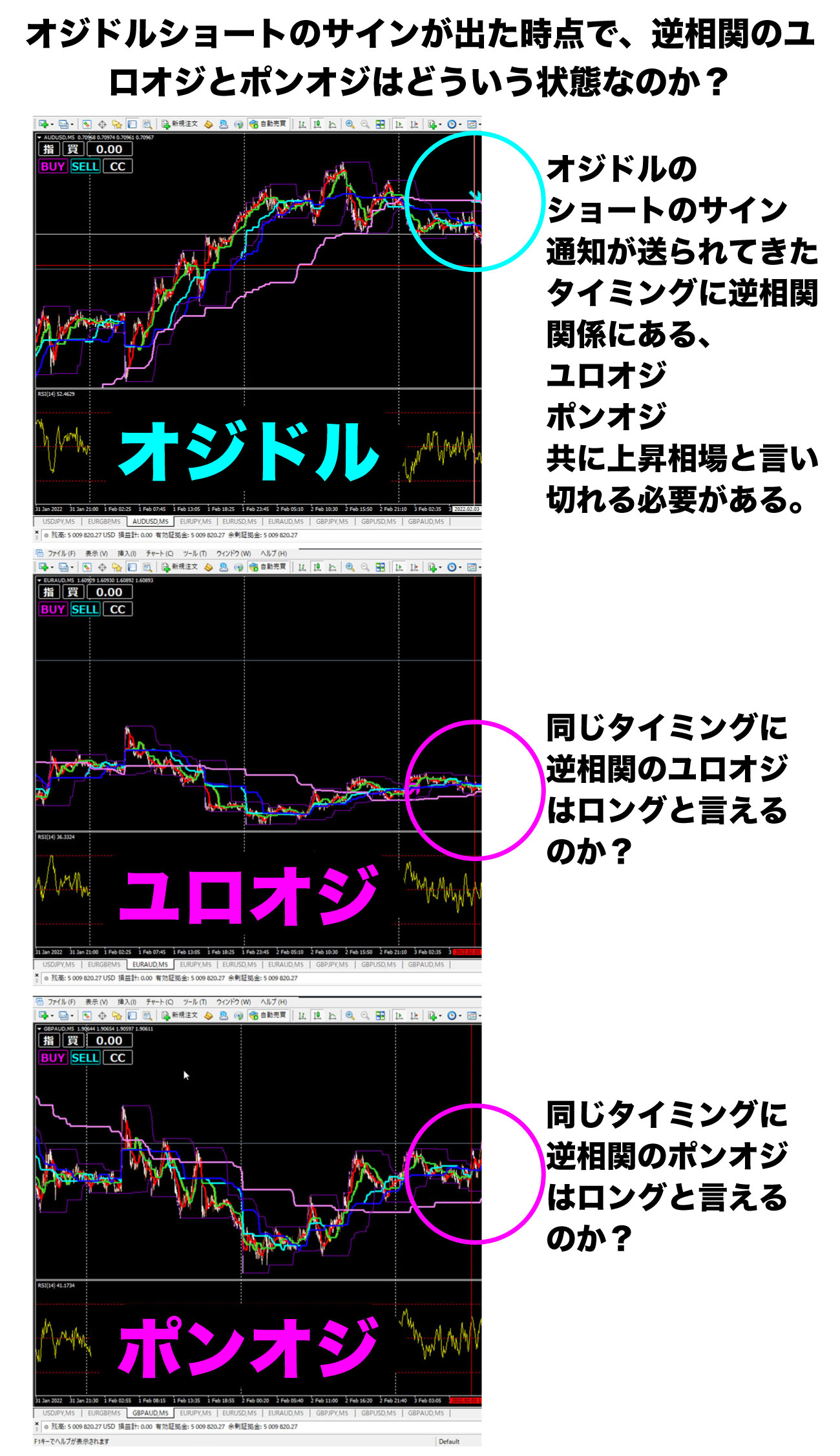
As shown above, the short signal for AUD/USD looks like the initial downtrend of a decline, but when comparing the reverse correlations EUR/JPY and GBP/JPY at the same time, if you only look at the AUD/USD short signal, you might want to enter, but when you see the two reverse-correlated pairs, can you say that both are in a reverse correlation trend?
In my view, it was a situation I should pass on.
The important thing is to refrain when you’re not convinced.
It’s important to develop a habit of entering only when you’re convinced or when you believe the probability is high.
In this case, to gain conviction, both reverse-correlated EUR/JPY and GBP/JPY would need to show a certain uptrend to some extent.
Also, in terms of probability, if either EUR/JPY or GBP/JPY shows a clear trend, you may judge the probability as high and enter.
In short, ideal is that both are in reverse-correlated trends, but at minimum one should be in a clean reverse-correlated trend, and entries should be based on that signal.
This time, the two reverse-correlated currency pairs are not showing a trend, so I think we should wait and observe for now.
Now, let’s test the next AUD/USD long signal.
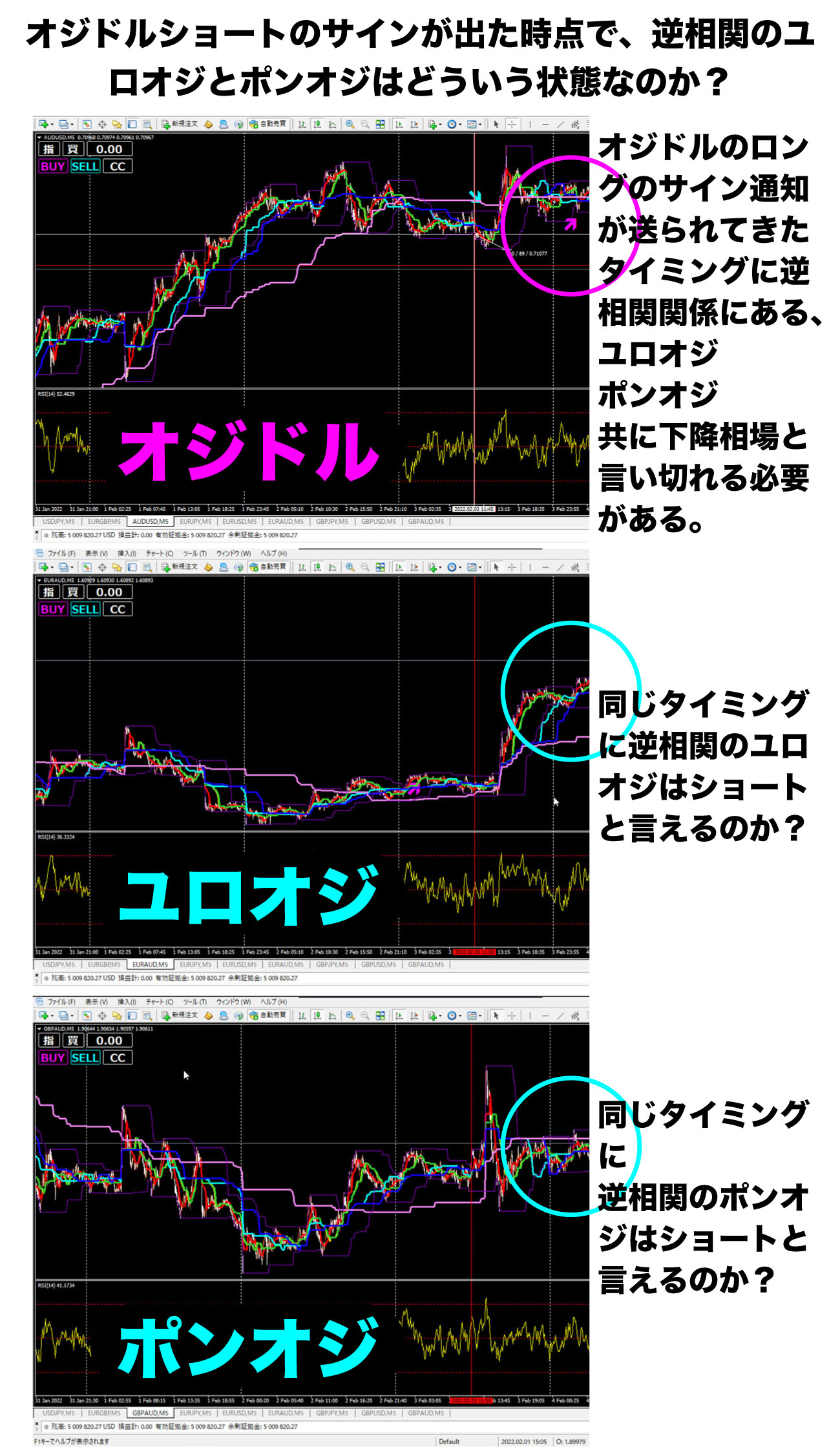
As shown above, when the AUD/USD long signal appeared, how about its reverse-correlated EUR/JPY and GBP/JPY?
EUR/JPY is a perfect long, so the AUD/USD long signal can be considered less reliable.
Looking at the three pairs above, if you have no conviction and low probability, you can avoid being tricked.
Thus, a signal is, at best, a tool that indicates the possibility of a trend.
For that trend to be true, it is important that the reverse-correlated pairs indicate the opposite direction.
By clarifying discretionary judgment criteria, I believe signal accuracy can be maximized and entries can lead to profits.
Now I’ll conclude today’s explanation of the “Aji-nicchi” Hybrid FX Trade System.
Aji-nicchi YouTube channel
Blog
↓ For the latest information on “Aji-nicchi,” click here!