
Japanese stocks, if they were to fall, how far will they drop?
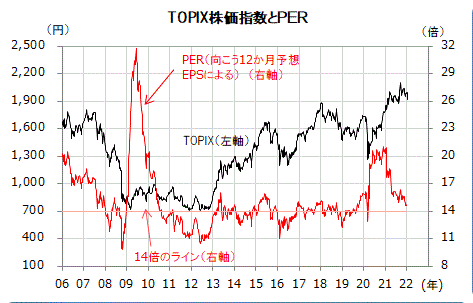
- Japanese stock prices have long been overvalued relative to earnings, but around 2008 that began to correct.
- Stock prices are a product of EPS and the P/E ratio. EPS represents earnings. The P/E ratio typically fluctuates with financial conditions, but in Japan it has been rigid and largely fixed around 14. In other words, the stock price equals EPS × 14.
The current situation is as follows.
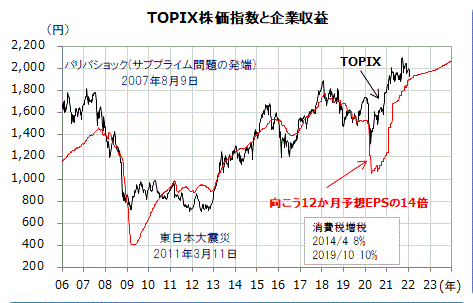
Currently, TOPIX is 1927.18, the EPS for the next twelve months is 136, and the P/E ratio is 14.17. It is almost fair value. If the forecasted EPS is correct, the P/E of 14 may overshoot slightly and dip below, but the downside may not be substantial.
So, is the EPS forecast correct?
The EPS forecast is estimated based on data from Nihon Keizai Shimbun. The data from Nihon Keizai Shimbun is essentially company-reported data.
When estimating, considerations include the year-on-year forecast for the exchange rate (effective exchange rate), the US ISM index forecast, base metal price forecast, and Japan’s GDP forecast. Of these, the most important are the year-on-year forecast for the exchange rate (effective exchange rate) and the US ISM index forecast.
For now, we are estimating based on a weaker yen and stable ISM, but if the US economy adjusts, obviously Japan's corporate earnings forecasts will also change. Fiscal year 2022 may see a profit decline.
If so, stock price forecasts will also change. The downside target will be revised downward. In forecasting Japanese stock prices, corporate earnings, and indisputably global economic trends, are important.
Reference
The above approached stock prices using forecast EPS, but a macro-based approach is also used.
With this, the downside target would be markedly different.