
The most important interest rate (United States)
I feel I wrote about this before, but anyway,
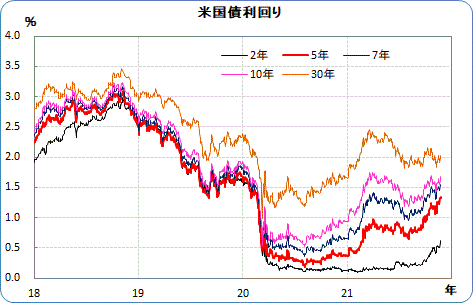
What is drawing the most attention in the United States right now is the five-year yield.
Two years is too short. It reflects too much of the Fed’s monetary policy. Despite inflationary pressures rising like this, the Fed shows no intention to raise rates.
Ten years is too long. The market expects a recession after this economic recovery. In ten years, when the policy rate once rose, it will have fallen again.
The five-year yield most clearly reflects current inflation concerns.
For the exchange rate too,nowthe five-year yield is the most important.
Next is the correlation between the dollar/yen rate and the U.S. five-year Treasury yield; you can see similar correlations with the euro and the Australian dollar as well.
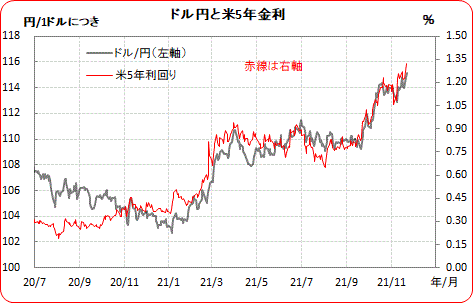
If that is the case, once the five-year yield rises above the pre-COVID level of around 1.6%, the price-earnings ratio of stocks would be revised (i.e., fall), and stock prices would be adjusted, wouldn’t they?
Also, even then, the dollar/yen rate would not necessarily exceed 120 yen just because of the U.S. five-year Treasury yield linkage.
Furthermore, the dollar/yen rate is also greatly influenced by crude oil prices. It’s hard to judge how to interpret the recent drop in crude oil prices. Will it be a temporary move due to coordinated releases from stockpiles?
Well, let’s reconsider these things later.
For now, the most watched rate is the U.S. five-year Treasury yield.
And we should also reconsider whether the U.S. five-year Treasury yield will continue to rise.
As I write this, the Nikkei Average is down nearly 500 points, but that should be within the normal daily range. The TOPIX hasn’t fallen below 2000.
Reference: U.S. government bond yields can be viewed on the following sites.
U.S. Treasuries & Yields - Bloomberg
Bonds | ReutersThe updates seem to be somewhat slow
Rates & Bonds Market Headlines | ReutersThe updates seem to be somewhat slow
Latest bond rates, interest rates, LIBOR and interbank rates - FT.com
The updates seem to be somewhat slow