
Japanese stocks holding up in an abnormally weak economy
Why are Japanese stocks holding up even as the Japanese economy, compared with foreign countries such as the United States, shows unusually weak resilience?The stock price resilience is exceptionally weakIn such a situation, why are stock prices staying afloat?
Stock prices are determined by earnings (EPS) and PER. Normally, when the economy is sluggish, corporate earnings are also sluggish, but Japanese companies do not follow that pattern.
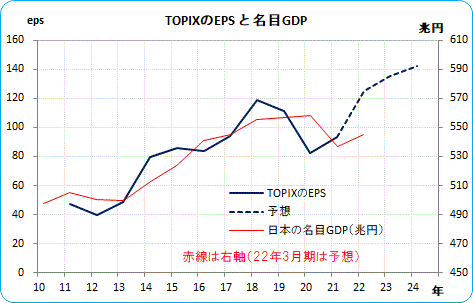
Earnings are strong.
The reason is simple. The overseas subsidiaries of companies that have expanded overseas are performing well, and the consolidated results are favorable. The representative example is Toyota. Now, Japanese corporate performance is determined by the global economy.
If so, would the performance be similar to that of U.S. stocks?
Unfortunately, not. U.S. corporate performance is led by technology companies. Those technology companies, whether Google or Microsoft, have large market capitalizations. In other words, price-weighted or market-cap-weighted indices are highly influenced by such companies, making them perform even better than Japanese corporate earnings.
Because of sector composition, U.S. and Japanese PERs tend to be higher in the United States.
Moreover, even though we talk about a global economy, Japanese companies are more affected by the Chinese economy than U.S. companies. For Japanese stocks, correlation with Chinese stocks becomes stronger.
It is as follows.