
Abnormally sluggish Japanese economic recovery
Obvious at a glance
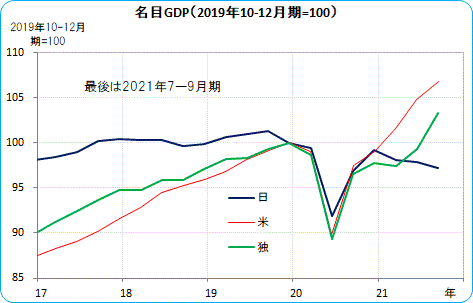
I’ll call it bad timing, but the October 2019 consumption tax hike also seems to have had an impact.
It seems unable to recover after a double blow.
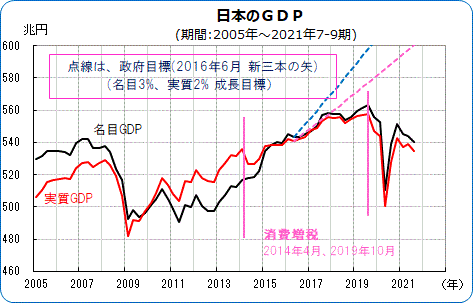
Consumption is weak anyway.
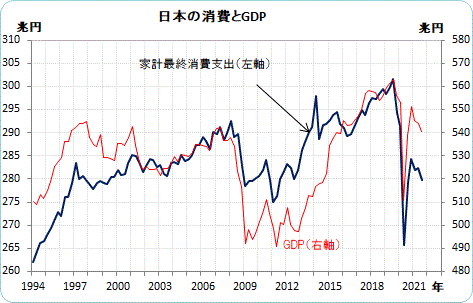
Employee compensation hasn’t fallen that much. Consumption remains depressed.
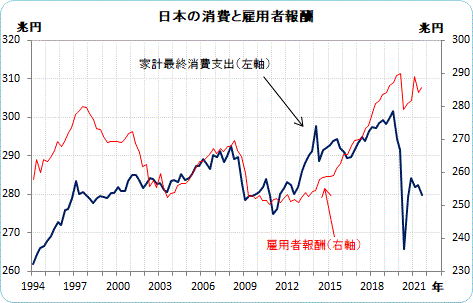
This tendency is not solely due to the spread of the novel coronavirus.
Generally speaking, consumption includes imputed rents.
Imputed rent means; for owner-occupied households, assuming the house you live in is rented, the rent you would pay.
In reality, you don’t actually pay it, so if you look at consumption excluding this, the red line in the next graph shows it.
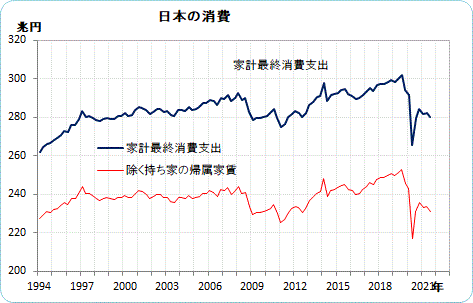
You can see how stagnant consumption is.
Now that Abenomics has failed, I believe there are only two remaining ways for the Japanese economy to break out of stagnation.
(1) Technological innovation
(2) Introduction of a basic income
That said, technological innovation is not something you can deliberately create. In the past few decades, the developments that could be called technological innovations are probably only: ① PCs (with OS), ② the Internet, ③ mobile phones.
① is the emergence of Windows. Microsoft
② Internet. Google and others
③ Apple being the greatest beneficiary
All of these are American.
Actually, Japan also had a chance. iPhone originated from iPod, but the iPod should have been developed by Sony, which had the technological capability. Why couldn’t it be done? Because President Okada at the time changed Sony’s concept. Details omitted.
Mr. Ohga was a baritone singer who graduated from an art university. He complained about the sound quality of Sony’s tape recorders, and was invited by Morita and Ibuka to join Sony. In his first year, he was appointed head of the Second Manufacturing Department. However, he had little interest in manufacturing. He focused on design and content. He also resigned as director after collapsing while conducting an orchestra in Beijing.
Sony today is a fine company, and it would not be surprising if it had become a company greater than Apple.
If that were the case, the remaining method would be the introduction of a basic income.
As for the recent provision of 100,000 yen, it makes no sense other than being a pledge of Komeito. What on earth is it for? Why is it a one-time thing?
If this benefit is continued for everyone, that would be called a basic income.
Indeed, I think the introduction of a basic income is a difficult issue. However, in Japan, I think we have finally been pushed into a situation where we have no choice but to implement it.
If a basic income is introduced, naturally, tax revenues must increase. Tax increases, taxation on financial income, and a tax system on financial assets will also be necessary.
There is no need to view tax increases negatively. Because before that, people are receiving a basic income. Those who end up with even higher taxes due to increased net income are wealthy enough to contribute more to society.
Even so, if that leads to economic expansion, those who end up paying more taxes will become even wealthier.
I’ll end here as this is getting lengthy, but I thought that the distribution-focused policy announced when Mr. Kishida announced his candidacy for party leader could lead to a basic income, but it seems Mr. Kishida did not think that far.