
Next week's 5 stocks
(4963) Starlight PMC
From the quarterly report: Industry: Chemicals.
【Features】Top class in papermaking chemicals. Production and sales in China being developed. Ink and other printing resin materials also.
【Slightly Up】Papermaking chemicals perform well for cardboard. Ink resins bottom out. Highly profitable adhesives show growth with capacity expansion. Chemical products' polymer exports exceed expectations. Higher depreciation costs push operating income up slightly. For the year ending December 2022, papermaking chemicals continued to rise, with operating income increasing.
【CAPITAL INVESTMENT】Developing bio-control agents to prevent fouling of filtration membranes for seawater desalination. To expand adhesive sales, installed additional production facilities at the Taiwan plant. Concern: Vietnam plant completion delayed due to COVID.
Announced August 10, 2021. Forecast for the year ending December 2021: operating profit up 12.6% from previous year to 2.940 billion yen, ordinary profit up 16.2% to 3.100 billion yen, with increased revenue and profit.
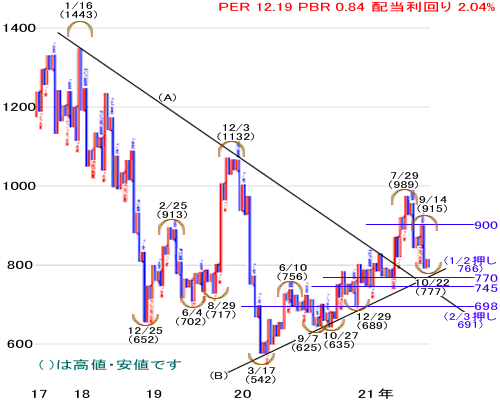
In the downtrend starting January 16, 2018 with a high of 1,443 yen, after a sharp drop to 652 yen on December 25, 2018, rebounded to 913 yen on February 25, 2019, then fell again, turning up at 702 yen on June 4 and 717 yen on August 29, rising to 1,132 yen on December 3, then being swept into the COVID market, dropping to 542 yen on the February downturn, and bottoming on March 17, 2020 at 542 yen. From here an uptrend (B) formed, rebounding to 756 yen on June 10, with a double bottom near 625 yen on September 7 and 635 yen on October 27, and reaching a year-to-date high of 989 yen on July 29, 2021, before entering a correction and dropping to 777 yen by October 22.
Points from Dezushima Shō's Shibata Kaisen
Bottoming at 542 yen on March 17, 2020, forming an uptrend (B). In this period, on July 29, 2021, it marked a year-to-date high of 989 yen. In the subsequent correction, it fell to 777 yen by October 22, a retracement to the 542 yen low on March 17. A 1/2 retracement (766 yen) from 989 yen to 542 yen is observed, with a 2/3 retracement near 691 yen would be a stop loss if closed below.
Buy points
① 770–800 yen
② 700–740 yen
Profit-taking points
① in the range of 900–950 yen
② if it drops to 850–900 yen
Stop loss
If a close below 691 yen (2/3 retracement) occurs, stop loss.
(9201) Japan Airlines
From the quarterly report: Industry: Air transportation.
【Features】Domestic and international routes both ranked second. Restructuring completed after government funding and reorganization. Parent company includes low-cost carrier “Spring and Autumn Japan.”
【Continued loss】Cargo volumes and full-capacity aircraft use drive revenue growth. Domestic routes recover mainly on Haneda flights, but international high-price demand remains weak. Despite cost-cutting efforts for personnel and aircraft-related costs, operating losses persist. LCC share losses shrink. Tax effects.
【Flagship】In FY23, to introduce the latest Airbus A350 on Europe and US routes. Trials of travel-tech venture and airline subscription. Mortgage loans to be started via an online bank account for miles members.
Announced May 7, 2021. Forecast for the year ending March 2021: operating profit decline of 553.4% to -3,904.14 billion yen, ordinary profit decline of 558.4% to -4,040.78 billion yen, a substantial decrease in revenue and profit.
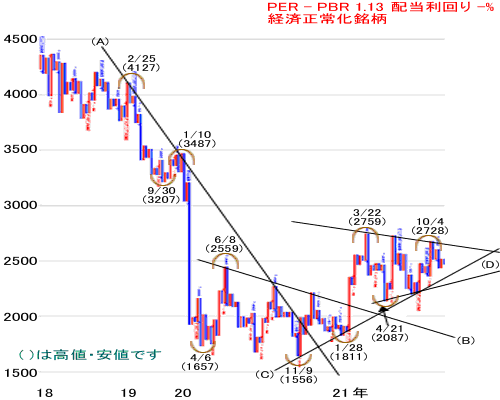
In a downtrend formed on February 25, 2019 with a high of 4,127 yen, the stock bottomed at 3,207 yen on September 30, 2019 and traded in a range, but COVID caused a sudden drop to 1,657 yen on April 6, 2020. After a rebound to 2,559 yen on June 8, it moved into a short-term downtrend (B) and then to 1,556 yen on November 9, updating the low, then turned up into an uptrend (C). In this uptrend (C), from the February 28, 2021 low of 1,811 yen to break upward through the downtrend (B) and reach a new high of 2,759 yen on March 22, followed by a decline to 2,087 yen on April 21, forming a triangle consolidation (D). Within this triangle, a pullback formed from the high of 2,728 yen on October 4.
Points from Dezushima Shō's Shibata Kaisen
In the COVID era, from the bottom of 1,657 yen on April 6, 2020, the stock rose to 2,559 yen on June 8, entered a mild downtrend (B), then in the triangle consolidation with a low of 1,556 yen on November 9, rose to 1,811 yen on January 28, 2021 and to 2,759 yen on March 22. Since then it formed a triangle and, as of September 21, credit term has passed; with normalization of the COVID economy, travel may recover and the aviation industry is expected to improve.
Buy points
① 2400–2500 yen
② 2200–2300 yen
Profit-taking points
① both 2800–3000 yen
② if it drops to 2600–2800 yen
Stop loss
There is no stop loss at present
(4392) FIG
From the quarterly report: Industry: Information & Communications.
【Features】Mobile Create, main supplier of mobile communication systems, established a holding company with subsidiary Ishii Koukou Kenkyusho.
【Recovery】Equipment business rebounds with renewed auto demand. Information and communications move toward monthly subscriptions; IP wireless steady for public sectors. In FY2022, new real estate rental business begins; demand recovery from the COVID-hit bus industry contributes to continued profit growth.
【IC transit card】In Okinawa Island, IC cards for passenger tickets can be used in taxis and shops. Joint development with Omron of a mobile robot with arms for semiconductors and medical devices.
Announced August 6, 2021. Forecast for the year ending December 2021: operating profit up 276.1% to 500 million yen, ordinary profit up 282.8% to 468 million yen, with increased revenue and profit.
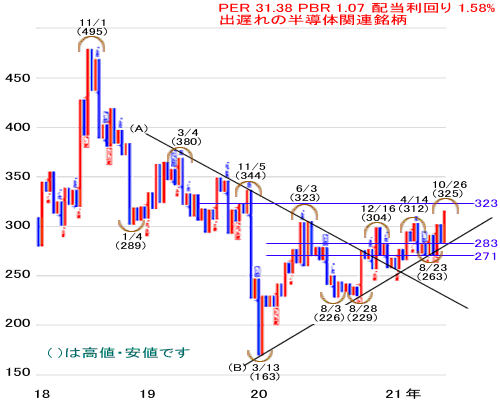
High in November 1, 2018 at 495 yen; then fell to 289 yen by January 4, 2019. Traded in a range while gradually rising, reaching a return high of 380 yen on March 4, then entering a downtrend and being swept into the COVID market, bottoming at 163 yen on March 13, 2020, and turning to an uptrend (B). By June 3 it rose to 323 yen, forming two bottoms at August 3 (226 yen) and August 28 (229 yen), turning up again; by December 16 it rose to 304 yen, then 312 yen on April 14 and 325 yen on October 26, continuing the rise.
Points from Dezushima Shō's Shibata Kaisen
From the COVID-era bottom of 163 yen on March 13, 2020, ascent to 323 yen by June 3, then two bottoms at 226 yen and 229 yen, surpassed 325 yen on October 26, reaching an all-time high for the year.
Buy points
① 290–310 yen
② 270–290 yen
Profit-taking points
① both 340–370 yen
Stop loss
As of now, there is no stop loss.
(3861) Oji Holdings
From the quarterly report: Industry: Pulp & Paper.
【Features】Founded in 1873. Japan's leading papermaker; overseas presence in Asia and South America in cardboard, pulp, and thermal paper.
【Operating income up】Rising overseas pulp market boosts earnings. Cardboard demand domestically and overseas for food, e-commerce, and industrial uses continues to grow, overcoming depreciation expenses. Increased sales of functional materials for automotive components; paper for newspapers and printing shows a partial rebound due to COVID-19; company operating income surpasses expectations.
【Capital region】Following last spring's Funabashi plant, a cardboard plant in Utsunomiya expected to operate in autumn 2022. Additional production line for film used in automotive components at the Shiga plant.
Announced August 3, 2021. Forecast for the year ending March 2022: operating profit up 41.5% to 12.00 billion yen, ordinary profit up 44.5% to 12.00 billion yen, with a return to growth for three consecutive years.
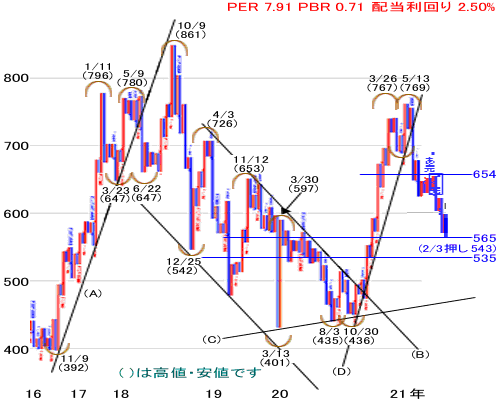
In the uptrend starting November 9, 2016 with a low of 392 yen, highs of 796 yen on January 11, 2018 and 780 yen on May 9, 2018 formed two top peaks, pushing the uptrend downward. After a dip to 647 yen on June 22, a rally to 861 yen on October 9, then a drop to 542 yen on December 25 and rebound to 726 yen on April 3, 2019. This becomes a downtrend (B). Within this downtrend, 11/12/2020 high of 653 yen; COVID market depressed to 401 yen on March 13, 2020 bottom. A gradual rise (C) ensued, with double bottoms at 435 yen on August 3 and 436 yen on October 30; turned to uptrend (D), surging to 767 yen on March 26 and 769 yen on May 13, nearly forming a double top and entering a correction. Since then, gradual decline continued, with credit date approaching on November 12, suggesting a rebound may be near.
Points from Dezushima Shō's Shibata Kaisen
This stock was recommended on September 10.
From the uptrend starting with the double bottom at 435 yen on August 3, 2020 and 436 yen on October 30, the stock formed a double top at 767 yen on March 26, 2021 and 769 yen on May 13, turning to a correction. The 2/3 retracement is near 543 yen, approaching closely; with the May 13 high of 769 yen marking a year-to-date high and 11 months until November 12 credit date, a rebound is expected. For now, there is no stop loss.
Buy points
① 540–560 yen
② 510–530 yen
Profit-taking points
① for both cases 630–660 yen
② if it drops, 580–600 yen
Stop loss
There is no stop loss at present
(6480) Nippon Tomson
From the quarterly report: Industry: Machinery.
【Features】Linear motion guide equipment for semiconductor manufacturing equipment is core. Needle bearings for two-wheeled vehicles also. Brand is 'IKO'.
【Moderate increase】First-quarter orders reached the second highest on record, especially driven by China. Strong activity in semiconductors, medical devices, and solar applications. Vietnam factory expansion now in full operation; selective orders and faster cost reductions exceed expectations. Weakened yen is a tailwind. Slight increase in operating income. Tax burden small.
【Expansion plans】Himeji plant paused in August, production centralized by transferring equipment to Gifu. Vietnam expansion under consideration. COVID response includes virtual factory tours.
Announced August 10, 2021. Forecast for the year ending March 2022: operating profit up 726.1% to 3.50 billion yen, ordinary profit up 1,544.4% to 3.70 billion yen, marking a large-scale increase in revenue and profit for the third year in a row.
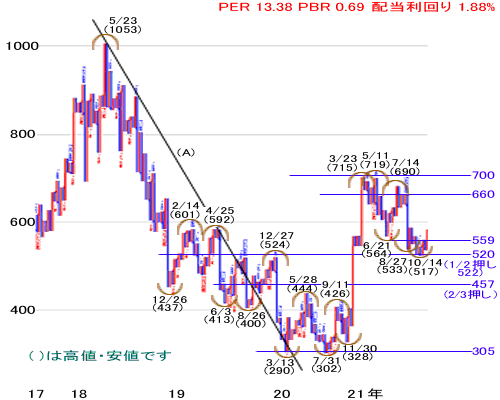
On May 23, 2018, stock peaked at 1,053 yen; formed a downtrend (A). In this period, bottomed at 437 yen on December 26, 2018, continued down to 413 yen on June 3, 2019 and 400 yen on August 26, with a three-point lower bottom before rising to 524 yen on December 27, before COVID dropped to 290 yen on March 13, 2020. Rebound to 444 yen by May 28, then to 302 yen on July 31 forming a second bottom, rose to 426 yen on September 11, then 328 yen on November 30, then surged to 715 yen on March 23, 2021 and 719 yen on May 11, reaching year-to-date highs, then corrected to 564 yen on June 21 and to 690 yen on July 14 before dropping sharply and turning down on October 14 to 517 yen.
Points from Dezushima Shō's Shibata Kaisen
From the COVID-era bottom of 328 yen on November 30, 2020, sharp rise to 715 yen on March 23, 2021 and 719 yen on May 11, two tops, then retraced to 564 yen on June 21 and to 690 yen on July 14, then declined to 517 yen on October 14, forming a rebound.
From the chart, if the close below 517 yen on October 14 occurs, stop loss.
Buy points
① 550–580 yen
② 530–550 yen
Profit-taking points
① for both cases 650–680 yen
② if it drops, 620–650 yen
Stop loss
As of now, there is no stop loss