

Future of Japanese equities seen in the U.S. interest rate gap after employment statistics
Hello, I’m the administrator Nikkei OP sales attendant.
Thank you very much for visiting this blog.
I would like to provide information that can be of help to everyone, so please support me.
Now, the theme this time isUS interest rate trends.
I think everyone is interested in the movement of the Nikkei Stock Average.
Currently, it seems that when the US dollar is strong and the yen is weak, the Nikkei average rises, and when the yen is strong and the US dollar is weak, the Nikkei average falls.
.
The yen-US dollar rate will be greatly influenced by the future trend of US interest rates.
Therefore, let’s recheck the US yield curve (the interest rate spread between the 10-year and 2-year bonds) which I have introduced several times beforehand.
Below is the 10-2 year bond yield spread (red, right axis) and the yen-US dollar rate (blue, left axis).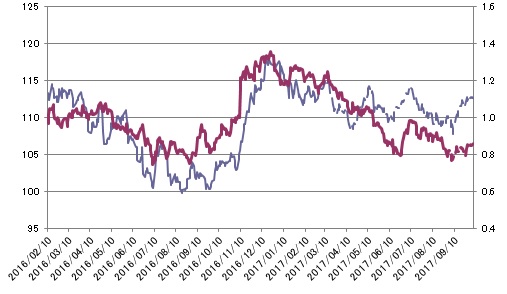
From a common perspective, when the yield spread between the 10-year and 2-year bonds widens, it indicates future interest rate hikes.
There is a fairly strong positive correlation between the yen-dollar rate and the yield spread.
Looking at the chart, around the end of 2016 the yield spread was about 1.2%.
Since then, it has recently fallen to the 0.8% range.
From this relationship, it means that the yen depreciation has progressed even more than the widening of the yield spread.
October 6th Close Low
10-year bond 2.361% 2.402%
2-year bond 1.508% 1.528%
====================================
10-2 year spread 0.853%
The level of the 2-year bond was 1.198% at the end of last year, so it has risen quite a bit to 1.508% after the October 6 employment data release.
This is thought to reflect expectations of a rate hike in December.
On the other hand, the 10-year bond yield has not yet recovered to last year's end level of 2.446%.
This reflects that the US economy is not overheating that much (or that the reasons for it are not that good), so further rate increases are not expected, or are quite gradual.
From this relationship, unless the yield spread widens further, the yen depreciation and dollar appreciation cannot be expected much.
Even with an early resolution to the North Korea issue, it seems difficult for sustained dollar strength to break 114.86 (the rate on the eve of President Trump's inauguration).
Therefore, for Japanese stocks to rise further, unless there is foreign exchange aid, it will be difficult unless the results for the July-September quarter are announced as continuing to grow.
Note) The above is my personal view, and is intended only to improve financial literacy. Therefore, it is not created for investment solicitation purposes. The final investment decisions should be made at your own risk.



<Please click to support us. Thank you. m(_ _)m>