
A timed bomb called Deutsche Bank ~ an unpredictable fuse ~ from Tetsuo Inoue's "Trends in the Market"
Mr. Tetsuo Inoue's "Trends in the Market" deeply investigates the essence of the Germany Bank problem, where a management crisis theory has suddenly risen to prominence, in the 9/30 (Fri) 08:28 issue of his newsletter.
It seems the warned situation is approaching.
A fuse with an unknown length
Reposting yesterday's "Trend" strategy.
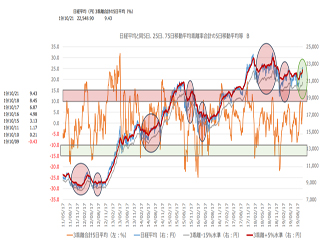
"In the Japanese market, after the 23rd, as written in 'Trends,' that RSI would bottom out around the 28th (nearby), as noted in Sign, it actually fell to 33.61% yesterday (the 25-day moving average deviation rate was -1.51%). It has not fallen to 32% yet, but if we assume the close level yesterday continues for consecutive days, yesterday will be the bottom, and it will gradually rise from here. We will continue the strategy of observing the 25-day moving average deviation rate and deciding on a qualitative put selling when the value is below 32% for 3 trading days. (However, if decisive news emerges from the Doom Bank, a time bomb/black swan, we will withdraw.)
We are entering a state where we must be strongly conscious of this last part.
Following the rise in the Japanese stock market and the yen’s decline yesterday, in the early London hours the dollar/yen rose to around the mid-101.70s, then, after hovering around the mid-101s, benefited from favorable US economic indicators and climbed to the 101.80s. In US time, the upward revision of GDP (Q2: +1.4%), and initial jobless claims (254,000: vs. 260,000 expected) were welcomed, and the dollar/yen rose to 101.84. However, this movement should be understood as not reflecting the Germany Bank issue at all.
What became new material regarding the Germany Bank issue last night is a Bloomberg report that some clients (hedge funds) migrated derivatives to other securities firms and withdrew excess collateral. Specific names mentioned include Millennium, Roc Capital, Capula, among others. As a result, while German bank shares rose for two days in European markets, US-market ADRs plummeted. Ultimately, it fell 6.7% (at one point down 7.8%).
Many may already know that German bank shares dropped sharply in the news, but what is important is that this material appeared in the latter half of the US market after European markets closed. Therefore, (as stated above) the prior currency movements are not a reference. The yen’s weakness in the Japanese market yesterday should be viewed as a one-day factor, similar to the OPEC informal meeting's production freeze. Indeed, in fact, the US market’s late session saw the dollar fall to its lowest level against the Swiss franc in a month, a move that immediately evokes yen strength.
Until now, since the newsletter began, and in TV/radio and seminars over the past year, we have warned about the "Germany Bank = Black Swan theory." However, we have recognized that this act is as dangerous as a boy crying wolf: if the market does not worry, nothing happens, but the opportunity loss from strong concern would occur. Nevertheless, I would like you to understand that in the past few weeks I have deliberately sounded this warning. This is also why we have not engaged in easy put selling in our strategies.
I believe the Germany Bank issue is a "fuse with an unknown length." Until the fire is completely extinguished, it will certainly progress. It could be a bomb kilometers ahead... or perhaps only a few centimeters ahead, which no one can know.
There are talks that it is "too big to fail." Comments like this will continue to appear. However, the essence of the problem does not lie there. The core fear, though repetitive to apologize, is "the transmission of credit concerns to other financial institutions."
Even if hedge funds withdraw funds like rats, the problem remains.
That is because the total amount of structured bonds issued by the same bank cannot be grasped.――
Please continue with Tetsuo Inoue's "Trends in the Market."