

GDP and Stock Market Capitalization: Are Japanese Stocks Overpriced? (1)
Hello, this is Nikkei OP Trader-in-Chief, the administrator.
Thank you very much for visiting this blog.
I would like to provide information that can be of help to everyone, so please support us.
Now, the theme this time isGDP and the market capitalization of stocks.
There is a relationship that Warren Buffett focuses on between GDP and the market value of the stock market.
The view is: what percentage of GDP is the market capitalization of the stock market?
The chart below shows the following numbers since 1985.
☆ Red: GDP (trillion yen, left axis)
☆ Blue: market capitalization (trillion yen, left axis)
☆ Green: market capitalization ÷ GDP (%, right axis)
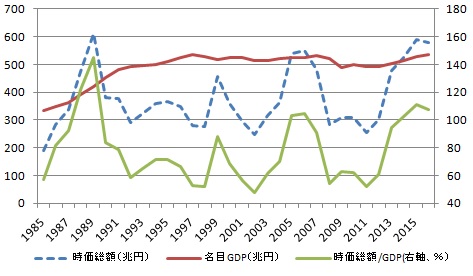
Source) Tokyo Stock Exchange, IMF
Please look at the latter part of the 1980s.
In 1989, when the Nikkei average was about to break through 40,000, the market capitalization of the stock market was 145% of nominal GDP. Therefore it was extremely overvalued.
Overvalued, indeed.。
At the end of 2016 as well, it was 107%, so it has entered the overvaluation range.
Given that the market can have momentum, it can become even more overvalued and form a bubble, so it is necessary to keep a careful eye on the current situation.
By the way, IMF's forecast as of April is that Japan's nominal GDP at the end of 2017 will be 546 trillion yen.
On the other hand, as of the end of August 2017, including emerging markets, Japan's stock market capitalization was 620 trillion yen.
This means the GDP ratio is 113.7%.
In a country like Japan where GDP does not grow much, this can be considered quite overvalued. Relying solely on PER to judge overvalued or undervalued might be risky.
Note) The above is my personal view, and it is intended only to improve financial literacy. Therefore, it was not created for investment solicitation. Please make final investment decisions at your own responsibility.



<Please click to show your support. Thank you very much. m(_ _)m>